An open letter to Iggy Pop
Oh, Iggy! An insurance commercial? Really?
It was one thing when you let them use "Lust for Life" in a cruise ship ad. That was funny. But look, I'm the adman and you're the Godfather of Punk. I'm the one whose creativity and principles are for sale, not you. You're a streetfighting cheetah with a heart full of napalm. I'm a cynical Creative Director with a belly full of poutine. You should stay away from my world. People will make fun of you. (Naughty language)
Even worse, you plugged an insurance product for a company that wouldn't even cover musicians.
Ig... Or "James", if I may call you that. You've even been accused of false advertising, something I have never knowingly done.
Look, I love you, man. You have always given me vicarious output for my independent impulses as you did whatever the hell you wanted to, even though it meant getting booted off every record major record label in existence. Even though it involved live recordings that sounded like they were recorded in a machine metal shop next door to the concert hall. Even if it meant working with Rick Astley's drum machine.
I'll get over this, I'm sure. Because no matter how bad things get, or what you feel you have to compromise to secure your retirement savings, we'll always have the way you were.
Take care of your legacy, Iggy. It means a lot to those of us who sold out before we even got there.

An industry look at social issues in advertising and media
Thursday, April 30, 2009


Wednesday, April 29, 2009
Survival of the hippest
I don't want to sound like I'm bashing anyone's faith, but I really feel bad for people who won't accept the theory of evolution. Not only is it the best tool we have for understanding human nature; you can also apply Darwin, Wallace & Co.'s thinking to almost any human endeavour.
My four-year-old son already understands the basic idea of evolving. That's because we're both huge fans of BBC's "Walking with..." series of shows on prehistoric life: Walking With Dinosaurs, Walking With Prehistoric Beasts, Walking With Monsters, and Walking With Cavemen. Cool shows, and even the 10-year-old CG animation holds up pretty well on high def TVs.
My son's love of these shows is part of his love affair with all things natural. But I'm also happy about what it's instilling in him for his adult life in any kind of business venture. It is helping him understand what "survival of the fittest" really means.
To many people, "the fittest" conjures up visions of the schoolyard bully, an unthinking brute who pushes aside all the girly men to impress the female folk. But that's not what it means at all. Evolution is all about flexibility, adaptation, and exploiting the opportunities of chance disaster.
There are two examples from the BBC series that give a more accurate object lesson in dealing with change:
Rise of the Mammals — Mammals have been dominating the world for more than 50,000,000 years, but it has not always been so. Prior to the great extinction event of 65,000,000 years ago, they were tiny creatures living at the fringes of the dinosaurs' world. The dinos in general were bigger, meaner, and way more successful at exploiting the relatively stable climates of the Jurassic and Cretaceous periods. But when the world was hurled into a nuclear winter by a cosmic collision, they didn't survive. Nothing big did. Only the smallest, most adaptable species survived. Among them were our furry ancestors, opportunistic living fossils like crocodiles, and the tiny, warm-blooded, feathered dinosaurs we now call birds.
Might did not make right, and the mammals outpaced even the remaining dinosaurs by adapting to, and dominating, almost every ecosystem in the planet. The mammals' penchant for adapting to change in novel ways is what lead to us. But there's another stop along the way.
Hominidmania — Over two million years ago, our ancestors were not the only hominids (humanoid apes) on the planet. Several different species rose and fell as the climate continued to change. Among them was Australopithecus boisei, a gorillalike brute that ate roots and lived in harems. They had a pretty easy life, browsing the available vegetation, but they were overspecialized. When the vegetation changed, they were outcompeted by other apemen with more curious natures and omnivorous appetites, such as our forebears.
In the current economy, large and traditional businesses can seem like dinosaurs, while the agile upstarts and shrewd early adopters may yet get through the fallout to grow into a new generation of leaders. Overspecialized and inflexible companies may find their food source dries up, while those with imagination and courage might just find new ways to survive.
The "fittest" are those most suited to adapt through, and take advantage of, change. Evolution may happen through random chance, but "intelligently designed" organizations can still learn from nature's lessons in hindsight.
My advice of the day? Executives should spend more time watching dinosaur movies.
My four-year-old son already understands the basic idea of evolving. That's because we're both huge fans of BBC's "Walking with..." series of shows on prehistoric life: Walking With Dinosaurs, Walking With Prehistoric Beasts, Walking With Monsters, and Walking With Cavemen. Cool shows, and even the 10-year-old CG animation holds up pretty well on high def TVs.
My son's love of these shows is part of his love affair with all things natural. But I'm also happy about what it's instilling in him for his adult life in any kind of business venture. It is helping him understand what "survival of the fittest" really means.
To many people, "the fittest" conjures up visions of the schoolyard bully, an unthinking brute who pushes aside all the girly men to impress the female folk. But that's not what it means at all. Evolution is all about flexibility, adaptation, and exploiting the opportunities of chance disaster.

There are two examples from the BBC series that give a more accurate object lesson in dealing with change:
Rise of the Mammals — Mammals have been dominating the world for more than 50,000,000 years, but it has not always been so. Prior to the great extinction event of 65,000,000 years ago, they were tiny creatures living at the fringes of the dinosaurs' world. The dinos in general were bigger, meaner, and way more successful at exploiting the relatively stable climates of the Jurassic and Cretaceous periods. But when the world was hurled into a nuclear winter by a cosmic collision, they didn't survive. Nothing big did. Only the smallest, most adaptable species survived. Among them were our furry ancestors, opportunistic living fossils like crocodiles, and the tiny, warm-blooded, feathered dinosaurs we now call birds.
Might did not make right, and the mammals outpaced even the remaining dinosaurs by adapting to, and dominating, almost every ecosystem in the planet. The mammals' penchant for adapting to change in novel ways is what lead to us. But there's another stop along the way.
Hominidmania — Over two million years ago, our ancestors were not the only hominids (humanoid apes) on the planet. Several different species rose and fell as the climate continued to change. Among them was Australopithecus boisei, a gorillalike brute that ate roots and lived in harems. They had a pretty easy life, browsing the available vegetation, but they were overspecialized. When the vegetation changed, they were outcompeted by other apemen with more curious natures and omnivorous appetites, such as our forebears.
In the current economy, large and traditional businesses can seem like dinosaurs, while the agile upstarts and shrewd early adopters may yet get through the fallout to grow into a new generation of leaders. Overspecialized and inflexible companies may find their food source dries up, while those with imagination and courage might just find new ways to survive.
The "fittest" are those most suited to adapt through, and take advantage of, change. Evolution may happen through random chance, but "intelligently designed" organizations can still learn from nature's lessons in hindsight.
My advice of the day? Executives should spend more time watching dinosaur movies.
Tuesday, April 28, 2009
Won't sum1 plz tnk of d kids?
Caught an interesting PSA by the Ad Council the other day. The topic? Teenage "textual harassment". Check it out:
Instant communication and teenage angst are a bad combination. I can recall being infatuated with a girl in high school, leaving love notes in her locker, and calling her every night for a spell. In retrospect, that seems pretty lame. I'm just glad I didn't have the ability to access her anytime, anywhere. She would've dumped me way sooner.
And yet now, I see adults creeping each other of Facebook, sending unwanted texts., and generally acting like Stalky McStalkersons. If these tools are abused by supposedly mature members of society, I can only imagine what it's like in the hands of a pimply 15-year-old.
And then there are photos. "Sexting" is the latest media panic regarding the degraded moral state of our children. You give two crazy, sexually experimental kids high-tech phones with digital cameras, and the next thing you know they're sending each other dirty pics. Hell, if Vanessa Hudgens can get naked for the world, why can't I? (The link is safe.)
Of course, beyond the permanent loss of privacy that committing your junk to digital can bring, there are also major legal ramifications. Kids are actually being charged with making and transmitting child pornography. Not just victims, but also self-portraitists. And it has opened up a huge public debate.
But sexting is only part of the issue. For teens, it must be confusing to know the boundaries of what's normal modern technological discourse, and what is harassment. We never handed them a rulebook with their iPhone. The problem is that these communication media are evolving so fast, we parents don't even know the rules ourselves. (How many of us still make gaffs on work e-mail, or post regretful comments on Facebook?)
The Ad Council, at least, is trying to give kids tools they can use at thatsnotcool.com. The site makes a good attempt at relevancy by taking a user-generated, community approach, rather than telling them what to think.
I'm a dad, but hopefully I have eight or nine years to go before I have to deal with pubescent shenanigans. And God knows what technology my son will abuse. But at least people are starting to have a conversation about these issues with kids, and encouraging them to talk amongst themselves. They'll be okay.
Instant communication and teenage angst are a bad combination. I can recall being infatuated with a girl in high school, leaving love notes in her locker, and calling her every night for a spell. In retrospect, that seems pretty lame. I'm just glad I didn't have the ability to access her anytime, anywhere. She would've dumped me way sooner.
And yet now, I see adults creeping each other of Facebook, sending unwanted texts., and generally acting like Stalky McStalkersons. If these tools are abused by supposedly mature members of society, I can only imagine what it's like in the hands of a pimply 15-year-old.
And then there are photos. "Sexting" is the latest media panic regarding the degraded moral state of our children. You give two crazy, sexually experimental kids high-tech phones with digital cameras, and the next thing you know they're sending each other dirty pics. Hell, if Vanessa Hudgens can get naked for the world, why can't I? (The link is safe.)
Of course, beyond the permanent loss of privacy that committing your junk to digital can bring, there are also major legal ramifications. Kids are actually being charged with making and transmitting child pornography. Not just victims, but also self-portraitists. And it has opened up a huge public debate.
But sexting is only part of the issue. For teens, it must be confusing to know the boundaries of what's normal modern technological discourse, and what is harassment. We never handed them a rulebook with their iPhone. The problem is that these communication media are evolving so fast, we parents don't even know the rules ourselves. (How many of us still make gaffs on work e-mail, or post regretful comments on Facebook?)
The Ad Council, at least, is trying to give kids tools they can use at thatsnotcool.com. The site makes a good attempt at relevancy by taking a user-generated, community approach, rather than telling them what to think.
I'm a dad, but hopefully I have eight or nine years to go before I have to deal with pubescent shenanigans. And God knows what technology my son will abuse. But at least people are starting to have a conversation about these issues with kids, and encouraging them to talk amongst themselves. They'll be okay.
Monday, April 27, 2009
Anti-violence ad banned for being too effective
Yeah, that's right. The shocking and powerful British cinema ad for Women's Aid, starring Keira Knightley, is apparently inappropriate for UK TV audiences.
Oh, you haven't seen it yet? Then watch before reading on:
This is social marketing at its best: surprising, gripping, and memorable. And stomach-churning. Just like the issue it portrays. But censors want to cut out the violence.
The ad was directed by Atonement's Joe Wright for Grey London. It quickly made the viral rounds via YouTube and has gained notice in advertising and entertainment blogs.
The censors in question are from Clearcast, the non-governmental organization that has to pre-approve all TV commercial scripts prior to broadcast. Here's their policy on violence:
The boldface is mine. How is this not justified as a public service message? Women's Aid says that:
This decision by Clearcast, an agency that's just over a year old, is obviously a bad one. But at least the commercial is "out there", having reached over a million viewers worldwide so far. And the additional publicity that this mistake will generate can only increase that reach.
One of my causes wasn't so lucky, a few years back, when a client panicked and killed an ad we created to tell people to obey speed limits in residential areas, showing a child's funeral. We can only hope that there is enough show of support for brutal honesty in social marketing, in cases like the Women's Aid ad, that clients and regulators decide that "bold gets told"...
Oh, you haven't seen it yet? Then watch before reading on:
This is social marketing at its best: surprising, gripping, and memorable. And stomach-churning. Just like the issue it portrays. But censors want to cut out the violence.
The ad was directed by Atonement's Joe Wright for Grey London. It quickly made the viral rounds via YouTube and has gained notice in advertising and entertainment blogs.
The censors in question are from Clearcast, the non-governmental organization that has to pre-approve all TV commercial scripts prior to broadcast. Here's their policy on violence:
6.2.2 Violence
Violence, cruelty and injury are themes which must be handled with great care and only in cases where they can be justified are they likely to be acceptable. These cases are likely to arise in public service messages, newsreel footage, film trailers and some charity advertising. Cartoon, theatrical and slapstick treatments may also be acceptable if they are clearly divorced from reality. However care must be taken not to give young viewers the impression that copying such violence would be safe or harmless fun.
The boldface is mine. How is this not justified as a public service message? Women's Aid says that:
1 in 4 women will be a victim of domestic violence in their lifetime – many of these on a number of occasions.
One incident of domestic violence is reported to the police every minute.
On average, 2 women a week are killed by a current or former male partner.
This decision by Clearcast, an agency that's just over a year old, is obviously a bad one. But at least the commercial is "out there", having reached over a million viewers worldwide so far. And the additional publicity that this mistake will generate can only increase that reach.
One of my causes wasn't so lucky, a few years back, when a client panicked and killed an ad we created to tell people to obey speed limits in residential areas, showing a child's funeral. We can only hope that there is enough show of support for brutal honesty in social marketing, in cases like the Women's Aid ad, that clients and regulators decide that "bold gets told"...
Friday, April 24, 2009
A portrait of the blogger as a young man
What prepared you for Web 2.0? I just took up this blog recently, but I've actually been preparing for it my whole life.
One of the biggest problems we face trying to get clients into social media is getting them to create their own content. "I know I should have a blog, but what would I write? How often would I have to do it? I don't have time!"
Most people are afraid of the blank page. Writers embrace it. We're the kind of people who never shut up about the latest insight or anecdote we've added to our magpie nest of a brain. Writing it down is just one more way to let it out. So here goes:
How do you become a natural writer? For me, it was good old pen-and-ink letters in high school. Nobody does it anymore, but regular correspondence is one of the best ways to get in the habit of writing even when you're not naturally inspired. I had one regular person who I wrote to, and who wrote back, weekly for years. It really got me in the rhythm even if it didn't improve my crabby handwriting.
In university, it wasn't the essays that refined my skills, it was the school paper. For about three years, I wrote concert and record reviews for the Queen's Journal. They were your typical sloppy, self-indulgent student journalism, but what could be more blog-like? Plus, concert passes gave me great cache to get dates and provided me with impressive stories to tell. The work also gave me a portfolio, which would serve as my pass into the working world after I dropped out.
In my early 20s, I eked out a living as a freelance Copywriter, paid by the column inch for advertorial to fill space between ads of "special features" for the Kingston Whig-Standard. Not exactly world-changing stuff, but I got to interview people from all walks of life, and tell their stories. Puff pieces. But it taught me insight.
At 25, I got my first agency Copywriting job. As a junior, I was tasked with lots of newsletters and brochures, as well as this new thing called a Web site. Even as I quickly progressed to "real" ad writing, as an Ottawa agency guy I was never able to leave long copy assignments behind.
So that's the professional writing story. What about social media? In 2001, at an agency that was on its was to imploding after the high tech bubble popped, I happened upon two web communities: Fark.com and Plastic.com. Both seemed like good sources of weird news and insights, so I started to lurk on them.
Fark.com is a news aggregator, but is better known for its comments sections. These are hardly learned discourses on the news of the day, but rather sophomoric collections of trolling, in-jokes, and abuse. At the same time, they formed a sense of community like the regulars at a bar. I went there to joke around, let off steam, and occasionally make a point. (I'm actually quoted twice in the Fark book.) Eventually, as the community grew, Fark's originator Drew Curtis started TotalFark.com, a subscription site-within-a-site. For five bucks a month, you can see all the links submitted (hundreds a day) and comment on the published ones before they become publicly available. But the real attraction there is TotalFark discussion, or "TFD", which is a pretty random discussion board where the smaller numbers have regained the sense of community that Fark had in its earlier days.
Fark is one of those sites that can be considered a real time-waster, but for me it has been great training. To keep up in an active thread, you have to think fast. If you get arrogant of short-sighted, people call you on it. And if you pay enough attention, it keeps you updated on all the geeky online trash talk and trends.
Plastic.com is another story. There, users submit positions on trending topics in mini-blog form, complete with primary and background links embedded. Then elite users vote the best submissions to the page. That was real blog training, with immediate rejection for poor or lazy submissions, and praise for good ones. I was able to make enough strong submissions and comments to gain the amount of "karma" points from other users that would let me be elite too.
Plastic went "out" for a period a few years ago, when founder Carl Steadman walked away from it suddenly, and even though it came back, I never really got back on it. I guess I just moved on. But it's still there, with the same logo, icons and arguments as ever.
And now I'm here. And on Twitter. And Facebook. My long journey has taught me to be quick, be relevant, and (sometimes) be funny, but most of all it's taught me to BE THERE.
If you're wondering how to get going in social media, my advice is simple: Start writing, and see what people think. There's even a convenient comment box below.
One of the biggest problems we face trying to get clients into social media is getting them to create their own content. "I know I should have a blog, but what would I write? How often would I have to do it? I don't have time!"
Most people are afraid of the blank page. Writers embrace it. We're the kind of people who never shut up about the latest insight or anecdote we've added to our magpie nest of a brain. Writing it down is just one more way to let it out. So here goes:
How do you become a natural writer? For me, it was good old pen-and-ink letters in high school. Nobody does it anymore, but regular correspondence is one of the best ways to get in the habit of writing even when you're not naturally inspired. I had one regular person who I wrote to, and who wrote back, weekly for years. It really got me in the rhythm even if it didn't improve my crabby handwriting.
In university, it wasn't the essays that refined my skills, it was the school paper. For about three years, I wrote concert and record reviews for the Queen's Journal. They were your typical sloppy, self-indulgent student journalism, but what could be more blog-like? Plus, concert passes gave me great cache to get dates and provided me with impressive stories to tell. The work also gave me a portfolio, which would serve as my pass into the working world after I dropped out.
In my early 20s, I eked out a living as a freelance Copywriter, paid by the column inch for advertorial to fill space between ads of "special features" for the Kingston Whig-Standard. Not exactly world-changing stuff, but I got to interview people from all walks of life, and tell their stories. Puff pieces. But it taught me insight.
At 25, I got my first agency Copywriting job. As a junior, I was tasked with lots of newsletters and brochures, as well as this new thing called a Web site. Even as I quickly progressed to "real" ad writing, as an Ottawa agency guy I was never able to leave long copy assignments behind.
So that's the professional writing story. What about social media? In 2001, at an agency that was on its was to imploding after the high tech bubble popped, I happened upon two web communities: Fark.com and Plastic.com. Both seemed like good sources of weird news and insights, so I started to lurk on them.
Fark.com is a news aggregator, but is better known for its comments sections. These are hardly learned discourses on the news of the day, but rather sophomoric collections of trolling, in-jokes, and abuse. At the same time, they formed a sense of community like the regulars at a bar. I went there to joke around, let off steam, and occasionally make a point. (I'm actually quoted twice in the Fark book.) Eventually, as the community grew, Fark's originator Drew Curtis started TotalFark.com, a subscription site-within-a-site. For five bucks a month, you can see all the links submitted (hundreds a day) and comment on the published ones before they become publicly available. But the real attraction there is TotalFark discussion, or "TFD", which is a pretty random discussion board where the smaller numbers have regained the sense of community that Fark had in its earlier days.
Fark is one of those sites that can be considered a real time-waster, but for me it has been great training. To keep up in an active thread, you have to think fast. If you get arrogant of short-sighted, people call you on it. And if you pay enough attention, it keeps you updated on all the geeky online trash talk and trends.
Plastic.com is another story. There, users submit positions on trending topics in mini-blog form, complete with primary and background links embedded. Then elite users vote the best submissions to the page. That was real blog training, with immediate rejection for poor or lazy submissions, and praise for good ones. I was able to make enough strong submissions and comments to gain the amount of "karma" points from other users that would let me be elite too.
Plastic went "out" for a period a few years ago, when founder Carl Steadman walked away from it suddenly, and even though it came back, I never really got back on it. I guess I just moved on. But it's still there, with the same logo, icons and arguments as ever.
And now I'm here. And on Twitter. And Facebook. My long journey has taught me to be quick, be relevant, and (sometimes) be funny, but most of all it's taught me to BE THERE.
If you're wondering how to get going in social media, my advice is simple: Start writing, and see what people think. There's even a convenient comment box below.
Thursday, April 23, 2009
Showing off your organs on the Internet
Our Agency bean counter suggested I check out a new campaign for organ and tissue donation at recycleme.org. 'Awesome cause', I thought. But I wasn't quite prepared for what I saw.
After a long load that showed various organ facts, a smiling, shirtless young man appears with a dotted line down his sternum. He smiles, blinks, and tells you to click on his "cool tattoo". Of course, once you do that his chest peels open to reveal his functioning internal organs with recycling symbols on them. If you haven't clicked away screaming in terror by this point, he proceeds to give you a guided tour of his upper body anatomy and explains how each part can help people after you die.
Creepy site, but an attention-getter to be sure. And it's aimed at young Canadians, who have grown up on grossout humour in advertising and cartoons, so it can't be all that freaky to its targets.
As an older guy (well out of the target demographic) it reminded me of the "Visible Man" and "Visible Woman" dolls of the late '70s, that you assembled and had transparent chests so you could see all the detailed organs within. But at least those dman things didn't talk back to me!
So who did it? According to Marketing, Trillium, Ontario’s governmental agency overseeing organ and tissue donation, developed the Recycle Me campaign over the last year with Narrative Advocacy Media, a division of Toronto creative agency Bensimon Byrne. (The site was developed by Mighty Digital, Bensimon Byrne’s digital and design team.)
Organ and tissue donation is a serious issue. According to CTV's coverage of the campaign:
I haven't been able to find official links to any of the drive-to-web campaign creative for this site, not even on BB's own online portfolio, so I'll have to quote Marketing again for a description:
I can't even locate them on Twitter. (No "recycleme", and too many people named Lung.) :(
So, will it work? As of this writing, the site has 580 new members. These aren't legal donation signatories, by the way, but simply "pledges" who are honour bound to do the requisite paperwork. As for myself, what I find most unsettling is that the hog of a site slows down the performance of this hand-me-down production Mac I use at work. I actually had to leave the site just to write this blog.
I sincerely hope that this social marketing campaign achieves its objective of making young people more aware and active in organ donation. They're certainly a well-meaning bunch. But will their famous feelings of immortality prevent them from planning for their own deaths, even if it will save a life? I'm not sure. But at least they'll get to see their parents grossed out by advertising that (if the research was done right) only they "get", and that will get them talking. It's a start.
After a long load that showed various organ facts, a smiling, shirtless young man appears with a dotted line down his sternum. He smiles, blinks, and tells you to click on his "cool tattoo". Of course, once you do that his chest peels open to reveal his functioning internal organs with recycling symbols on them. If you haven't clicked away screaming in terror by this point, he proceeds to give you a guided tour of his upper body anatomy and explains how each part can help people after you die.
Creepy site, but an attention-getter to be sure. And it's aimed at young Canadians, who have grown up on grossout humour in advertising and cartoons, so it can't be all that freaky to its targets.
As an older guy (well out of the target demographic) it reminded me of the "Visible Man" and "Visible Woman" dolls of the late '70s, that you assembled and had transparent chests so you could see all the detailed organs within. But at least those dman things didn't talk back to me!
So who did it? According to Marketing, Trillium, Ontario’s governmental agency overseeing organ and tissue donation, developed the Recycle Me campaign over the last year with Narrative Advocacy Media, a division of Toronto creative agency Bensimon Byrne. (The site was developed by Mighty Digital, Bensimon Byrne’s digital and design team.)
Organ and tissue donation is a serious issue. According to CTV's coverage of the campaign:
Every three days, someone dies waiting for an organ transplant and nearly 1,700 patients in Ontario are on a transplant waiting list. One organ donor can save up to eight lives and enhance the lives of up to 75 others through tissue donation.
I haven't been able to find official links to any of the drive-to-web campaign creative for this site, not even on BB's own online portfolio, so I'll have to quote Marketing again for a description:
Traffic is driven to the site by an online, out-of-home and transit campaign.
One transit execution advertises the fictitious Kidney Depot, a “one-stop renal shop” that offers free installation. Copy at the bottom of the ad says “If organs and tissue were this easy to find, we wouldn’t need donors.”
“Coming soon” construction site wraps for the fake organ store are also going up in cities across the province, including Toronto, Hamilton and Thunder Bay.
Trillium has also started a Twitter feed authored by a lung to drive social media users to the site.
I can't even locate them on Twitter. (No "recycleme", and too many people named Lung.) :(
So, will it work? As of this writing, the site has 580 new members. These aren't legal donation signatories, by the way, but simply "pledges" who are honour bound to do the requisite paperwork. As for myself, what I find most unsettling is that the hog of a site slows down the performance of this hand-me-down production Mac I use at work. I actually had to leave the site just to write this blog.
I sincerely hope that this social marketing campaign achieves its objective of making young people more aware and active in organ donation. They're certainly a well-meaning bunch. But will their famous feelings of immortality prevent them from planning for their own deaths, even if it will save a life? I'm not sure. But at least they'll get to see their parents grossed out by advertising that (if the research was done right) only they "get", and that will get them talking. It's a start.
Wednesday, April 22, 2009
How I learned to stop worrying and love my generation.
Hate me. Do it and do it again - Nirvana
Times are gone for honest men, and sometimes far too long for snakes. - Soundgarden
I hate my generation. - Sloan
What the hell was wrong with us? Beaten down, cynical, angry young brats is what we were. Slackers. Proof that the world was truly going to hell. Generation X.
According to famed demographers Strauss and Howe:
Whaa, whaa, whaa. Or in the parlance of our times: "Whatever..."
There was actually a lot of truth to Gen-X stereotypes in my life in the early '90s. I dropped out of university (slacker move), became a freelance writer (slacker career), and was constantly just planning my next trip to Europe (slacker ambition). Today, dealing with people 14-15 years younger than me at work, I can't believe how organized and driven many of them are just out of school. If you had predicted my future from age 24, you probably would've assumed I'd end up now as a used bookstore manager who kept waiting for his 'zine to take off. But it didn't happen.
I wasn't the only late bloomer. Many of my high school friends struggled to find their direction in university. Some dropped out, and followed alternative career paths. Others stayed in, taking degree after degree until they got it right. When we started grade 9 in 1984, we were told that we had to think about our careers from day one, learn computers (BASIC, actually), and get high marks so we could get into the best programmes, at the best schools, for the highest starting salary.
As far as I know this message continues to be hurled at unwitting teens, but it our case something weird happened around graduation. The stock market crashed, recession hit, good entry-level jobs became scarce, and we just lost steam.
As Lloyd Dobler said:
Ouch. And yet I didn't do much more than that until my first agency job at age 25. But then something happened. I went from Junior Copywriter to Creative Director in five years, and basically "got a life" (marriage, house, kid) in four more. How did we end up turning out okay?
This kind of thought is what makes me take stock of my cohort. Older or younger, I'd like to give you five good reasons why we are now rocking business, the family, culture, science and sports.
1) Business — our world is flat. Sure, the boomers lost the ties and burned the bras, but we were the ones who really made the workplace casual and equitable. We started out a little timid, but once we got into positions of power, we started demanding more work-life balance (especially maternity rights), better access to upper management, and made our bosses cringe with our serial career attitude. We distrust formality, like innovation, and value coworkers more on what they do than how hard they appear to work. We hate sycophants. If anything, our biggest challenge as managers is to remember that we're the boss. Because telling people what to do "just because I said so" just doesn't feel cool.
2) Family — We're really involved. I realize that X parents drive non-parents nuts. We bring babies to pubs and nice restaurants, we demand flexibility and support to be hands-on two-income families, and we treat our kids like superstars. But the upside is, we want to have relationships with our kids from Day 1. We have pushed for changes that bring the family back into everyday life, rather than just keeping kids "out of the way". Isn't that what "family values" really are?
3) Culture — recycling ideas. Yeah, that's right: we're creative environmentalists. This actually sounds kind of lame, but it's not. Everyone knows that there is rarely true innovation in human ideas, but rather building on the trials and successes of others. We accept that. Our best bands, like The White Stripes, Radiohead, The Beastie Boys or Wilco, just shamelessly recombine sounds from rock's 50+ year history in clever new ways. Directors like Paul Thomas Anderson and Quentin Tarantino talk openly about their influences in every scene. It may not be new under the sun, but it sure is honest.
4) Science – A more balanced approach. I'm reading the book "Supersense" by Bruce M. Hood right now. Like other Gen X social scientists I've read, he seems to take a much more balanced approach to human nature than angry single-minded Pre-Boomers like Richard Dawkins. In fact, he takes a few good jabs at the inflexible extremism of the old atheist evangelist. Very Gen X of him!
5) Sports. Okay, we're getting a little old for professional athletics, but let's just end this with our finest representative in the field (or, rather, "course"): Tiger Woods. Rising above old ideas about ethnicity, adding charisma to a stuffy old game, and carefully managing his persona as a brand.
Maybe another Gen-X band, Smashing Pumpkins, were right on the button with their sneering faux-optimism:
Oh, and "happy Earth Day". Or whatever...
Times are gone for honest men, and sometimes far too long for snakes. - Soundgarden
I hate my generation. - Sloan
What the hell was wrong with us? Beaten down, cynical, angry young brats is what we were. Slackers. Proof that the world was truly going to hell. Generation X.
According to famed demographers Strauss and Howe:
The 13th Generation (Nomad, born 1961–1981) survived a “hurried” childhood of divorce, latchkeys, open classrooms, devil-child movies, and a shift from G to R ratings. They came of age curtailing the earlier rise in youth crime and fall in test scores — yet heard themselves denounced as so wild and stupid as to put The Nation At Risk. As young adults, maneuvering through a sexual battlescape of AIDS and blighted courtship rituals—they date and marry cautiously. In jobs, they embrace risk and prefer free agency over loyal corporatism. From grunge to hip-hop, their splintery culture reveals a hardened edge. Politically, they lean toward pragmatism and nonaffiliation, and would rather volunteer than vote. Widely criticized as “Xers” or “slackers,” they inhabit a Reality Bites economy of declining young-adult living standards. (AMERICAN: Tom Cruise, Jodie Foster, Michael Dell, Deion Sanders, Winona Ryder, Quentin Tarantino; FOREIGN: Princess Di, Alanis Morissette)
Whaa, whaa, whaa. Or in the parlance of our times: "Whatever..."
There was actually a lot of truth to Gen-X stereotypes in my life in the early '90s. I dropped out of university (slacker move), became a freelance writer (slacker career), and was constantly just planning my next trip to Europe (slacker ambition). Today, dealing with people 14-15 years younger than me at work, I can't believe how organized and driven many of them are just out of school. If you had predicted my future from age 24, you probably would've assumed I'd end up now as a used bookstore manager who kept waiting for his 'zine to take off. But it didn't happen.
I wasn't the only late bloomer. Many of my high school friends struggled to find their direction in university. Some dropped out, and followed alternative career paths. Others stayed in, taking degree after degree until they got it right. When we started grade 9 in 1984, we were told that we had to think about our careers from day one, learn computers (BASIC, actually), and get high marks so we could get into the best programmes, at the best schools, for the highest starting salary.
As far as I know this message continues to be hurled at unwitting teens, but it our case something weird happened around graduation. The stock market crashed, recession hit, good entry-level jobs became scarce, and we just lost steam.
As Lloyd Dobler said:
You mean like career? Uh, I don't know. I've, I've thought about this quite a bit sir, and I'd have to say considering what's waiting out there for me, I don't want to sell anything, buy anything or process anything as a career. I don't want to sell anything bought or processed, or buy anything sold or processed, or... process anything sold, bought or processed, or repair anything sold, bought or processed, you know, as a career I don't want to do that. So, uh, my father's in the army, he wants me to join, but I can't work for that corporation, so what I've been doing lately is kickboxing, which is really a, uh, new sport, but I think it's got a good future. As far as career longevity goes, I don't really know, because, you know, you can't really tell. Your training sticks as a fighter, you know, but it's no good, you know, you have to be great, but I can't really tell if I'm great until I've had a couple of pro fights. But I haven't been knocked out yet. I don't know, I can't figure it all out tonight sir, I'm going to hang with your daughter.
Ouch. And yet I didn't do much more than that until my first agency job at age 25. But then something happened. I went from Junior Copywriter to Creative Director in five years, and basically "got a life" (marriage, house, kid) in four more. How did we end up turning out okay?
This kind of thought is what makes me take stock of my cohort. Older or younger, I'd like to give you five good reasons why we are now rocking business, the family, culture, science and sports.
1) Business — our world is flat. Sure, the boomers lost the ties and burned the bras, but we were the ones who really made the workplace casual and equitable. We started out a little timid, but once we got into positions of power, we started demanding more work-life balance (especially maternity rights), better access to upper management, and made our bosses cringe with our serial career attitude. We distrust formality, like innovation, and value coworkers more on what they do than how hard they appear to work. We hate sycophants. If anything, our biggest challenge as managers is to remember that we're the boss. Because telling people what to do "just because I said so" just doesn't feel cool.
2) Family — We're really involved. I realize that X parents drive non-parents nuts. We bring babies to pubs and nice restaurants, we demand flexibility and support to be hands-on two-income families, and we treat our kids like superstars. But the upside is, we want to have relationships with our kids from Day 1. We have pushed for changes that bring the family back into everyday life, rather than just keeping kids "out of the way". Isn't that what "family values" really are?
3) Culture — recycling ideas. Yeah, that's right: we're creative environmentalists. This actually sounds kind of lame, but it's not. Everyone knows that there is rarely true innovation in human ideas, but rather building on the trials and successes of others. We accept that. Our best bands, like The White Stripes, Radiohead, The Beastie Boys or Wilco, just shamelessly recombine sounds from rock's 50+ year history in clever new ways. Directors like Paul Thomas Anderson and Quentin Tarantino talk openly about their influences in every scene. It may not be new under the sun, but it sure is honest.
4) Science – A more balanced approach. I'm reading the book "Supersense" by Bruce M. Hood right now. Like other Gen X social scientists I've read, he seems to take a much more balanced approach to human nature than angry single-minded Pre-Boomers like Richard Dawkins. In fact, he takes a few good jabs at the inflexible extremism of the old atheist evangelist. Very Gen X of him!
5) Sports. Okay, we're getting a little old for professional athletics, but let's just end this with our finest representative in the field (or, rather, "course"): Tiger Woods. Rising above old ideas about ethnicity, adding charisma to a stuffy old game, and carefully managing his persona as a brand.
Maybe another Gen-X band, Smashing Pumpkins, were right on the button with their sneering faux-optimism:
Oh, and "happy Earth Day". Or whatever...
Tuesday, April 21, 2009
Taste in advertising?
I've seen scratch and sniff ads. I've seen tactile ads. (Sight and sound go without saying.) But I just read an article about ads you can taste.
Inspired by the flavoured wallpaper in Willy Wonka and the Chocolate Factory, Adnan Aziz and Jay Minkoff have come up with "First Flavor", a company that makes edible film strips that can be inserted into print ads for food and beverage products.
They've done taste-test ads for Welch's grape juice, Campbell's soups, SKYY Vodka, and even a disgusting-tasting anti-smoking ad for Tobacco Free Florida. They made Adweek's Media Plan of the Year '08 and are starting to get buzz in the media and blogosphere.
This is an obvious opportunity for print ads to find a niche that Internet advertising cannot fill: sampling. But is it really worth the cost? And is this just another smell-o-vision type fad? Or will it be the next perfume sample, ubiquitous in magazines, direct mail and outserts?
All I know is I'm really scared about what these new ads might do if they fall into the hands of advertisers of questionable taste. American Apparel anyone? Ummm...
(Could be considered not safe for work)
Inspired by the flavoured wallpaper in Willy Wonka and the Chocolate Factory, Adnan Aziz and Jay Minkoff have come up with "First Flavor", a company that makes edible film strips that can be inserted into print ads for food and beverage products.
"Enhance your advertising with the Peel 'n Taste® Marketing System. Using patent-pending technology, the flavor of your product is replicated in quick dissolving edible film strips which are distributed through individually packaged pouches to prospective customers. Peel ‘n Taste® is easily integrated into all of your promotional marketing programs as a means of driving product trial."
They've done taste-test ads for Welch's grape juice, Campbell's soups, SKYY Vodka, and even a disgusting-tasting anti-smoking ad for Tobacco Free Florida. They made Adweek's Media Plan of the Year '08 and are starting to get buzz in the media and blogosphere.
This is an obvious opportunity for print ads to find a niche that Internet advertising cannot fill: sampling. But is it really worth the cost? And is this just another smell-o-vision type fad? Or will it be the next perfume sample, ubiquitous in magazines, direct mail and outserts?
All I know is I'm really scared about what these new ads might do if they fall into the hands of advertisers of questionable taste. American Apparel anyone? Ummm...
(Could be considered not safe for work)
Monday, April 20, 2009
Social Media in the Dark Ages
My family and I were driving through Kanata yesterday, and as we passed a building where an old client of mine used to be, I had a huge flashback.
Let me bring you to ten years ago. The High Tech bubble in Ottawa was just about to pop. At that time, much of the local ad industry's time and energy was applied to the problem of recruiting massive numbers of engineers and technologists from an inadequate labour pool.
I was at another agency, The Bytown Group, at the time. One of our biggest clients was DY 4 Systems, the manufacturer of single board computers for military applications. It was a real challenge getting people into the defence industry at that relatively peaceful time, but DY 4 had a lot of strength in its small size and fairly progressive corporate culture. The key was to let the people who worked there do the recruiting for us.
Today, you approach this kind of challenge with a social media plan. In 1999, we had to make it work with Web 1.0. But when I think of the plan we came up with, I am simultaneously amazed at its innovation and painfully aware that it was tragically ahead of its time.
That year, Cisco systems was operating a "buddy program" where potential recruits could interact with an employee in a similar position. This was a real breakthrough at the time, and everyone wanted to break down the walls between prospects and internal brand champions. We hired an Internet hotshot (whose name I have completely forgotten, sorry) to work with us to integrate new and traditional media in an effort to bring potential hired around the world "inside DY 4" for a look into their culture.
Basically, what the client had to offer was a relatively flat structure, the opportunity to work on something cool (taking commercial computer technology and making it virtually indestructible), and employees who genuinely liked each other.
The first order of business was to find a new place on the Web to drive people to. The corporate site was an intimidating beast meant to appeal to military-industrial-complex types. So we created a "workatdy4" microsite, where the content and imagery was all about the work, culture and career paths from an employee's perspective. We put up "talking head" videos of employees describing why they liked their work there in unscripted form (such a pain to host in pre-YouTube days) and developed a moderated discussion board where people could "ask an employee" anything, live during certain periods.
It was all very ambitious, and we needed to get people using it fast. So we applied traditional media, doing a local print and radio campaign based on corporate culture to drive competitors' employees and recent grads to the site.
At the same time, we purchased a weekly column in Ottawa's local paper as an "advertorial" space, but one which featured a weekly column from DY 4 talking about what the latest buzz in high tech HR was. Basically, it reported on what were new and hot topics at the workatdy4 discussion boards, linking people back to the site (manually, since it was print). It was moderately successful.
What we really needed to do was to generate some PR. So for the next phase of the campaign we turned a small staff dinner celebrating DY 4's 20th anniversary into a web spectacle. Based on looking into the past, present and future of their industry, we developed a "time machine" format that did a funny send up on 70s and 80s computer technology. But the main event was a talk by Frank Ogden, AKA "Doctor Tomorrow", a renowned futurist and personality. We invested a fair chunk of our budget in his speaker's fee, so we planned and advertised a live webcast of his performance through the recruitment microsite. With the IP tracking of the day, we were able to see that we got lots of hits from the immediate area, as well as random ones from as far away as Australia.
This campaign was judged a success, based on DY 4 getting adequate new resumes and inquiries as a direct result of our efforts. But did it work? Ten years later, we could have done much more with a blog, a Facebook page, YouTube videos, Twitter and more, all hooked directly into a dynamic microsite. But for the time, pushing Web technology and trends as far as we thought they could go, we at least prepared ourselves for the Internet's next iteration.
The other thing I got out of it was romantic win. When we were pitching the plan to DY 4, senior management was so nervous about all of our untried tactics, they made us present the plan three times to different groups of decision-makers within the company. I was more formal then (due to the professional insecurity of youth) so that was three times I came home from work dressed in a nice suit and tie. My next-door neighbour, a teacher, was off for the summer so she always greeted me as I passed. I guess she was impressed by my appearance— I looked like more of a hotshot adman than I really am. But we still got married three years later.
Let me bring you to ten years ago. The High Tech bubble in Ottawa was just about to pop. At that time, much of the local ad industry's time and energy was applied to the problem of recruiting massive numbers of engineers and technologists from an inadequate labour pool.
I was at another agency, The Bytown Group, at the time. One of our biggest clients was DY 4 Systems, the manufacturer of single board computers for military applications. It was a real challenge getting people into the defence industry at that relatively peaceful time, but DY 4 had a lot of strength in its small size and fairly progressive corporate culture. The key was to let the people who worked there do the recruiting for us.
Today, you approach this kind of challenge with a social media plan. In 1999, we had to make it work with Web 1.0. But when I think of the plan we came up with, I am simultaneously amazed at its innovation and painfully aware that it was tragically ahead of its time.
That year, Cisco systems was operating a "buddy program" where potential recruits could interact with an employee in a similar position. This was a real breakthrough at the time, and everyone wanted to break down the walls between prospects and internal brand champions. We hired an Internet hotshot (whose name I have completely forgotten, sorry) to work with us to integrate new and traditional media in an effort to bring potential hired around the world "inside DY 4" for a look into their culture.
Basically, what the client had to offer was a relatively flat structure, the opportunity to work on something cool (taking commercial computer technology and making it virtually indestructible), and employees who genuinely liked each other.
The first order of business was to find a new place on the Web to drive people to. The corporate site was an intimidating beast meant to appeal to military-industrial-complex types. So we created a "workatdy4" microsite, where the content and imagery was all about the work, culture and career paths from an employee's perspective. We put up "talking head" videos of employees describing why they liked their work there in unscripted form (such a pain to host in pre-YouTube days) and developed a moderated discussion board where people could "ask an employee" anything, live during certain periods.
It was all very ambitious, and we needed to get people using it fast. So we applied traditional media, doing a local print and radio campaign based on corporate culture to drive competitors' employees and recent grads to the site.
At the same time, we purchased a weekly column in Ottawa's local paper as an "advertorial" space, but one which featured a weekly column from DY 4 talking about what the latest buzz in high tech HR was. Basically, it reported on what were new and hot topics at the workatdy4 discussion boards, linking people back to the site (manually, since it was print). It was moderately successful.
What we really needed to do was to generate some PR. So for the next phase of the campaign we turned a small staff dinner celebrating DY 4's 20th anniversary into a web spectacle. Based on looking into the past, present and future of their industry, we developed a "time machine" format that did a funny send up on 70s and 80s computer technology. But the main event was a talk by Frank Ogden, AKA "Doctor Tomorrow", a renowned futurist and personality. We invested a fair chunk of our budget in his speaker's fee, so we planned and advertised a live webcast of his performance through the recruitment microsite. With the IP tracking of the day, we were able to see that we got lots of hits from the immediate area, as well as random ones from as far away as Australia.
This campaign was judged a success, based on DY 4 getting adequate new resumes and inquiries as a direct result of our efforts. But did it work? Ten years later, we could have done much more with a blog, a Facebook page, YouTube videos, Twitter and more, all hooked directly into a dynamic microsite. But for the time, pushing Web technology and trends as far as we thought they could go, we at least prepared ourselves for the Internet's next iteration.
The other thing I got out of it was romantic win. When we were pitching the plan to DY 4, senior management was so nervous about all of our untried tactics, they made us present the plan three times to different groups of decision-makers within the company. I was more formal then (due to the professional insecurity of youth) so that was three times I came home from work dressed in a nice suit and tie. My next-door neighbour, a teacher, was off for the summer so she always greeted me as I passed. I guess she was impressed by my appearance— I looked like more of a hotshot adman than I really am. But we still got married three years later.
Saturday, April 18, 2009
Looks like I hit a nerve with this PowerPoint thing
All this social media whoring is starting to pay off. Yesterday, I blogged about the Society for the Prevention of Cruelty to PowerPoint group that I set up on Facebook, and got a pretty decent response. The Google Analytic numbers weren't staggering, but it was nice to see visits, reTweets and discussion involvement from complete strangers all over North America. That's what these wacky media are all about.
Another great thing was that my plea brought together Copywriters and other professional communicators from all over my local industry. Treesaw, a former colleague and now competitor, was kind enough to share VC superstar Guy Kawasaki's 10/20/30 rule of PowerPoint:
Great stuff. Another link someone sent my way was a six-year-old Wired article by Edward Tufte that had the great subhead, "Power Corrupts. PowerPoint Corrupts Absolutely." His points were mostly about data-driven presentations, but I think these words are still relevant to us all:
On that note, after stretching the setup of a small joke Facebook group over two days of blogging, I'll respect your precious weekend time and sign off until Monday. Cheers!
Another great thing was that my plea brought together Copywriters and other professional communicators from all over my local industry. Treesaw, a former colleague and now competitor, was kind enough to share VC superstar Guy Kawasaki's 10/20/30 rule of PowerPoint:
It’s quite simple: a PowerPoint presentation should have ten slides, last no more than twenty minutes, and contain no font smaller than thirty points. While I’m in the venture capital business, this rule is applicable for any presentation to reach agreement: for example, raising capital, making a sale, forming a partnership, etc.
Ten is the optimal number of slides in a PowerPoint presentation because a normal human being cannot comprehend more than ten concepts in a meeting—and venture capitalists are very normal. (The only difference between you and venture capitalist is that he is getting paid to gamble with someone else’s money). If you must use more than ten slides to explain your business, you probably don’t have a business. The ten topics that a venture capitalist cares about are:
1. Problem
2. Your solution
3. Business model
4. Underlying magic/technology
5. Marketing and sales
6. Competition
7. Team
8. Projections and milestones
9. Status and timeline
10. Summary and call to action
Great stuff. Another link someone sent my way was a six-year-old Wired article by Edward Tufte that had the great subhead, "Power Corrupts. PowerPoint Corrupts Absolutely." His points were mostly about data-driven presentations, but I think these words are still relevant to us all:
The practical conclusions are clear. PowerPoint is a competent slide manager and projector. But rather than supplementing a presentation, it has become a substitute for it. Such misuse ignores the most important rule of speaking: Respect your audience.
On that note, after stretching the setup of a small joke Facebook group over two days of blogging, I'll respect your precious weekend time and sign off until Monday. Cheers!
Friday, April 17, 2009
The Society for the Prevention of Cruelty to PowerPoint
So I started a new Facebook group today, partly out of frustration and partly because my job is to help people communicate better.
How many bad PowerPoint presentations have you had to sit through? How many have you done yourself? According to Mike Futty at PowerfulPresenationsAlliance.com (PDF), most audiences find PowerPoint presentations complicated, hard to digest, and smelling of poor planning because the presenter did not use the tool properly.
What is PowerPoint anyway? As someone who does a lot of public speaking, I treat it as a whiteboard. When I speak with a whiteboard, I write down words, or draw simple pictures or diagrams that help the visual learners in my audience understand my key points. PowerPoint shouldn't be asked to do more than save audiences from my poor handwriting and sketching skills.
For those of you who don't present much, just think back to your college, university or high school days. Remember the teacher who caught your attention because they cared about what they were saying, and used the blackboard for emphasis? (I lived the ones who would write down a single word and keep underlining it every time it came up.) Those were good presenters. Remember the ones who had the whole lesson pre-written on every inch of the blackboard when you arrived, and just rambled through? Bad presenters. I even remember an alcoholic science teacher who didn't bother to teach at all. He just left the lesson up on the board, went into his office, and hit the beaker.
Your slides need to be minimal. They should complement what you say, not repeat it. It's that simple.
Now, I know what the other side of this argument thinks, because we get into it almost daily at the agency:
"My clients want something they can read at their computer, without missing details."
This is not a presentation. It is a document. Write it in Word, and make a PDF.
"My audience wants handouts that they can take away for future reference."
This is just laziness. Either write out your speaker's notes and print out handouts that include them, or else suck it up and create a separate and complete (PDF) document to be handed out after the show.
The last thing you want, as a public speaker, is for your audience to be reading when you are talking. It's an epic fail, because it means they're bored.
Even if you don't think you are a strong presenter, here are some tips to help you avoid PowerPoint abuse:
1) Don't write slides. Write your speaker's notes first. Point form is best, but write it out as a speech if you're unsure of yourself. Only then take key words, summary points, or visual support and put it on your slides. They'll be cleaner, and your presentation will be better structured.
2) Know your material. Most bad presentations I've seen stink of last-minute panic. The presenter doesn't know the material, so he or she reads straight off the text-heavy slides. It's sloppy and unprofessional. And really, really boring.
3) Don't be lazy. Give yourself enough time to plan out what you're going to say, and prepare proper documents for audience handouts or later reference. When you throw everything in a PowerPoint and just print it out, smart people will know you've cut corners.
The one other thing to remember is to forget everything your mom taught you about written grammar. Slides should rarely contain full sentences, and never paragraphs. Get rid of all unnecessary words, and make them read like real bullets, which should sound like a 1950s sci-fi robot:
- Don't abuse technological friend
How many bad PowerPoint presentations have you had to sit through? How many have you done yourself? According to Mike Futty at PowerfulPresenationsAlliance.com (PDF), most audiences find PowerPoint presentations complicated, hard to digest, and smelling of poor planning because the presenter did not use the tool properly.
What is PowerPoint anyway? As someone who does a lot of public speaking, I treat it as a whiteboard. When I speak with a whiteboard, I write down words, or draw simple pictures or diagrams that help the visual learners in my audience understand my key points. PowerPoint shouldn't be asked to do more than save audiences from my poor handwriting and sketching skills.
For those of you who don't present much, just think back to your college, university or high school days. Remember the teacher who caught your attention because they cared about what they were saying, and used the blackboard for emphasis? (I lived the ones who would write down a single word and keep underlining it every time it came up.) Those were good presenters. Remember the ones who had the whole lesson pre-written on every inch of the blackboard when you arrived, and just rambled through? Bad presenters. I even remember an alcoholic science teacher who didn't bother to teach at all. He just left the lesson up on the board, went into his office, and hit the beaker.
Your slides need to be minimal. They should complement what you say, not repeat it. It's that simple.
Now, I know what the other side of this argument thinks, because we get into it almost daily at the agency:
"My clients want something they can read at their computer, without missing details."
This is not a presentation. It is a document. Write it in Word, and make a PDF.
"My audience wants handouts that they can take away for future reference."
This is just laziness. Either write out your speaker's notes and print out handouts that include them, or else suck it up and create a separate and complete (PDF) document to be handed out after the show.
The last thing you want, as a public speaker, is for your audience to be reading when you are talking. It's an epic fail, because it means they're bored.
Even if you don't think you are a strong presenter, here are some tips to help you avoid PowerPoint abuse:
1) Don't write slides. Write your speaker's notes first. Point form is best, but write it out as a speech if you're unsure of yourself. Only then take key words, summary points, or visual support and put it on your slides. They'll be cleaner, and your presentation will be better structured.
2) Know your material. Most bad presentations I've seen stink of last-minute panic. The presenter doesn't know the material, so he or she reads straight off the text-heavy slides. It's sloppy and unprofessional. And really, really boring.
3) Don't be lazy. Give yourself enough time to plan out what you're going to say, and prepare proper documents for audience handouts or later reference. When you throw everything in a PowerPoint and just print it out, smart people will know you've cut corners.
The one other thing to remember is to forget everything your mom taught you about written grammar. Slides should rarely contain full sentences, and never paragraphs. Get rid of all unnecessary words, and make them read like real bullets, which should sound like a 1950s sci-fi robot:
- Don't abuse technological friend
Thursday, April 16, 2009
Get with the now!
I have a Thursday challenge to all you suits out there. I want you to spend the rest of the week without once using the verbs "receive", "obtain" or even "acquire". Instead, use "get".
Yes... "get", the bane of all snooty writers, and one of my favourite words:
"Buy one, get one free"
"Get bent!"
"Lets Get it On"
"Get me a beer, please"
I'm a career copywriter, and nothing bothers me more than people over-formalizing their language. The beauty of English is its simplicity. And yet prescriptive grammarians continue to tell people they won't sound smart if they use simple language. Bullcrap.
Smart communicators understand their audience, and speak in a way that is relevant and persuasive to them. If you're writing an essay in university, you have to read your prof's generation and attitude as much as you read the published styleguide. When you write a cover letter for a job application, you have to read the style of the company you're trying to appeal to. (Believe me, I've lost interest in a lot of copywriter resumes after seeing one too many "leverage"s or "in order to"s in their career objectives.) And when you write for John and Jane Q. Public, you need to speak to them conversationally.
Seeing "Buy One, Receive One Free" in advertising copy or in-store signage always makes me cringe. I just assume it's the fault of people being conditioned by certain uptight high school English teachers or profs that there's only one proper way to write English. These are the same people who bemoan the degradation of the English language due to e-mail, Twitter and text messaging.
Me? I think it's great that people are enriching their vocabularies with new words and expressions. English is a descriptive language, not a strictly controlled one like French and many others. As long as we still manage a little bit of real verbal communication, English will evolve naturally as the world's conversational language. And the Grammar Nazis (offensive subtitles) will just have to get on with their lives.
Get it? Got it? Good.
Yes... "get", the bane of all snooty writers, and one of my favourite words:
"Buy one, get one free"
"Get bent!"
"Lets Get it On"
"Get me a beer, please"
I'm a career copywriter, and nothing bothers me more than people over-formalizing their language. The beauty of English is its simplicity. And yet prescriptive grammarians continue to tell people they won't sound smart if they use simple language. Bullcrap.
Smart communicators understand their audience, and speak in a way that is relevant and persuasive to them. If you're writing an essay in university, you have to read your prof's generation and attitude as much as you read the published styleguide. When you write a cover letter for a job application, you have to read the style of the company you're trying to appeal to. (Believe me, I've lost interest in a lot of copywriter resumes after seeing one too many "leverage"s or "in order to"s in their career objectives.) And when you write for John and Jane Q. Public, you need to speak to them conversationally.
Seeing "Buy One, Receive One Free" in advertising copy or in-store signage always makes me cringe. I just assume it's the fault of people being conditioned by certain uptight high school English teachers or profs that there's only one proper way to write English. These are the same people who bemoan the degradation of the English language due to e-mail, Twitter and text messaging.
Me? I think it's great that people are enriching their vocabularies with new words and expressions. English is a descriptive language, not a strictly controlled one like French and many others. As long as we still manage a little bit of real verbal communication, English will evolve naturally as the world's conversational language. And the Grammar Nazis (offensive subtitles) will just have to get on with their lives.
Get it? Got it? Good.
Wednesday, April 15, 2009
Liquid courage
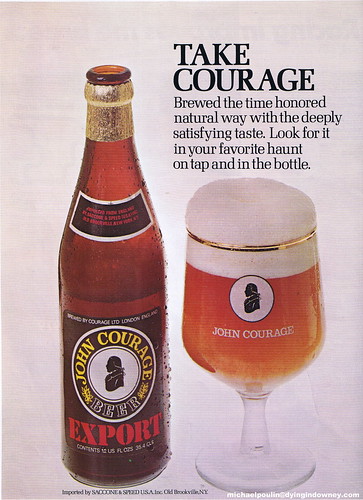
Take Courage, my friends. Old ad slogans never die; they just annoy a whole new generation of ninnies.
A new ad campaign for Courage beers, by Wells & Young's Brewing Company Limited has resurrected a 50+ year old slogan "Take Courage my friend" to promote the venerable brand. The ads (which can be seen in the above link) feature an ironic hero, who is kind of a slob, facing three frightening prospects: a polka-dot sweater set being knitted by his mum, a rectal exam, and being asked by his large-bummed woman friend how she looks in a tight dress. In all the ads, a pint of the beer is saying to the man (in a talk bubble) "Take Courage my friend".
Funny campaign. The third one might be a little sexist, but still funny because it's true.
The "Take Courage" slogan was used extensively from the '50s to the '80s in international advertising. It's painted on the side of old pubs in Great Britain. There was even an LP produced, I assume, of drinking songs.
And yet, today? The UK Advertising Standards Authority has banned the new campaign because three people complained about the big bum ad:
Here's a little more detail:
Gods forbid that anyone might see a correlation between drinking and courage. The phrase "liquid courage" has only been around since the days of sail (the jingoistic Brits also used to call it "Dutch courage"). Everyone is familiar with the phrase as a cultural artifact. And yet it was technically ruled foul because it implied alcohol could somehow enhance performance which, some scientists have said, will make you drink more. (But, channelling Douglas Adams, I think that it's 'mostly because they didn’t get invited to those sorts of parties'.)
Whether a question of sexism or false advertising, this is a classic "oh come ON!" situation for me that shows how much of our sense of humour has been lost in the post-PC age. People read way too much into ads today. I can't but agree when I read the brewer's defence:
Cheers.
A new ad campaign for Courage beers, by Wells & Young's Brewing Company Limited has resurrected a 50+ year old slogan "Take Courage my friend" to promote the venerable brand. The ads (which can be seen in the above link) feature an ironic hero, who is kind of a slob, facing three frightening prospects: a polka-dot sweater set being knitted by his mum, a rectal exam, and being asked by his large-bummed woman friend how she looks in a tight dress. In all the ads, a pint of the beer is saying to the man (in a talk bubble) "Take Courage my friend".
Funny campaign. The third one might be a little sexist, but still funny because it's true.
The "Take Courage" slogan was used extensively from the '50s to the '80s in international advertising. It's painted on the side of old pubs in Great Britain. There was even an LP produced, I assume, of drinking songs.

And yet, today? The UK Advertising Standards Authority has banned the new campaign because three people complained about the big bum ad:
The complaints said the poster implied that the beer would give the man confidence to either be rude about the woman's appearance or to take advantage of her.
The brewer, Wells & Young's Brewing Company Ltd., said it believed many men would relate to the problem of being asked to comment on a woman's new dress. The company arged that it was clear from the man's expression that he would rather not answer.
The Authority said it didn't believe that consumers would believe that the poster suggested that the man would be unnecessarily negative or take advantage, but would simply tell the truth.
Here's a little more detail:
“Three members of the public believed the poster implied that the beer would give the man confidence to either make negative comments on the woman’s appearance or take advantage of her.
“We considered that the combination of the text and the image of the man with an open beer can and half-empty glass of beer was likely to be understood by consumers to carry the clear implication that the beer would give the man enough confidence to tell the woman that the dress was unflattering.
"Although we understood the humorous intention of the scenario, we concluded that the poster breached the (advertising) code by suggesting that the beer could increase confidence."
Gods forbid that anyone might see a correlation between drinking and courage. The phrase "liquid courage" has only been around since the days of sail (the jingoistic Brits also used to call it "Dutch courage"). Everyone is familiar with the phrase as a cultural artifact. And yet it was technically ruled foul because it implied alcohol could somehow enhance performance which, some scientists have said, will make you drink more. (But, channelling Douglas Adams, I think that it's 'mostly because they didn’t get invited to those sorts of parties'.)
Whether a question of sexism or false advertising, this is a classic "oh come ON!" situation for me that shows how much of our sense of humour has been lost in the post-PC age. People read way too much into ads today. I can't but agree when I read the brewer's defence:
"Our intention through this advertising is to portray humorous everyday occurrences which Courage drinkers can relate to.
"Every man with some life experience has been in the situation where they have been asked the infamous line: 'Does my bum look big in this?' And as every man in Britain knows, the correct response is 'No!'
"It is because this is universally understood that we did not put these words on the poster."
Cheers.
Tuesday, April 14, 2009
It's what plants crave
The following is not a deleted scene from Idiocracy.
PepsiCo has filed a false advertising suit against Coca-Cola Co. over the number of electrolytes in their respective sports drinks.
Check out the claims on the POWERADE site. (And turn your speakers down.)
What's funny is what the legal argument says about the industry in general:
Let's have a reality check here: the two major ingredients in sports drinks are sugar and salt. Some public health advocates even want them declared junk food, and taken out of schools:
"...a report from the University of California at Berkeley warns that students who drink one 20-ounce sports drink every day for a year may gain about 13 pounds. This is no surprise to some nutritionists, who note that when you look at the ingredients, it's water, high-fructose corn syrup, and salt."
But what about those other electrolytes? According to the sports medicine article on About.com:
So back to the case of Pepsi. How did Coke respond?
All I can get out of the latest chapter of the Pepsi Challenge is that both Pepsi and Coke offer tasty sports drinks that can give you a sugar boost and replace salt and potassium lost in extreme workouts. (They're also good for hangovers.) One contains two more meaningless trace elements than another. Case closed. Pass the Gatorade.
PepsiCo has filed a false advertising suit against Coca-Cola Co. over the number of electrolytes in their respective sports drinks.
Check out the claims on the POWERADE site. (And turn your speakers down.)
What's funny is what the legal argument says about the industry in general:
PepsiCo unit Stokely-Van Camp Inc., the maker of Gatorade, alleges the ads falsely claim that Powerade Ion4 sports drink is "the complete sports drink" and Gatorade is "missing two electrolytes" and "incomplete." The lawsuit was filed in U.S. District Court in Manhattan.
"There is no evidence, scientific or otherwise, that Powerade Ion functions better than Gatorade as a sports drink," the lawsuit said. "There is no evidence that Powerade Ion will help consumers achieve better hydration, have more energy or get nutrients that will result in improved athletic performance."
The complaint claims there is no evidence the "minute quantities of magnesium and calcium" present in the Powerade drink make it superior to Gatorade.
Let's have a reality check here: the two major ingredients in sports drinks are sugar and salt. Some public health advocates even want them declared junk food, and taken out of schools:
"...a report from the University of California at Berkeley warns that students who drink one 20-ounce sports drink every day for a year may gain about 13 pounds. This is no surprise to some nutritionists, who note that when you look at the ingredients, it's water, high-fructose corn syrup, and salt."
But what about those other electrolytes? According to the sports medicine article on About.com:
Sports drinks can be helpful to athletes who are exercising at a high intensity for 60 minutes or more. Fluids supplying 60 to 100 calories per 8 ounces helps to supply the needed calories required for continuous performance. It's really not necessary to replace losses of sodium, potassium and other electrolytes during exercise since you're unlikely to deplete your body's stores of these minerals during normal training. If, however, you find yourself exercising in extreme conditions over 3 or 5 hours (a marathon, Ironman or ultramarathon, for example) you may likely want to add a complex sports drink with electrolytes.
So back to the case of Pepsi. How did Coke respond?
"We stand behind our product and are prepared to defend the role Powerade plays in hydrating consumers," Coke said in a statement received later on Monday.
All I can get out of the latest chapter of the Pepsi Challenge is that both Pepsi and Coke offer tasty sports drinks that can give you a sugar boost and replace salt and potassium lost in extreme workouts. (They're also good for hangovers.) One contains two more meaningless trace elements than another. Case closed. Pass the Gatorade.
Saturday, April 11, 2009
Fail saving throw versus nerdgasm
Dave Arneson died this week. Nerds everywhere put on their mourning robes and wizard hats. And I'm one of them.
Arneson was a co-creator, with the late Gary Gygax, of Dungeons & Dragons. Begun in the '70s, it launched a revolution in paper-and-dice role-playing games that led to many lost nights' sleep for the adolescent boys of Generation X. You may now point and laugh...

...okay, now to the point. I didn't actually play that much D&D. I wanted to, but never got around to organizing the giant "campaign" that I dreamed of. Instead, I found I spent most of my time reading the dungeon modules and writing my own. Creating worlds in my head. It was the best training I could have had for the years to come.
You see, D&D trained a generation of young minds to create stories for other people to live. You came up with the backstory, mapped out the sets, the props and the background cast, but you left the actual plot development to others. You drew, for example, an underground maze full of monsters and treasures, but you had to leave it up to your friends to decide how to go through it, and in what order.
This new, non-linear, user-centred storytelling quickly made its way into the adolescent books of the time. "Choose Your Own Adventure" was a popular series where every page gave you several choices of where to take the story next, creating almost countless possibilities (even though they tended to shepherd you to only three or four quite predictable endings).
The parallels with computers and programming are hardly accidental. (Especially when we had to draw flowcharts for our BASIC programs.) The home computer revolution was going on at the time, and the technology of the early '80s was stretched to its limits trying to create text-based role playing games that didn't completely suck.
And thank God that our Commodores weren't up to the challenge. Because having to do all of that non-linear storytelling and handing all the plot decisions over to users in our heads is what trained the minds who created the Web, 10+ years later. It took us a while to get the hang of it, but writing for Web in the '90s was very much like mapping out a dungeon without knowing which route the players would take through it, or authoring a Choose Your Own Adventure where every page had to create a random but continuous flow with every other one. Same as when I map out labyrithine social media engagement strategies in 2009.
I still consider those early days with graph paper, a pencil, and my dog-eared copy of the Monster Manual (with its ridiculous carnivorous jellies and line art naked lady demons) to be the beginning of something important in communications that's still playing out today.
R.I.P., Gary and Dave.
Arneson was a co-creator, with the late Gary Gygax, of Dungeons & Dragons. Begun in the '70s, it launched a revolution in paper-and-dice role-playing games that led to many lost nights' sleep for the adolescent boys of Generation X. You may now point and laugh...

...okay, now to the point. I didn't actually play that much D&D. I wanted to, but never got around to organizing the giant "campaign" that I dreamed of. Instead, I found I spent most of my time reading the dungeon modules and writing my own. Creating worlds in my head. It was the best training I could have had for the years to come.
You see, D&D trained a generation of young minds to create stories for other people to live. You came up with the backstory, mapped out the sets, the props and the background cast, but you left the actual plot development to others. You drew, for example, an underground maze full of monsters and treasures, but you had to leave it up to your friends to decide how to go through it, and in what order.
This new, non-linear, user-centred storytelling quickly made its way into the adolescent books of the time. "Choose Your Own Adventure" was a popular series where every page gave you several choices of where to take the story next, creating almost countless possibilities (even though they tended to shepherd you to only three or four quite predictable endings).
The parallels with computers and programming are hardly accidental. (Especially when we had to draw flowcharts for our BASIC programs.) The home computer revolution was going on at the time, and the technology of the early '80s was stretched to its limits trying to create text-based role playing games that didn't completely suck.
And thank God that our Commodores weren't up to the challenge. Because having to do all of that non-linear storytelling and handing all the plot decisions over to users in our heads is what trained the minds who created the Web, 10+ years later. It took us a while to get the hang of it, but writing for Web in the '90s was very much like mapping out a dungeon without knowing which route the players would take through it, or authoring a Choose Your Own Adventure where every page had to create a random but continuous flow with every other one. Same as when I map out labyrithine social media engagement strategies in 2009.
I still consider those early days with graph paper, a pencil, and my dog-eared copy of the Monster Manual (with its ridiculous carnivorous jellies and line art naked lady demons) to be the beginning of something important in communications that's still playing out today.
R.I.P., Gary and Dave.
Friday, April 10, 2009
New words to assimilate
I love English. Yeah, it's my mother tongue, but it's also the Borg of linguistics. Encounter a new word that you can't translate? Assimilate!
Several years ago, I happened upon a list of potential new words and phrases for English to steal in the 1995 edition of the Book of Lists :
1. Cavoli riscaldati — This is supposedly an Italian expression for trying to revive a dead love affair, likening it to reheating cabbage. My Italian friends at the time claimed it was new to them. Must be dialect or something.
2. Dohada — A Sanskrit word for "the unorthodox cravings of pregnant women". (No further comment needed.)
3. Drachenfutter — German for "dragon fodder", a gift that a husband buys to placate his wife when he arrives home late.
4. Esprit de l'escalier — "The spirit of the staircase", or thinking up a great comeback too late to burn the other guy. This one has real potential.
5. Kyoikumama — A Japanese mother ("school mama") who pushes her kids into academic achievement. And here you thought it was just a stereotype...
6. Nakhes — Yiddish for the combination of pleasure and pride that you get from your kid's achievement, especially if you're a kyoikumama.
7. Ondinnonk — Iroquois word for the soul's innermost benevolent desires. A really optimistic taked on human nature, IMHO.
8. Razbliuto — Apparently a Russian term for the non-feelings a man has towards an ex lover.
9. Schaddenfreude — The joy Germans feel when someone they don't like gets what's coming to him.
10. Tartle — Supposedly a Scottish term for not remembering something right away. (Doesn't say whether it's Gaelic or dialect, but I definitely detect a whiff of Scotch.)
Recognize any of these? So far, only #9 (spelled "Schadenfreude") has gotten any traction that I've noticed. As far as I know, they could all be made up. But I would like to add one of my own experience that I think has great relevance in the current age of social networking:
11. Cazzate — Italian for what we might call "talking shit", but it's a little more specific than that. When Italians pepper cazzate (pronounced like "cats-atta", and loosely translated as "penis words") into their conversation, they are engaging in an Italian form of humour that involves saying ridiculous things with a straight face to amuse themselves and their friends. It's like trolling, but in sophisticated company.
Enough with the cazzate. Enjoy your Good Friday! And please feel free to add to my list of borg words for the long weekend.
Several years ago, I happened upon a list of potential new words and phrases for English to steal in the 1995 edition of the Book of Lists :
1. Cavoli riscaldati — This is supposedly an Italian expression for trying to revive a dead love affair, likening it to reheating cabbage. My Italian friends at the time claimed it was new to them. Must be dialect or something.
2. Dohada — A Sanskrit word for "the unorthodox cravings of pregnant women". (No further comment needed.)
3. Drachenfutter — German for "dragon fodder", a gift that a husband buys to placate his wife when he arrives home late.
4. Esprit de l'escalier — "The spirit of the staircase", or thinking up a great comeback too late to burn the other guy. This one has real potential.
5. Kyoikumama — A Japanese mother ("school mama") who pushes her kids into academic achievement. And here you thought it was just a stereotype...
6. Nakhes — Yiddish for the combination of pleasure and pride that you get from your kid's achievement, especially if you're a kyoikumama.
7. Ondinnonk — Iroquois word for the soul's innermost benevolent desires. A really optimistic taked on human nature, IMHO.
8. Razbliuto — Apparently a Russian term for the non-feelings a man has towards an ex lover.
9. Schaddenfreude — The joy Germans feel when someone they don't like gets what's coming to him.
10. Tartle — Supposedly a Scottish term for not remembering something right away. (Doesn't say whether it's Gaelic or dialect, but I definitely detect a whiff of Scotch.)
Recognize any of these? So far, only #9 (spelled "Schadenfreude") has gotten any traction that I've noticed. As far as I know, they could all be made up. But I would like to add one of my own experience that I think has great relevance in the current age of social networking:
11. Cazzate — Italian for what we might call "talking shit", but it's a little more specific than that. When Italians pepper cazzate (pronounced like "cats-atta", and loosely translated as "penis words") into their conversation, they are engaging in an Italian form of humour that involves saying ridiculous things with a straight face to amuse themselves and their friends. It's like trolling, but in sophisticated company.
Enough with the cazzate. Enjoy your Good Friday! And please feel free to add to my list of borg words for the long weekend.
Thursday, April 9, 2009
Revenge of the Copywriters
I'm a Creative Director by name, but by trade I'm a Copywriter. I've always been a writer, from bad teenage poetry to whoring myself in the blogosphere. So it gives me great pleasure to say to all the Designers and Art Directors out there: We're back!
For years, copy has been taking a back seat in traditional advertising. This is partly due to the fashion for visual puns that gained steam in the '90s, and partly because advertising became more and more international. Here's a famous example from BSB Hong Kong for Preparation H:

And another from Leo Burnett for Heinz spicy ketchup:

Don't bother trying to blow them up. There's no need to. They got their message across with a visual joke and logo alone. Once the creative team settled on the idea, the Copywriter most likely went out for a beer or ten.
Print, outdoor, out-of-home, even most Internet ads are an Art Director's world. The more you can say with less, the better. Advertising that bypasses the literate mind.
But what's happening now? Social media. Words, words, words. It may be 140 characters or less in some channels, but with regimented pages on Facebook, Twitter, and others, words are the only way to really differentiate yourself. (This drives Art Directors crazy, by the way. My design better half, our Associate CD in charge of Art Direction, complained that the Twitter logo on CreativeTweets kept covering up our corporate identity. The newsfeed floats over the background, after all, so there's not much control to be had.)
Today, in the agency, my Copywriting team is busier than ever. Every Social Media plan we pitch to clients needs content generated, several times a day, and even found links require catchy captions to capture overwhelmed eyeballs. The ability to write concise and compelling copy, on-strategy and in real time, is quickly becoming one of the most valuable skills in the integrated marketing world.
No offence intended towards my visual colleagues, of course. As a creative writer in a time when everyone with a spellchecker has delusions of Tolstoy, it's just nice to be appreciated again.
For years, copy has been taking a back seat in traditional advertising. This is partly due to the fashion for visual puns that gained steam in the '90s, and partly because advertising became more and more international. Here's a famous example from BSB Hong Kong for Preparation H:

And another from Leo Burnett for Heinz spicy ketchup:

Don't bother trying to blow them up. There's no need to. They got their message across with a visual joke and logo alone. Once the creative team settled on the idea, the Copywriter most likely went out for a beer or ten.
Print, outdoor, out-of-home, even most Internet ads are an Art Director's world. The more you can say with less, the better. Advertising that bypasses the literate mind.
But what's happening now? Social media. Words, words, words. It may be 140 characters or less in some channels, but with regimented pages on Facebook, Twitter, and others, words are the only way to really differentiate yourself. (This drives Art Directors crazy, by the way. My design better half, our Associate CD in charge of Art Direction, complained that the Twitter logo on CreativeTweets kept covering up our corporate identity. The newsfeed floats over the background, after all, so there's not much control to be had.)
Today, in the agency, my Copywriting team is busier than ever. Every Social Media plan we pitch to clients needs content generated, several times a day, and even found links require catchy captions to capture overwhelmed eyeballs. The ability to write concise and compelling copy, on-strategy and in real time, is quickly becoming one of the most valuable skills in the integrated marketing world.
No offence intended towards my visual colleagues, of course. As a creative writer in a time when everyone with a spellchecker has delusions of Tolstoy, it's just nice to be appreciated again.
Wednesday, April 8, 2009
Give it away, give it away, give it away now
Years ago, my genius brother tried to explain to me why he kept giving away his intellectual property. He had developed new languages and other tools that helped put massive amounts of academic information online in the 1990s, but he refused to patent or sell any of it.
If I recall correctly, his explanation was to the effect of "if I try to sell it, a few people might buy it; if I give it away, then lots of people will use it and I can sell my expertise as the originator". (Sorry if I got this horribly wrong, David.)
This line of thinking has been an influence on me ever since. In the first years of this century, ad agencies were falling all over each other trying to brand their own proprietary processes, as if they were off-the-shelf products.
It was so bad that ADWEAK, the sadly short-lived but hilarious ad satire site, was able to make me LOL with the following:
The joke, of course, is that we all pretty much do it the same way. You can count the steps differently, and call them whatever you want, but what differentiates one agency's branding process from another's is the insight, expertise and experience of the people doing it.
When we set out to develop our own description of branding process for pitches, etc., I was determined to make it an "open source" system that deliberately looked throughout the industry for best practises and gave clients something that they could easily implement. And then we applied those simple (or "SIMPL", for "Social issues Marketing PLan", since we can't help but brand everything that moves us) steps to every process we undertake, from advertising and design, to communication and media planning and digital marketing development. Here it is, on the house:
Postscript: If you're over 30, I apologize for putting that song in your head. The only remedy is to listen to it again:
Ironically, the vid has been completely nuked from YouTube over copyright violations.
If I recall correctly, his explanation was to the effect of "if I try to sell it, a few people might buy it; if I give it away, then lots of people will use it and I can sell my expertise as the originator". (Sorry if I got this horribly wrong, David.)
This line of thinking has been an influence on me ever since. In the first years of this century, ad agencies were falling all over each other trying to brand their own proprietary processes, as if they were off-the-shelf products.
It was so bad that ADWEAK, the sadly short-lived but hilarious ad satire site, was able to make me LOL with the following:
Ogilvy Planners Claim Bates' "Brandwheel™" Is a Direct Ripoff of Their Own "360º Branding®"
NEW YORK— Allegations surfaced last week when a team of account planners from Ogilvy & Mather suggested that Bates Advertising has infringed on their trademarked process of building brands.
Ogilvy, which operates under the term “360° Branding®” claims that Bates “Brandwheel™” process is “strikingly similar” to their own. “We’ve spent millions of dollars and months of work creating 360° Branding®. This is something that sets us apart from every other agency, “ said Martin McVeney, Senior Account Planner at Ogilvy. “To have Bates basically just rip it off is appalling,he added.
Planners at Bates contend that their “Brandwheel™” process was created without outside influence. “This is ludicrous,” noted Bates’ Director of Planning, John McDougal. “Our process for creating advertising that gets results is something we take great pride in. After all, it’s not like our creative is going to win new business. We had to have something we could trademark and Brandwheel™ was just the kind of approach we were looking for.”
The two approaches are indeed quite similar. Both suggest that the agencies look at the brand from all aspects and integrate any marketing efforts based on the entire brand under a sub-process which Ogilvy terms “SyneBranding®” while Bates calls theirs “Brand-Alysis™.”
Further, the agencies have nearly identical tactics in consumer research. Ogilvy locates consumer “Touchpoints™” by initiating dialogue where people “actually interact with the brand.” Similarly, Bates seeks to understand consumers with a process called “MindSeek®.”
“All we have is our proprietary marketing tools,” said Mr. McVeney. “Without it, what do we have to offer clients? Good creative? I don’t think so.”
There’s no word yet as to how the situation will be resolved at the two agencies but insiders say that more agencies could become involved in the fray. Nearly every major ad agency in the U.S. boasts of a “proprietary marketing tool” unlike any other. Noted one anonymous insider, “We all do the same god-damned thing, we just give it some stupid trademarked name and a logo and say we’re different. For Chrissakes, what happened to doing better creative than anyone else? Did that ever occur to anyone? Now every agency is flapping their gums about how they do better focus groups. It’s just f*cking pathetic, if you ask me.”
The joke, of course, is that we all pretty much do it the same way. You can count the steps differently, and call them whatever you want, but what differentiates one agency's branding process from another's is the insight, expertise and experience of the people doing it.
When we set out to develop our own description of branding process for pitches, etc., I was determined to make it an "open source" system that deliberately looked throughout the industry for best practises and gave clients something that they could easily implement. And then we applied those simple (or "SIMPL", for "Social issues Marketing PLan", since we can't help but brand everything that moves us) steps to every process we undertake, from advertising and design, to communication and media planning and digital marketing development. Here it is, on the house:
1. Understand the issueThose are the words we use, but like I said the overall process is standard. And like everything else, we give the details of the process away quite freely in pitches, classes, meetings and seminars. Why? Because there's no voodoo involved in what we do, no "secret formula". Getting marketing right just takes listening, understanding, inspiration, and a hell of a lot of hard work. Every branding job leads to a unique solution, even if the steps that got us there are the same. The unique part is what our clients are really paying us for.
2. Inspire ourselves
3. Inspire our client
4. Inspire change
5. Build on our results
Postscript: If you're over 30, I apologize for putting that song in your head. The only remedy is to listen to it again:
Ironically, the vid has been completely nuked from YouTube over copyright violations.
Tuesday, April 7, 2009
The Omegle Experiment: one-on-one social marketing
About two weeks ago, I was introduced to Omegle, the latest thing in "social" networking. I use the scare quotes because Omegle is an entirely anonymous site where you connect with random strangers and have a spontaneous conversation. As you can imagine, it immediately attracted hordes of Internet trolls trying to outdo each other in crudity and abuse.
What I've been wondering is, can Omegle be used for good and not evil? What if I tried to use this weirdly intimate medium to preach social change? Social marketing one-on-one, pure and simple.
As an issue, I chose styrofoam. Toxic, unrecyclable and non-biodegradable, it's one of those little evils we do to the Earth every time we go use a disposable plate for company birthday cake, buy overpackaged stuff from China, or order a poutine.
I decided I'd log in, and start evangelizing. Here's what happened: (typos and all)
What I've been wondering is, can Omegle be used for good and not evil? What if I tried to use this weirdly intimate medium to preach social change? Social marketing one-on-one, pure and simple.
As an issue, I chose styrofoam. Toxic, unrecyclable and non-biodegradable, it's one of those little evils we do to the Earth every time we go use a disposable plate for company birthday cake, buy overpackaged stuff from China, or order a poutine.
I decided I'd log in, and start evangelizing. Here's what happened: (typos and all)
Attempt #1:Connecting to server...You're now chatting with a random stranger. Say hi!You: Hi thereStranger: heey !Stranger: how are you darlin?You: Do you use a lot of styrofoam?You: Hello?Stranger: hiConnection imploded.
Attempt #2:Connecting to server...You're now chatting with a random stranger. Say hi!You: Hi thereStranger: hiYou: Do you use styrofoam a lot?Stranger: cant say that i doYou: That's great!Stranger: why?You: I want people to use lessStranger: why do you want that?You: It's not recyclableYou: And it's nasty stuffStranger: do you preach the green way of life on this site?You: AbsolutelyYou: Just small changes that can change the worldStranger: what other things should i not be using to help save the trees?Stranger: like?You: Plastic forks?Stranger: I believe you, I'm just curious what efforts should be taken by one personYou: Bottled water?You: Public transit?Stranger: I dont use much plasticYou: Awesome!Stranger: unfortunately, i have to drive a lotYou: Where do you live?Stranger: bostonYou: I hear the ttraffic is brutalStranger: that it isYou: What's your opinion on environmental stufff?You: Hello?Stranger: i understand that many overconsume stuff that isnt safe for the earthYou: That's great!Stranger: i also believe that there are other environment things that people should be talking aboutStranger: but they focus on this whole being 'green' thingYou: Like what?Stranger: i wish people would draw more attention to things like environmental racism/injusticeYou: Please elaborateStranger: places like cancer alley in louisana#3:You: ?Connection imploded.Connecting to server...Looking for someone you can chat with. Hang on.You're now chatting with a random stranger. Say hi!Stranger: hiYou: HeyStranger: how are you?You: Good.Stranger: where are u from?You: Ottawa. Do you use a lot of styrofoam?You: Hello?Stranger: styrofoam? i didnt understandYou: I'm trying to get people to use lessStranger: butYou: Toxic, unrecyclable and non-biodegradable, it's one of those little evils we do to the Earth every time we go use a disposable plate for company birthday cake, buy overpackaged stuff from China, or order a poutine.You: ASL?Stranger: ohConnection imploded.
#4Connecting to server...You're now chatting with a random stranger. Say hi!You: Hi thereStranger: hey there!Stranger: goshStranger: darn itStranger: oh geeStranger: im nervousYou: Do you like styrofoam?You: Do you use a lot of it?Stranger: ive never been in a chatroom beforeConnection imploded.
#5Connecting to server...You're now chatting with a random stranger. Say hi!You: Ho thereStranger: are you a retard??You: Want to talk about styrofoam?Stranger: sorryStranger: sureYou: Do youn use a lot?You: What do you think about it?Stranger: you know it lasts practically forever and will never biodegrade?You: Exactly!You: And it's non-recyclableStranger: it is made from hydrocarbons, usually from crude oilStranger: yesStranger: non-recycalbleYou: Wow! You're well-informedStranger: thankyouYou: Do you want to say anything to my blog followers? I'm gonna blog thisYou: I'm doing social marketing 1 on 1You: In real timeStranger: okStranger: how about....global warming is a farce.You: Go on...Stranger: but pollution is an ongoing problemYou: What kind?You: ...of pollution?Stranger: we would all still be talking about oil spills and factory run-off if some idiot hadn't started this crackpot global warming malarkyStranger: plastics in the oceanStranger: pesticidesYou: Carcinogens?Stranger: 10/80 poison is still used todayYou: What's that?Stranger: yes, many toluene based productsYou: Are you an expert?Stranger: it's a poison used to kill ratsStranger: noStranger: an enthusistStranger: enthusiastYou: you just like to be well-informed?Stranger: yesStranger: you blog?You: YupStranger: where can i read it?You: workthatmatters.blogspot.comStranger: don't go away,,,,2minsStranger: not much to readYou: huh?Stranger: no much to read?Stranger: nothing on your blog mateYou: OhYou: content wise, or...?Connection imploded.
So, in answer to my original question: Probably not. At least nobody swore at me or sent porn this time.
What is "Social Issues Marketing"?
Here at Acart, we thought long and hard about what we're really all about.
For decades, we've been doing "pure" social marketing for the Canadian Federal Government and NGOs, corporate social responsibility for various private and association clients, cause marketing for charities, and supporting a mixed bag of sports, consumer and technology clients. That's quite a big tent for a corporate brand to live in.
At the same time, we were facing increasing dilution of the "social marketing" category by agencies who broadened the definition to include anything with a cause attached to it, whether it was selling an attitude, a brand, or even a product.
So we did what any good marketer would do — we invented our own category:
We defined our“issues” of expertise as follows:
• Energy
• Environment
• Health
• Safety & Security
• Education
• Transportation
• Community
• Econonomic Development
These issues fit neatly into the areas of most concern to our clients’ target markets. At the same time, they allowed us to find unity in our work with clients as diverse as Atomic Energy of Canada Limited (clean-air energy), the Canadian Urban Transit Association (sustainable transportation) and the Ottawa Senators Hockey Club (building a community of fans).
This “issues” approach also allowed us to focus its business development efforts by identifying areas of expertise that could be transferred easily from the public to the private sectors. For example, Acart’s work with Transport Canada on distracted driving informed our later work with the Canadian Automobile Association on the same issue, which led to work with the Traffic Injury Research Foundation, and will hopefully have value to corporate clients (such as cell phone and car manufacturers) interested in taking a stand on the issue.
Once you begin thinking this way, almost any client can be approached based on the issue that’s most relevant to their relationship with their target markets. A food company can benefit from our extensive government work on food safety; an appliance manufacturer can identify and promote energy conservation, etc.
Plus, we get to be the world's leading expert in Social Issues Marketing :)
What do you think of this positioning?
For decades, we've been doing "pure" social marketing for the Canadian Federal Government and NGOs, corporate social responsibility for various private and association clients, cause marketing for charities, and supporting a mixed bag of sports, consumer and technology clients. That's quite a big tent for a corporate brand to live in.
At the same time, we were facing increasing dilution of the "social marketing" category by agencies who broadened the definition to include anything with a cause attached to it, whether it was selling an attitude, a brand, or even a product.
So we did what any good marketer would do — we invented our own category:
"Acart is a social issues marketing specialist. We inspire people to think more deeply about issues that affect their lives and society. We deliver useful information to decision makers, influencers and the general public with passion, creativity and honesty. We build trust and belief in our clients as agents of change who help people make informed choices to improve quality of life."Basically, what almost every one of our clients has in common is an issue. They may be trying to increase awareness or action on a social issue close to their hearts, to align their brand or offering with an issue important to their target market, or simply embrace the issue that has been driving them all along.
We defined our“issues” of expertise as follows:
• Energy
• Environment
• Health
• Safety & Security
• Education
• Transportation
• Community
• Econonomic Development
These issues fit neatly into the areas of most concern to our clients’ target markets. At the same time, they allowed us to find unity in our work with clients as diverse as Atomic Energy of Canada Limited (clean-air energy), the Canadian Urban Transit Association (sustainable transportation) and the Ottawa Senators Hockey Club (building a community of fans).
This “issues” approach also allowed us to focus its business development efforts by identifying areas of expertise that could be transferred easily from the public to the private sectors. For example, Acart’s work with Transport Canada on distracted driving informed our later work with the Canadian Automobile Association on the same issue, which led to work with the Traffic Injury Research Foundation, and will hopefully have value to corporate clients (such as cell phone and car manufacturers) interested in taking a stand on the issue.
Once you begin thinking this way, almost any client can be approached based on the issue that’s most relevant to their relationship with their target markets. A food company can benefit from our extensive government work on food safety; an appliance manufacturer can identify and promote energy conservation, etc.
Plus, we get to be the world's leading expert in Social Issues Marketing :)
What do you think of this positioning?
Monday, April 6, 2009
A Message From The Government of Canada
Today I'm supposed to speak to a class at Algonquin College about "writing for television".
Now, I've worked on quite a few TV spots over the years, and I've learned quite a bit. But most of it is really "how to write a 30-second spot that fits within a competitive budget and government policies and still not have it suck".
This is not meant as any slight to the clients. They're working under the same constraints, which are forced upon them by political realities and the extra scrutiny the public turns on when they see an ad they've paid for in taxes. Our best government clients act more like partners, working with us to navigate the barriers and pitfalls throughout the process.
Working together, we manage to create good work. Just last month, our campaign for Public Safety Canada's 72 Hours Emergency Preparedness packed a good amount of information, drama, and motivation into 27.5 seconds (leaving the mandatory 2.5 second "A Message From The Government of Canada" tag).
How we got there was an exercise in knowing our client's internal audiences as well as we know the public ones.
Budget
On every government job, we have to write a detailed proposal outlining our skills, experience, approach, and budget. Even if we don't go with the spec concept pitched, we are usually tied to those numbers.
Since talent tends to be our biggest production cost consideration on a national campaign, we try to keep it minimal. No casts of thousands for us.
Language
All Canadian government advertising has to be equally effective in English and French. No hiring separate agencies to regionalize the message; we need an almost identical spot. Most times, this (as well as budget) means we end up shooting a silent spot with voiceover added in post. This has become even more common now that many of our spots get dubbed into multiple "ethnic" languages. (LGT a CFIA spot we did, coincidentally, with the same Quebec Director as 72 Hours.)
Inclusivity
We must always represent "all Canadians". This means showing representatives of lots of visibly different populations within Canada. If we're casting an unrelated group, the challenge is just to make the mix not looked contrived. In a family situation, however, we have two choices: show a family of mixed origins (as in the 72 Hours spot); or else cast people who are more ethnically ambiguous ("Mediterranean" is a popular catch-all.)
Beyond ethnic inclusivity, we also have to consider age, income, region... within the most targetted audience, there can still be a fair amount of diversity. So we usually shoot for averages.
Focus Groups and Committees
Finally, our work is scrutinized by two rounds of focus groups across Canada, as well as two or three high-level decision-making groups within government who we never get to meet directly. We have to anticipate the objectives of policy-makers, as well as the subjectivity of members of the public willing to give up their evening for fifty bucks and a stale sandwich.
And yet somehow, we do it. I guess all agencies have similar challenges with other sectors. Our particular constraints would probably frustrate a consumer agency... but at the end of the day it's just nice to get our work on TV. Plus, we actually might help some people.
Now, I've worked on quite a few TV spots over the years, and I've learned quite a bit. But most of it is really "how to write a 30-second spot that fits within a competitive budget and government policies and still not have it suck".
This is not meant as any slight to the clients. They're working under the same constraints, which are forced upon them by political realities and the extra scrutiny the public turns on when they see an ad they've paid for in taxes. Our best government clients act more like partners, working with us to navigate the barriers and pitfalls throughout the process.
Working together, we manage to create good work. Just last month, our campaign for Public Safety Canada's 72 Hours Emergency Preparedness packed a good amount of information, drama, and motivation into 27.5 seconds (leaving the mandatory 2.5 second "A Message From The Government of Canada" tag).
How we got there was an exercise in knowing our client's internal audiences as well as we know the public ones.
Budget
On every government job, we have to write a detailed proposal outlining our skills, experience, approach, and budget. Even if we don't go with the spec concept pitched, we are usually tied to those numbers.
Since talent tends to be our biggest production cost consideration on a national campaign, we try to keep it minimal. No casts of thousands for us.
Language
All Canadian government advertising has to be equally effective in English and French. No hiring separate agencies to regionalize the message; we need an almost identical spot. Most times, this (as well as budget) means we end up shooting a silent spot with voiceover added in post. This has become even more common now that many of our spots get dubbed into multiple "ethnic" languages. (LGT a CFIA spot we did, coincidentally, with the same Quebec Director as 72 Hours.)
Inclusivity
We must always represent "all Canadians". This means showing representatives of lots of visibly different populations within Canada. If we're casting an unrelated group, the challenge is just to make the mix not looked contrived. In a family situation, however, we have two choices: show a family of mixed origins (as in the 72 Hours spot); or else cast people who are more ethnically ambiguous ("Mediterranean" is a popular catch-all.)
Beyond ethnic inclusivity, we also have to consider age, income, region... within the most targetted audience, there can still be a fair amount of diversity. So we usually shoot for averages.
Focus Groups and Committees
Finally, our work is scrutinized by two rounds of focus groups across Canada, as well as two or three high-level decision-making groups within government who we never get to meet directly. We have to anticipate the objectives of policy-makers, as well as the subjectivity of members of the public willing to give up their evening for fifty bucks and a stale sandwich.
And yet somehow, we do it. I guess all agencies have similar challenges with other sectors. Our particular constraints would probably frustrate a consumer agency... but at the end of the day it's just nice to get our work on TV. Plus, we actually might help some people.
Subscribe to:
Posts (Atom)