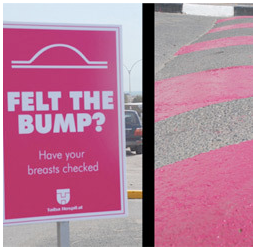
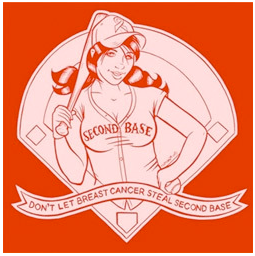
Wednesday, March 31, 2010

"My eyes are up here"

Regular readers know that cancer awareness and prevention social marketing is a topic close to my heart. So when I caught this adorably simple Belgian campaign on Osocio's Facebook fanpage, I just had to post it here:


As part of the 2010 outreach for the Campagne de dépistage du cancer du sein en Communauté française de Belgique, it targets older women, and includes print collateral and a postcard campaign for loved ones:


Nice, witty approach that doesn't stray into shock or prurience. And it's almost hypnotic...

Tuesday, March 30, 2010

Australia's war on "dickhead" drivers


Victoria Police have launched a blunt campaign against dangerous driving, telling people who text behind the wheel or fail to put on their seatbelts "don't be a dickhead":


Not surprisingly, the approach has attracted more than its fair share of controversy — including from young drivers themselves:

Leah Meade, 20, said she believed it was unfair for young drivers in particular to be singled out in the campaign ...

“I think we’re targeted because we are younger, but often it’s a lot of the older people doing silly things as well.

“Older people are as guilty as young people of talking on their phones.”


And the Australian Opposition quipped, "I think it’s an appalling message. I think it’s a shocking message, one of the worst I’ve ever heard.”

The backlash has also spawned a Facebook Group called "Don't Be a Dickhead - Worst Campaign Ever!"

So, in short, the campaign is at least successful in getting attention and getting people talking. As the Police Minister said, “Road safety campaigns are designed to confront, and this one confronts people that don’t have respect for other people on and off the road.”

ninemsn claims the campaign cost just $100,000 to make, and the Premier of Victorian and Communications Council are standing behind it as a strong approach to an important issue.

The "dickhead" move has instantly become a popular meme in Australian politics and media. When asked if race driver Lewis Hamilton was a "dickhead" because of a recent dangerous driving charge, Victoria transport minister Tim Dallas replied, OK, I'll say it - he's a dickhead."

Offensive or not, I think these folks are on the right track. If just one Australian teen tells another "don't be a dickhead" for bad driving, and everyone else laughs, the campaign will have succeeded.

**sound of screeching tires**

But wait! Then there's this weirdness:


Ginger hate? Really? Is there something I don't know about Australian culture?


Okay, Emos I'll give them.


And Twitter? Whatever.

So there you have it. Great meme takes a wrong turn into bizarre and even mean-spirited territory. Damn shame too. With those first three lighthearted PSAs, they had me at "dickhead"...

Monday, March 29, 2010

All the (local) Mad Men

Last weekend, Ottawa at Home magazine published a series of profiles of local "Mad Men" as part of their issue on mid- 20th Century style.


Who's that guy with the Scotch?


It's actually iced tea, but I couldn't pass up the opportunity to get my own vintage style on. I've always had a thing for skinny ties.

Here's the text of the interview:

How did you get started in advertising?

After failing to break into honest travel or entertainment writing, I answered an ad for Copywriters at an Ottawa advertising agency. Within five years, I was a Creative Director.

What is an advertising slogan that has stuck with you for a long, long time?

“You got it, Pontiac!” It actually became part of our jargon in the playground when I was a kid.

Where do you do your best work?

Anywhere I can get together with my best colleagues. I prefer to do it at a pub, but a quiet corner of the agency will do. Solo writing I do in my head while walking to and from; I usually arrive with my best ideas behind me.

What are the challenges the advertising world faces these days?

Changing media behavior. While it’s killing some traditional admen, I think this is a great time to be in the business. It’s like when radio and TV were still innovative media — back in the ‘50s. It ushered in a golden age for our industry.

What local tourist attraction would you most like the opportunity to promote and what would your slogan for it be?

We did a campaign for The Bytown Museum. It was part of a pro-bono creative strategy plan. It’s "Where Ottawa Begins.


I was featured along with Todd Marcotte of Electric Medialand, Don Masters of Mediaplus, and Gord McMillan (my first CD) from McMillan.


It was kind of cool to be up there with a bunch of agency Presidents — and me just a humble salary man. But I was a little disappointed that I was the only one who dressed up. And I can't help but sigh and acknowledge that none of our city's Mad Women was featured. Especially since the up-and-coming character of Peggy is such an important aspect of the show's examination of social change. Seeing a sausage party in this spread makes it look like nothing has changed.

Nonetheless, it's great to get some print exposure, to give Acart a boost and name-check my friends at The Bytown Museum.

But enough about me. There's social issues marketing to do!

Friday, March 26, 2010

Parents think their kids are dummies


[don't click... it's just a sceen cap. Link below.]

In January or February of 1983, my buddy Harry and I were standing in a field, up to our knees in snow. Looking around nervously, we took a stubby brown bottle out of his Adidas bag. But we'd forgotten to bring an opener.

Twenty minutes later, we were back in the field and happy to find our stash still safe under a bush. We opened the bottle, and dared each other to take the first sip. It tasted horrible, and I had to choke back the bubbles. But damn it, we drank a beer. Then we were on our way to meet the rest of our friends from Grade 7 at a chaperoned party.

Sound familiar? You may have been older or younger than 12, but if you're an adult who drinks alcohol, I'd be surprised if you waited until you were legal age to try it.

This is not to say that teen drinking is hunky-dory. Alcohol poisoning, liver damage, impaired driving, unsafe or unwanted sex, and all sorts of dangers are lurking in that bottle.

But as a parent, I haven't forgotten what teens get up to. I have a few more years before my son gets there, but I have no doubt he'll try whatever interests him — with or without my blessing.

Which is why I'm of two minds on these American ads from the Substance Abuse and Mental Health Services Administration (click this link to see them — the videos are unfortunately locked inside the otherwise social media friendly site)

The TV creative is quite good. The parents talk about their kids as if they're little angels, and the reveal shows that they're not talking about real kids at all — they're mannequins. I like what this says about parents' ability to be in denial about what their kids are exposed to.

The print also does a good job of being honest, and taking the tried-and-true approach of getting parents to at least talk to their kids about the issue:


And the web site has some decent messaging:
"If you don't talk about it, you're saying something.

What you say to your child about alcohol use is up to you. But remember, if you don't say anything to your child about drinking, you might give the impression that underage drinking is acceptable."

(Reminds me of when I tell clients that, in social media, not joining in an uncomfortable online conversation about your brand is as good as an admission of guilt.)

My problem with this campaign is strictly personal. My own opinion about teenage drinking is that it needs to be approached responsibly. Hell, I intend to be one of those parents who offers his kid a glass of wine at holiday dinners once he hits puberty.

And this is the problem. As a government initiative, the "Talk Early. Talk Often. Get others involved." campaign is still, at the end of the day, a "just say no" approach. The page with conversation tips has the following:
"Why do you drink?
Explain to your child your reasons for drinking – whether it's to enhance a meal, share good times with friends, or celebrate a special occasion. Point out that if you choose to drink, it's always in moderation. Tell your child that some people shouldn't drink at all, including children who are underage."

Would that have convinced you, as a kid whose self-image was 15-going-on-21?

This one, fortunately, is a little better:

"Did you drink when you were a child?
If you drank as a teenager, experts recommend that you give an honest answer.1 Explain why you were tempted to try alcohol and why underage drinking is dangerous. You could even give your child an example of an embarrassing or painful moment that occurred because of your drinking."


But hey... at least the American government is telling parents to be (somewhat) realistic about a social issue that affects almost everyone. However, as long as the bottom line is "it's bad for you because it's illegal" the argument has a built-in fail.

After all, this is a country that will let an adult go to jail, or go to war for up to three years before they consider them old enough to have a beer.

Thursday, March 25, 2010

50 years too late and a dollar short

CBC yesterday reported on public reactions to this Calgary condo campaign:


There was another ad in the series with the headline "A $20,000 down payment is easier than scoring on a four-minute 5 on 3. And way, way easier than scoring with your waitress."

Produceed by Calgary's Watermark Advertising, the ads seem to be the result of a desperate creative team doing an all-night Mad Men marathon on DVD, then nursing their hangovers at the "free businessmen's lunch" of their local gentlemen's club.


I mean, really. I love Mad Men, and I own several vintage ties from the era. But it's just a TV show. And more than that, it's a show about the end of that era. That's the whole point. The sexism, racism, and sense of entitlement of that time are supposed to make you cringe. I don't know if my mother would be able to stand watching that show, as she lived through the time. I know several women of my own generation who can't bear it, as well-made and realistic as it is — as a HISTORICAL drama.

For their part, Watermark apologized following a flurry of criticism in mainstream and social media:

"As creators of the Midtown condo campaign, Watermark Advertising apologizes unreservedly for any offence these washroom ads may have caused," [a statement] read.

"Obviously our idea of fun isn't funny to the audience we are attempting to engage — which immediately makes the communication wrong, so of course just as immediately, they will be removed."


But the developer was less contrite:

"It wasn't our intention to offend anybody. We took it as tongue-in-cheek. We were trying to address a target audience. But obviously we've offended 25-year-olds."


Nice Parthian shot against the perceived social media demographic. The irony here is that I'm pretty sure people over 25 are the ones who are most offended. Especially the ones over 65.

Sorry mom. We're not all like that.

Wednesday, March 24, 2010

What's the best way to fight cancer in advertising?

Regular readers of this blog know how much I hate cancer. So as a social marketer, I'm constantly trying to come to terms with what's the best way to raise awareness and funds to fight the sneaky bastard.

You can attack it head-on, as the Canadian Cancer Society has. You can frighten people about consequences of dangerous behaviour, like indoor tanning, or smoking, or you can spend a little of your ego to get people talking about things such as breast, prostate, or colon cancer.

All of these approaches have their supporters and their detractors. Some dislike shock advertising, while others find silly activities inappropriate for such a serious issue.

Breast cancer is a particularly sensitive issue, since like other women-specific diseases, it brings gender politics into play.

It is in this context that I bring you an interesting gallery of "Bizarre Breast Cancer Ads", from the momlogic blog.

It runs from the unexpected:


To the scary:


To the, ummmm, Freudian:


To the silly:


To the sick:


What do you think is the best way to attack the issue? Or does every little effort help?

On another note, I am pleased to announce that I am also now a contributor to Osocio, a great collaborative blog for the latest in "social advertising" (what I call "social issues marketing") all around the world. If you don't already follow it, please do.

Tuesday, March 23, 2010

V is for "viral"

Going viral is a complicated thing.

According to Ed Robinson, executive director and co-founder of The Viral Factory, 'You've got to be prepared to polarise your audience and generate debate".

And what better way to do that, than by provoking an outrageous case of censorship?

Kotex has done just that.


A very funny ad, making fun of clichés that (literally) dance delicately around something that half of the fertile human race contends with on a monthly basis. That's entertaining enough to draw eyeballs, but the original version went even further: according to Sociological Images (and other sources) it ended with the woman saying "so that's what's supposed to happen in my vagina". (Or maybe it's "to" — I have yet to find the original!)

Some U.S. networks refused to run the original ad because it was "too frank". As reported in the New York Times:
"Merrie Harris, global business director at JWT, said that after being informed that it could not use the word vagina in advertising by three broadcast networks, it shot the ad cited above with the actress instead saying 'down there, which was rejected by two of the three networks. (Both Ms. Harris and representatives from the brand declined to specify the networks.)

'It’s very funny because the whole spot is about censorship,' Ms. Harris said. 'The whole category has been very euphemistic, or paternalistic even, and we’re saying, enough with the euphemisms, and get over it. Tampon is not a dirty word, and neither is vagina.'

Too frank? We see ads for erectile dysfunction all the time that talk about erections lasting several hours, and something completely natural is too frank? Somebody's priorities are obviously messed up.

As for Kotex, it turns out that some of the "parody" footage in the ad is actually taken from their own, unironic, campaigns.

“We are guilty, so it’s not that Kotex is any different,” said Andrew Meurer, vice president for North American feminine, adult and senior care for Kotex’s parent company, Kimberly-Clark. “We’re turning the light on ourselves, and we’re not saying, look at what other people do. We’re saying look at what we’ve done in the past, which typifies everyone in the category.”


The new Kotex campaign also has cool "hidden camera" video and print components.


(via Sociological Images)

Interestingly, the Australian site for the product is a little more frank, and even more cheeky — it uses an animated beaver as a mascot.


Meanwhile, even the censored version of the American ad has broken a quarter million views on YouTube.

Break the cycle, indeed. Vagina.

Monday, March 22, 2010

Too close for comfort?

As anyone in the business can tell you, advertising is pretty conservative in nature. Sure, we wear jeans to work and have the vintage action figures arranged on our desks in obscene tableaux, but we're not in the business of exposing our clients to great risks. For that reason, advertising seldom leads popular culture, but rather reflects it. Because, like Hollywood (which is also now driven by investors and focus groups) the ad industry usually wants ideas that it knows will work.

This pressure to deal in known quantities doesn't just lead to advertising cliches. As agencies mine our increasingly recycled pop culture for cool memes, it can also lead to some rather troubling infringements of creative rights.

Just last night, I caught a Microsoft ad on TV that looked a lot like a commoncraft video, with simple paper cutouts manipulated by on-screen hands, deadpan voiceover delivery, and all.

I can't for the life of me find this ad online, but here's what I can only assume was the "inspiration":


We worked with commoncraft to do a social PSA for one of our government clients last year, so it's possible Lee was involved in this. But I doubt it.

You see, copycatting in advertising happens all the time. Just last week, Cundari Group in Toronto were accused of ripping off U.S. pop artist Thomas Allen in an ad for a Vancouver bookstore. The evidence below comes via Agency Spy:


The artist was so mad at what he calls the "theft" of his trademark cutout style, he decided to put the case forward to the court of social media, starting with his blog:

"I contacted a friend who is a well-known and highly respected figure in the world of design. Since this wasn’t a real campaign, he advised me not to waste any more time pursuing it. Instead (since Cundari’s chosen to walk on the wrong side of a very fine line), he suggested that I publicly shame them because 'they should know better'."

Another, perhaps less severe, form of copycatting I've noticed lately is HSBC's ad featuring the Chinese man fishing with trained birds:


Which, with the exception of the oddly out-of-place Canadian dude, is a pretty clean lift from the cormorant fisherman scene in BBC's Wild China.

So, what is inspiration and what is theft? In his correspondence with Thomas Allen, Cundari SVP CD Andy Manson retorted:
"Inspiration can come from anywhere. We were inspired by your technique just as you were inspired by the artists who painted the original pulp novel covers. So nobody is stealing anything from anybody. Think of all the executions that Andy Warhol’s lithograph technique has inspired. Or that celebrates Shepard Fairey’s style. Or Peter Beard’s. Or Barbara Kruger’s. Or Robert Indiana’s. The list goes on and on. Advertising routinely reflects the society around it and, as a result, what is popular.
Nobody was trying to pull the wool over anyone’s eyes."

What do you think?

Tuesday, March 16, 2010

Branding's Bad Side

.
[After today's post, Change Marketing will take a short March Break. I'll be back next week.]


Just over three years ago, R.J. Reynolds decided it needed to capture a greater share of the young, fashionable and female smoking public. After all, if up-trending rates of lung cancer among American women are anything to go by, it's a growing market.

And thus Camel No.9 was born: A sleek, pink, and pretty cigarette brand that sold itself in fashion magazines. Cool, eh?

However, people noticed something funny about this brand. Why were they marketing their smokes using teeny-bopper giveaways like glitter stickers and cell phone accessories? And what kind of adult is this promotion aimed at?


(via Sociological Images)

Well, a recent study by Moores Cancer Center at the University of California, San Diego has the answer. They conducted five phone interviews about cigarette awareness and use between 2003 and 2008 with 1,036 males and females who were 10 to 13 years old.

One interesting finding was that youth who had never smoked before, but who named a favorite cigarette ad at the beginning of the study, were 50% more likely to start smoking later on.

That makes the other major finding all the more distressing:

"The number of boys with a favorite ad was stable across all five surveys. For girls, however, it was stable across the first four surveys, but by the fifth survey, which took place after the start of the Camel No. 9 campaign, the proportion of girls who reported a favorite ad jumped by 10 percentage points, to 44 percent. The Camel brand accounted almost entirely for this increase."


Study lead John P. Pierce, PhD, professor of Family and Preventive Medicine and director of the Cancer Center’s Cancer Prevention and Control Program, commented: “This national study demonstrated that the Camel No. 9 campaign had a huge impact on young adolescent girls across the country, effectively encouraging them to smoke.”

He also points out that the results go against the Tobacco Industry's agreement with U.S. State Attorneys General not to target adolescents with advertising.

What do you think? Can R.J. Reynolds actually plead ignorance on this one, and claim that they weren't targeting teenage girls?


Bling it on, indeed.

Monday, March 15, 2010

BFs Vs. the Third R


This Norwegian social marketing ad (via Ads of The World) about proper recycling procedures is pretty amusing on first viewing:


But then, of course, the whole "double standard" thing ran through my brain. Can you imagine this ad with the gender roles reversed? With a man handling a woman like that, and discarding her when she's "used up"? It would be torch and pitchfork time in Oslo.


But you wouldn't see that version of the ad, because the fact is it's still okay to pick on "the man". Even in the modern Western World, there is enough perceived power disparity between man and women that men are expected to be able to take a little satirical abuse. Hence all the dufus husbands and boyfriends that are a staple of advertising aimed at adult women.

What do you think? Harmless fun, or sexism against men? Or both?


UPDATE: Adfreak's post of their take of this ad on Facebook provoked one fan to offer a link to this Czech ad that does, in fact, switch the gender roles in a similar situation (but much less violent):

Friday, March 12, 2010

Smarter than the average cause marketing

The idea of trophy hunting grizzly bears kind of sickens me. I don't understand why anyone would want to kill an animal they don't intend to eat. But the issue remains a controversial one in Canada's West.

Now that you know my bias, I'd like to share some funny social marketing videos that came my way today from the site No More Grizzlies in Alberta:


Produced by the Alberta Wilderness Association, these satirical PSAs do the job of showing Canadians how absurd the legal cull of Grizzlies really is.


Nice campaign, and yesterday the Alberta Government announced that the grizzly bear hunt will be suspended for another year. Thank God, because the last resort would have been to deploy Bear Force One.


And nobody wants that.

Thursday, March 11, 2010

This viral is making me paranoid

I don't usually like to do partisan politics here, but this is an exception. First of all, it's an amazing example of customized online content creating a compelling viral campaign. Second, it's American politics. Third, it's Glenn Beck, who nobody with half a brain takes seriously anyway — whatever their political affiliations.

Yesterday, reader Casey sent me this link: http://beck.cnnbcvideo.com/?rc=taf&b=b|641948-uziKFmx&referred_by=17606663-ozs8g9x

It's an American left-wing parody news report generator (from cnnnbc) using footage of insane pundit Glenn Beck to demonstrate that his tea-party witch hunt could target anyone next. (Including, apparently, Canadians!)

When you click the link, it asks you to connect with Facebook. I was assured it was "safe", but I am not recommending that you do it just for liability reasons. I am, however, willing to give up my own privacy to show my readers just how cool (and terrifying) customized video has become.


Yup, that's me in Glenn's sights.


He even knows where I came from.


I think everyone already knew that...


Oh my God!! He's also after my Facebook friends!!!


The protest signs were particularly impressive. I wish one of them had said "Get a brain, morans!"


The bottom line.

If you want to see how it works, I've put placeholders in this one:


Whatever your politics (this is, admittedly, a message from moveon.org), it's pretty amazing what they can do these days.

Wednesday, March 10, 2010

The decline and fall of print


It's been at least five years since I last subscribed to a newspaper. I still read magazines, but mostly when travelling. So I wasn't all that surprised when the news we've been waiting to hear for the past 10 years came rattling through the tubes:

US online advertising spend set to overtake all print and DM

New York - Spending on digital advertising in the US will overtake print for the first time this year, according to new figures.

The report from marketing analyst Outsell forecasts that marketers will spend $119.6bn on digital strategies and $111.5bn on print, including ads in newspapers and magazines and all direct mail.

Overall, US ad spend is expected to return to growth and increase 1.2% to $368bn.
Despite the growth of online, magazine advertising is expected to increase by 1.9% to $9.4bn after falling 26% last year.

Chuck Richard, vice president and lead analyst at Outsell, said: "Advertisers are directing dollars toward the channels which generate the most qualified leads and most effective branding.

"As they emerge from the recession, they need more accountability, and they're spreading their spending over a widening set of options."

The Outsell report surveyed more than 1,000 US marketers online in December.

Last September, a report from the Internet Advertising Bureau (IAB) suggested that online had usurped TV to become the biggest advertising medium in the UK after rising 4.6% in the first half of 2009.

According to the biannual IAB report, internet UK ad spend generated £1.75bn pounds and accounted for 23.5% of all spend. This compared with 18.7% in the first half of 2008. Elsewhere, Television accounted for 21.9%, press display for 18.5% and direct mail for 11.5%.


So there you go. Print is on its way out, at least as far as advertisers are concerned. Is anyone really shocked?

The major publications, seeing which way the wind was blowing, long ago added online versions. Some are for subscribers only, but many are free. Instant, free, and tree-free. That's how I like my news.

But there is some question as to whether the "papers" are giving too much away online. Publicis bigman, Maurice Levy, recently told the Abu Dhabi media summit that news organizations are already giving too much away, and are therefore over-dependent on advertising(!):

"Analogue media has to find a new model ... content has value and that's something for which I have a strong point of view. I think media giving away their content is not a good service to themselves. It's a shame, a pity. This content has a lot of value and it has to be valued reasonably."

Silly me. I always assumed that the nominal charge for a newspaper was to cover printing and distribution expenses. And the only ones I pick up these days are the free commuter ones anyway. How do they do it?

I'm not even an early adopter, and I get much of my news sent my way through my social networks. The rest, I get through paper-free sites like cbc, or news aggregators like Google or Fark.com (for the weird stuff).

The Independent last week stated that social media is the TV and newspaper of the future:
"The wider availability of nearly instantaneous micro newsfeeds has changed the very notion of our news consumption. Younger generations and technological savvy individuals are relying on news sources that are delivered in the form of community-sourced information. These "news sources" are often supplied in the form of friends status updates, blogs, trending topics and retweeted news headlines."

The only part I'd argue with is the headline's use of the word "future". It's happening right now (even as you read this humble blog).

So I agree with Google, who recommended to generalist newspapers to modernize their approach and engage readers directly during their leisure hours, rather than trying to charge them for generic news they can get everywhere.

Tuesday, March 9, 2010

Diversity progresses awkwardly in the strangest places

Just watch this ad, then we'll talk:


Now, first let's put aside that it's an ad for an online betting service. Then let's decide to temporarily overlook the stereotyped South Asian waiter.

Okay, done? Now let's talk about how disabled people are portrayed in this spot.

According to utalkmarketing.com, this ad has been pre-emptively banned from airplay by Clearcast, the UK TV regulator.


"A Clearcast spokesperson said that they were concerned about the 'juvenile behaviour' portrayed in an advert for a betting company and that the advert could be seen as 'offensive' in the way that the men with disabilities were portrayed.

'It could be considered that they were being laughed at and at the butt of the joke rather than being in control of their situation,. she added. 'We would never ban a disabled person from an advert, but they need to be portrayed in positive and feisty way, in control of their situation.'"


The client, Paddy Power (whose name also makes me go "hmmmm..."), counters: "As a brand, Paddy Power looks to display a fun and irreverent look on life and those ‘ground open up and swallow me’ moments we’ve all experienced are certainly such occasions.”

So we're supposed to be focussed on the waiter, and the fact that he has been "run" out on, rather than the blokes in the wheelchairs. Paddy Power is then able to explain how, by comparison, they are a safe bet because they guarantee payout.


But back to the guys in the wheelchairs. utalkmarketing.com points out that one of them is wearing a Hearts & Balls rugby shirt. It's a UK charity that helps out people disabled by rugby-related injuries, and their families. Why is it in there?

I suspect, and this is just me being optimistic, that there is a tiny seed of desire in this spot that wants to grow into the idea that people in wheelchairs are "just ordinary blokes" who do the things able-bodies rugby yobs might do. It's unfortunately stunted by the comical getaway scene at the doorway. But just imagine if the guys had slipped away in a more subtle manner, then rolled down the street at top speed when they were caught. That would have been progress towards my dream world where people with physical disabilities are seen as people first — even flawed people — and their disabilities are just an afterthought.

Personally, I'm more offended by the portrayal of the waiter. "That's the second time today they've done that!" He might as well have been played by Rowan Atkinson or the late Peter Sellers.

There are two other ads in the series. One is pretty funny, the other one painfully awkward:


What do you think? Do I give these bookies too much credit?

Monday, March 8, 2010

Rethinking shame

I just caught up with an article from last week's Advertising Age that is kind of a big deal for social marketers.

It previews a study by Northwestern University's Kellogg School of Management on the use of shaming in anti-binge-drinking ads — with specific reference to a prom night campaign initiated by the LCBO:


Copy: “Your prom should be memorable – for all the right reasons. You know you don’t need to drink to have fun. Plan ahead and make smart choices. Don’t let drinking flush your prom night down the drain.”

The study interviewed 1,200 undergraduate students at Northwestern, and concluded that the attempt to shame students straight had ironic psychological consequences:

"Viewers already feeling some level of guilt or shame instinctively resist messages that rely on those emotions, and in some cases are more likely to participate in the behavior they're being warned about."


Seems counterintruitive, doesn't it? But it seems this study dredged up a phenomenon psychologists were already well aware of, something called "defensive processing".

I'm only an armchair shrink, but I get this. It has to do with self-esteem. We don't really want to feel badly about ourselves, so when our self-esteem is under attack by a message meant to induce shame, we get defensive. We block it out, we make fun of it, or we even defy it by engaging in even more of the behaviour.

Medical News Today puts it this way:

"Findings show such messages are too difficult to process among viewers already experiencing these emotions -- for example, those who already have alcohol-related transgressions.

To cope, they adopt a defensive mindset that allows them to underestimate their susceptibility to the consequences highlighted in the ads; that is, that the consequences happen only to 'other people.' The result is they engage in greater amounts of irresponsible drinking, according to respondents."


This is a great reminder to social marketers about the holier-than-thou approach we are often tempted to take — particularly when we and our client are "true believers" on a social issue. I've always said that the problem with being an activist is that you naturally want to preach to the choir. And this is not what social marketing should aim to do.

If you want to change attitudes, you have to get inside the heads of the people you want to change. Sure, you can identify their behaviour as negative, but you have to give them an out, and you have to show the positive outcome.

As one of the study's authors concludes, there are two things we need to keep in mind:

"The first involves media: Ads placed in more-positive surroundings -- such as in a sitcom or a positive magazine article -- have a better chance at resonating than those placed in tense or negative contexts.

Second... anti-alcohol groups would be better served focusing their messages around how to avoid situations that lead to binge drinking than on the consequences of the behavior, because attempting to shame people out of binge drinking doesn't work."


If you want to read more on this issue, there's another academic article about it here. It's long, but both it and the Kellog study should make good professional development reading for anyone in the biz.

Friday, March 5, 2010

Pornvertising, Aussie style

Do not watch this ad:


Why not? Because it's one of the most sexist things you'll see today. (If you're lucky.)

I'm not opposed in principal to sex in advertising. It's one of our most potent triggers, after all. And when I see fellow Hoser Pammy Anderson in an ad, I know what I'm in for.

So why am I being all square on this one? It's the context.

If you took my advice and didn't watch the ad (yeah, right!) let me give you the scenario: Pamela plays the CEO of a company who challenges her team in the boardroom to come up with a better domain hosting solution. Our hero, however, is too busy fantasizing about his boss in a bikini, rubbing round bits with her bikini-clad female secretary, while they are doused in cream. (Yeah, really.) He suddenly snaps out of the fantasy as Ms. Anderson puts him on the spot for a host, and he spits out the name of the sponsor.

Who could possibly have a problem with that?


“It is all about sex [and has] nothing to do with domains, unless it’s to start a porn site.”

"[the ad] belittles women in the workforce and portrays them as sexual property”.


That's a sample of public complaints received by the Australian Standards Bureau since the ad first ran last December. According to ARN, they have now banned it from broadcast.

The client claims that big brands like Coke have run sexy ads before, without getting banned:

“The ASB is treating us differently under the same code of ethics as it did for the multinational likes of Coca Cola and Lynx and that just doesn’t seem fair,” he said. “I believe it is trying to set a precedent here with regards to supposed objectification of women but it is going about it the wrong way and punishing us for something that should have been done before.”


I think they may be missing something, though. First of all, I can't recall any Coca-Cola ads featuring fake lipstick lesbians actively engaged in performing male fantasy moves. Second, the workplace thing really bugs me.

In my field, I work with a lot of women. I've worked for women. I respect women.

When men and women work together, there's an implicit agreement that we ignore the 800 pound gorilla in the boardroom that is our natural sexuality. I won't claim that men don't have an instinct to objectify women. But as Katharine Hepburn said to Humphrey Bogart on the African Queen, "Nature, Mr. Allnut, is what we are put in this world to rise above."

This ad is socially dangerous because it breaks the agreement, and seems to imply that it's perfectly normal to think of your female boss and colleagues in purely sexual terms. I'm uncomfortable with the censorship, because far worse things have been done on TV. But I have no problem calling it out as an example of bad taste.

So yeah, today I'm a prude.

Thursday, March 4, 2010

Imagine you never saw this ad


I have a confession to make: I never really got over John Lennon's murder.

Some kids have sports heroes. At 10 years old, mine was a Beatle. A damaged, but brilliant musician who had just recently come out of retirement to transform himself from one long anger management case study to a domesticated urban dad.

Even at my tender age, I was put off by how many people cashed in on his death. But as I grew up and fell in love myself, I became an apologist for the one person most vilified in the examination of his life: Yoko Ono.

John loved Yoko. Understanding what that means, now, brings tears to my eyes when I hear the songs he wrote about her. And while she is often (erroneously) blamed for breaking up the Beatles, John always insisted that she "saved" him. And modern accounts of his life seem to indicate that he did need saving — from profound depression and abandonment issues.

John's music has appeared in commercials since his death. "Revolution" for Nike. "Merry Xmas (War is Over)" on a children's charity appeal. But no posthumous endorsement has been as cynical as this:


What's even worse is that it is not a misappropriation, but authorized by John's heirs, Yoko and "Beautiful Boy" Sean.

New Music Express quotes Sean from his Twitter feed"
"She [Yoko] did not do it for money. Has to do w hoping to keep dad in public consciousness. No new LPs, so TV ad is exposure to young," Ono Lennon said, adding: "Look, TV ad was not for money. It's just hard to find new ways to keep dad in the new world. Not many things as effective as TV."


Who knows what John Lennon would be like, had he outlived George. Maybe the '80s would have seen him mellow out to the point of total commercialism. But when someone dies relatively young, they get the benefit of having their principles trapped in the amber of the day.

I can't see the John Lennon of my childhood hawking cars with his revolutionary words. To my mind, the best way to keep John relevant is not to twist what he said but to just let young people hear the actual words.

So kids, for your benefit, here's some social marketing that matters from the man I remember:


And the controversial one:


I wonder why, if she wanted to make John's message relevant to today, Yoko didn't just buy her own ad space somewhere, as she and John did for their NYC "War is Over" billboard back in the day:


We miss you, John. But you probably would've forgiven Yoko anyway.

Wednesday, March 3, 2010

Social Branding

As integrated Social Issues Marketing specialists, we do more than PSAs at Acart. A big part of our business includes the branding of campaigns and programs that change attitudes, provoke action and improve lives.

One of our recently-launched social brands is Hazardcheck, a Health Canada program to help Canadians identify and reduce environmental health hazards in their homes.


Our stated objective was to create a brand that could be the next "Participaction" — that is, an engaging and potentially grassroots campaign that could be used as a basis for ongoing communication about home hazards.

As you can imagine, we went through a long process of generating naming options. We put together a large think-tank of creative and strategic people, and I moderated one of the most intense brainstorming sessions we've ever had. And, of course, it had to be developed concurrently in English and French.


Next, we worked on identifiers for the program that would get a strong message across without being overly shocking.

I can't tell you what else was on our shortlist, but "Hazardcheck" was the winner.


As a parent, I really appreciated the chance to work on something so basic, and yet so essential, to helping people keep their families in good health. Doing research for the branding project, I also learned a few new things to look out for.

Social branding is all about making important things simple and relevant. I think we've done that with the development of a plain-language name that is also a call-to-action, as well as an internet-inspired icon that communicates both "home" and "caution".

Our next job was to develop a Guide and other materials to promote the new brand. And a video is now in the works. (Maybe someday they'll let me write a Participaction-esque jingle!)


Get the information you need to keep your family healthy and safe at http://www.hc-sc.gc.ca/ewh-semt/hazards-risques/index-eng.php

Tuesday, March 2, 2010

Slow down, eh?


Yesterday, the Winnipeg Police Service launched its "Just Slow Down" campaign to reduce traffic injuries and deaths by trying to convince drivers to reduce their speed.

The feature of the site is a "Webisode" featuring a short melodrama about a group of teens on their way home from playing basketball, and an impatient businessman tearing up the road. Of course it ends in graphic tragedy.

The video, and the PSAs, can be viewed at this link. Unfortuntaley, the Winnipeg Five-0 have decided not to make the videos shareable through YouTube or other social media. While there is some user-generated content, the site itself is pretty rigid.

According to the site:

"While there are a variety of factors that may cause a collision, speed is deadly. Faster speeds exponentially increase vehicle damage and the seriousness of injuries in a collision. In fact, 1 out of 5 collisions result in serious injury or fatality."


Just Slow Down seems to focus on vehicle vs. vehicle collisions, particularly at intersections. A few years ago, I was doing work with Transport Canada of vehicle vs. pedestrian collisions. They gave me even more eye-opening stats similar to these ones at their Safe Kids Canada site:

"Children are more likely to be struck by a car in areas with higher speed limits. In fact, there is a direct correlation between an increase in vehicle speeds and the increase of the risk of injury. A pedestrian struck by a car traveling at 50 km/hr is eight times more likely to be killed than a pedestrian struck at 30 km/hr. and even small reductions in speed can be significant. For each 1.6 km/hr reduction in average speed, collision frequency is reduced by five per cent. Reducing vehicle speed has been proven to be effective in preventing crashes and reducing the severity of injuries. At a speed of 30km/hr, vehicles and pedestrians are able to co-exist with relative safety, which means that drivers have sufficient time to stop for pedestrians, and pedestrians can make better crossing decisions."


A 1997 study by another client, the Traffic Injury Research Foundation (TIRF), found that approximately 5.4 million Canadians admitted to excessive speeding.

Speed kills. People need to be reminded of that. So this is an important initiative for Winnipeg. The video may not be the most compelling bit of social marketing I've seen this week, but I hope at least next time Winnipeg Police Service will take notice of Embrace Life's decision to produce an elegantly simple PSA and share it with the world.

Monday, March 1, 2010

Who is influencing whom?

On the CBC today:

"Children and teens spend about as much time with media as they do sleeping, and the overexposure could take a toll on their health, a new U.S. study suggests.

...

The study, reported in Monday's issue of the journal Pediatrics, showed Americans aged eight to 18 spend more than seven hours per day on average consuming both old media such as TV, movies and magazines as well as new media including internet, social networking sites, video and computer games and cell phones.

...

The study found exposure to the media can make children more prone to:

• Violence — the impact of media violence on real-life aggressive behavior is 0.31 times higher, compared with 0.39 times for the link between smoking and lung cancer.
• Early and unprotected sexual activity, particularly if exposed to pornography.
• Alcohol and tobacco consumption, with exposure to smoking in movies in Grades 5 to 8 predicting the likelihood of starting smoking within eight years.
• Obesity, with possible culprits including the marketing of junk food and fast food and the tendency to eat while watching media.
• Heavy television-viewing — that is, two to three hours a day in early childhood has been linked with attention-deficit disorder during the early school years, though experts disagree about the nature of the connection."


Okay, so I'm in the industry. Of course I'm going to question these findings. Not because they threaten my livelihood in any way (they don't) but rather because they ignore important research done over the past few decades into the science of human nature.

In that time, I've been keenly reading pop evolutionary psychology books by scientists like Steven Pinker, Matt Ridley, Geoffrey Miller and others. And what they have taught me is that people are not simply vessels for culture. They're slaves to much greater forces.

Basically (if I recall correctly) your personality is mostly determined by your genes. Peer influence is what acculturates you and shapes your natural character. And parenting has a small but important influence — which can wreck havoc with the final product if it takes the form of abuse or neglect.

The effects of "Media" don't even enter these discussions. Why is that? Here's where my people come in.

As I mentioned in my blog about body image and advertising on Friday, advertisers give the people what they want. This can be expanded into all media. Movies, TV shows, games, social networks — they only succeed because people vote for them with their time and their wallets.

Today, especially, when consumers have a choice of endless media options with which to waste their time, they have more power than ever before. And it's this element of choice that makes me question these findings:

"The impact of media violence on real-life aggressive behavior is 0.31 times higher..."


Or, do naturally aggressive people like more violent entertainment?
"Early and unprotected sexual activity, particularly if exposed to pornography."


I don't know about you, but I was never "exposed" to pornography. In my day, getting your hands on a girlie mag was hard work! So some of the kids who look at dirty pictures are sexually precocious? Who knew! (I wasn't so lucky...)

"Alcohol and tobacco consumption, with exposure to smoking in movies..."


This one may have some merit, since old movies make smoking look so damn cool. But I still have to give credit to peer pressure here, and the fact that these "bad" kids are watching more adult media.
"Obesity, with possible culprits including the marketing of junk food and fast food and the tendency to eat while watching media."


...and the not exercising. But then, of course, we'd have to blame books too.
"Heavy television-viewing — that is, two to three hours a day in early childhood has been linked with attention-deficit disorder during the early school years, though experts disagree about the nature of the connection."


That one seems to cancel itself out. As far as I can see, today's movies and TV shows seem to be made by people with ADHD — not the other way around.

"And where's the parenting in all this?", you might ask. Kids who are spending too much time alone with electronic media are doing so because it's being allowed. Their parents either lack the time or the inclination to engage with their kids face-to-face, to get them out of the house and into activities, and to stop relying so much on an army of electronic babysitters.

This kind of correlation without causation research reporting reminds me of that bit in Freakonomics where a mayor looked at research showing that kids with books in their homes had higher literacy levels, so naturally set out to put books in every home. No question as to what sociological factors are at play. Just more books = more reading.

Media do not equal behaviours. At least, not unless you see people as sponges. I don't. I think it's the other way around.

PS: Welcome to new readers from the Sprott School of Business at Carleton University. It was great speaking to the Marketing class this morning.