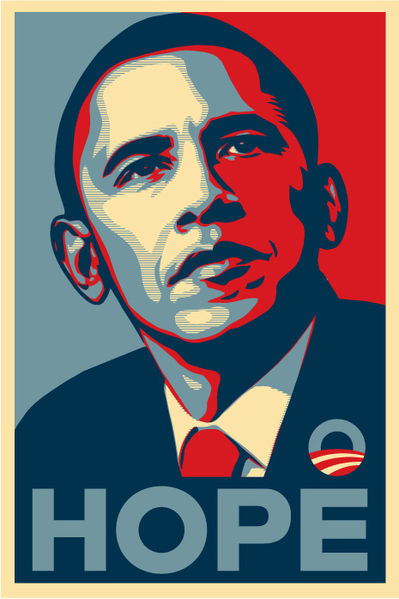
Remember this? It's hard not to. Artist Shepard Fairey's homemade poster became the symbol of Barack Obama's first successful Presidential campaign in 2008. In branding terms, it summarized all of the promise of a new, more positive, empathetic and diverse United States, after eight years of President George W. Bush. It was President Obama's brand.
What made it new and interesting, to a branding nerd like me, is that it was not a "top-down" brand. It incorporated Mr. Obama's face, his official
"O" logo, and one of his campaign themes. But in bringing it together in sharable, emotive and graphic form, Mr. Fairey created a meme that could be passed around the emergent social mass-media,
remixed, and "owned" by just about anyone. It became Barack Obama's brand not because his campaign team said it was. The brand was what his fans (and enemies) said it was. Branding had made the leap from autocracy (monolithic, professionally-designed brand properties with thick standards guides and "brand cops") to democracy (grassroots, evolutionary and widely distributed).
Social media were key to President Obama's political success.
When the mid-term election of 2010 came, the right wing of the United States had caught on to idea of ground-up, populist, branding. And so we saw the rise of
the Tea Party movement. But things had changed already. Branding a political movement had become not a matter of developing one powerful with emotional resonance for supporters to rally around. Instead, it was a broad idea that encouraged individual expression.
As you can see from this page from a Google Image Search, the various Tea Party organizations use a variety of symbolism and messaging. The original movement was one of constitutional literalism and drastic reduction in both taxes and government spending. This old-school conservatism, however, was soon swamped by a plethora of popular "culture war" ideologies taken from fundamentalist Christianity, such as visceral opposition to a
bortion, the
science of evolution, and
equal rights for homosexual people, as well as various anti-immigrant, pro-gun and other right wing issues. It became not one movement, but many.
Which brings us to the election that just happened. In 2012, social media have evolved to the point where any person — or idea — can become famous and powerful simply on its own merits.
Early on, organizations such as Planned Parenthood identified the potential for young women to be a significant factor in the election. As a large and established NGO, they took many of the traditional paths to advocacy, such as spending $5,086,007 on political action — most of which went to opposing Tea Party and other ultra-conservative candidates. (They achieved the highest return on investment, 98.58%, of any Political Action Committee in the election, according to
TPM.)
Planned Parenthood also engaged in extensive social media campaigning, creating "
Pillamina" (a birth control pill mascot who followed Mitt Romney's campaign to highlight reproductive freedom) and a branded campaign,
Women Are Watching.
But underneath all the big guns booming the feminist message, two truly spontaneous brands emerged that, in my opinion, really turned out the female voters for President Obama.
One was just three words:
As the election approached, this
catchphrase from 2010 gained new life on Twitter as a hashtag. Suddenly, it attached to every news item about Republican politicians who made outrageous comments about birth control, abortion, rape, and women's sexuality in general. It became such a powerful brand that opponents started using it too.
The other branded idea that emerged resulted from
a single comment by conservative radio comedian Rush Limbaugh, about a young female law student who was denied the right to speak at a congressional hearing on contraception:
"What does it say about the college co-ed [Sandra] Fluke who goes before a congressional committee and essentially says that she must be paid to have sex -- what does that make her? It makes her a slut, right? It makes her a prostitute. She wants to be paid to have sex. She's having so much sex she can't afford the contraception. She wants you and me and the taxpayers to pay her to have sex."
"Slut"... the word had already been successfully appropriated for the women's movement by Toronto's (and soon the world's)
Slut Walk movement. Now the self-branded "sluts" turned their anger on the politicians who would challenge their reproductive freedom. Facebook cause pages with names like "
Rock the Slut Vote" and "
This Slut Votes" suddenly appeared, attracting legions of followers. On every online social platform, there was a constant flow of political "slut" memes, statements and articles.
Like the Tea Party movement, this was not a single organized movement, but many individuals, brands and interest groups that interacted loudly online. Unlike the Tea Party, the #waronwomen and "slut" brands achieved far more unity in their voice and objectives. The focus was simple: reproductive freedom, choice, and support were women's rights. With a single purpose, feminists were able to expose and ridicule some of the Tea Party's most extremist rogues and tie them to Romney/Ryan campaign through the traditional brand strategy of consistent messaging, followed by proof points. And they seemed to have made a real difference.
While
exit polls showed that women in the United States supported both President Obama and Governor Romney at an almost even split (55% vs. 45%) among unmarried women, who make up 23% of voters, President Obama was favoured by 67%.
It is
widely reported that a political groundswell of (often young) women won the election. Here's how a writer at Christian Men's Defense Network summarized the results (from
BoingBoing):
The famous “gender gap” isn’t really a gap based on gender. The right overwhelmingly wins older and married women. The “gender gap” should more accurately be called the slut vote.
Obama appealed to rich white sluts by forcing someone else (the Catholic church, in this case) to pay for their birth control, and by scaring them about alleged threats to their ability to take advantage of Planned Parenthood’s services (Planned Parenthood being conveniently located in the minority part of town, of course, so as to provide anonymity to visiting white girls whose white girl friends never go over there–except to visit Planned Parenthood themselves). This created a wedge issue in the suburban community that allowed Obama to play more strongly there than he might have if the election ended up purely about the economy or the national debt.
One thing one has to remember about women, especially slutty ones: They usually don’t make decisions based on reason. So all the Obama administration had to do was scare them that Mitt Romney was going to take away their birth control and their access to abortion. The fear for them is that, without birth control and abortion, they might actually get pregnant and have to give birth. That is scary not simply because of the economic burden of having a child (since, hey, they can get all kinds of cash and prizes if that happens), but because if that happened then everyone would know they’re sluts, and their image as daddy’s pure little snowflake princess goes out the window.
Three elections, with three very kinds of branding playing a major role in motivating voters. When the next (mid-term) election comes in 2014, it will be interesting to watch how the lessons learned in the past three will be applied to creating the next big brand in American politics.