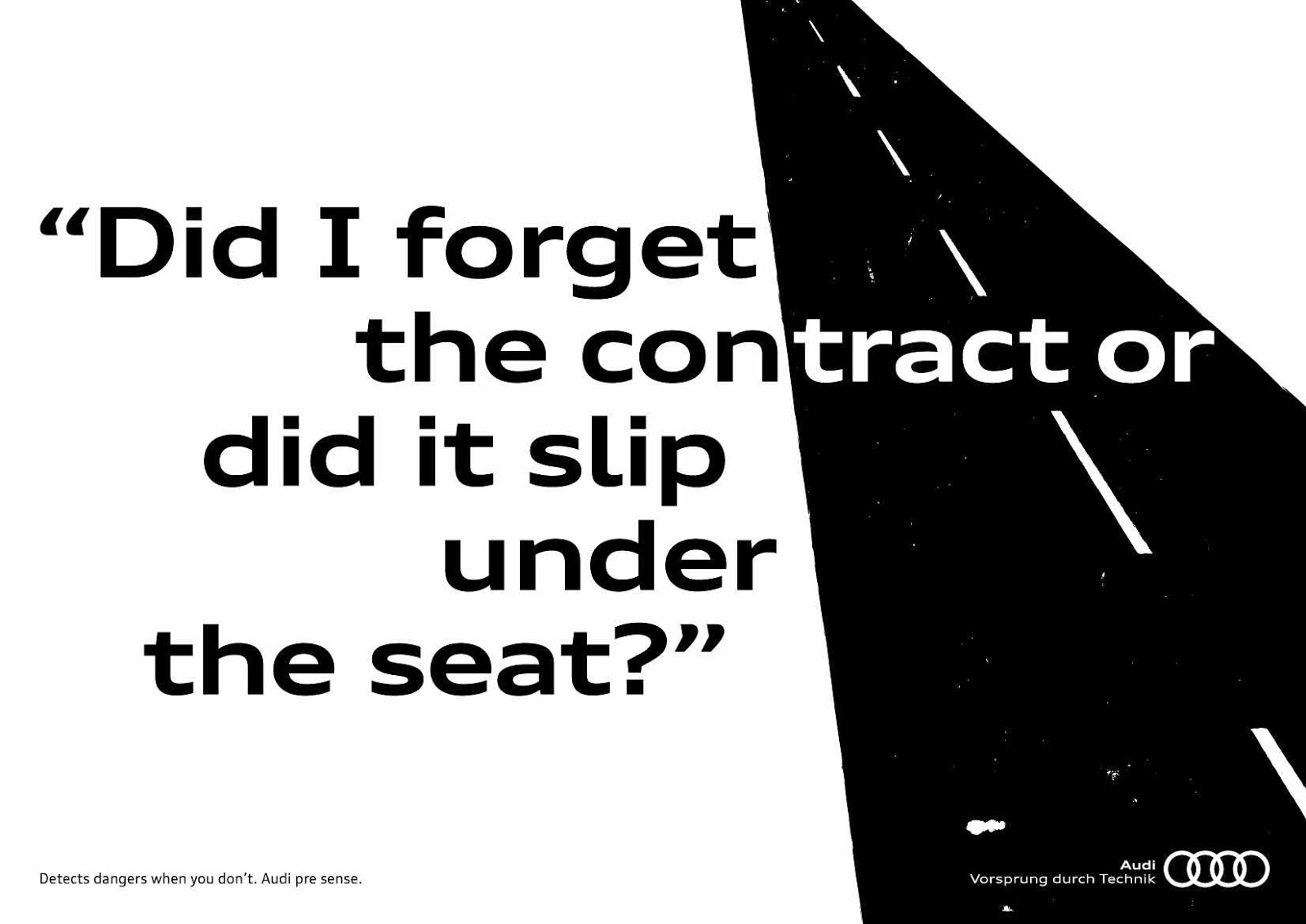
At first sight, I thought this was a CSR campaign against distracted driving. But after reading the fine print ("Detects danger when you don't. Audi Pre Sense") it feels like the exact opposite.
In my work with the Traffic Injury Research Foundation (TIRF), one of the many things I've learned is that safety features can actually make people drive more carelessly. We did a whole campaign about it, called "Brain On Board," for the Toyota Foundation, because Toyota Canada feels the need to remind drivers not to let their advanced safety features make them less careful drivers.
This German Audi campaign, however, especially the "emails" one above, take the dangerous position that distracted driving is going to happen anyway, and that this new feature can save you from your own stupidity.
I have a message for the agency, "thjnk", in Hamburg, Germany: THINK!
According to our client, the Traffic Injury Research Foundation, 81% of licensed drivers never drive after drinking. Those who do are clearly in the minority. So why are a third of road deaths alcohol related?
The problem is that we Canadians tend to be very tolerant of others, and shy about confrontation. Many of us are proud of doing the right thing for ourselves, but we pause before either letting other people know what we believe or speaking out against wrongs.
That's the challenge we faced when TIRF asked us to partner with them on the Change The Conversation campaign. Responsible drinkers are in the vast majority, and it is time that we do something about the hard core of irresponsible people.
Confrontational, and even aggressive in their look and message, these posters are here to get attention and invite people to join the conversation at the campaign site, changetheconversation.ca, a Facebook page, a Twitter feed (@changetheconvo) and an eventual YouTube Channel.
What do you think? Would this campaign make you think twice before getting in a car with someone who had been drinking irresponsibly, or letting someone drive home from your place after a few?
The rest of the campaign brings further challenges: Planning ahead not to drink and drive, not letting young drivers get distracted driving drunk friends around, and the career limitations of conviction.
The Fédération Internationale de l'Automobile's FIA Foundation has established a global safety campaign called "Make Roads Safe" to gather public support to tackle road deaths by:
• Calling on governments and the United Nations to commit to a ‘Decade of Action for Road Safety’ • Supporting a $300 million, 10 year, global Action Plan to help improve road safety in developing countries • Calling on the World Bank and other multilateral and bilateral donors to ensure that at least 10% of their road budgets are dedicated to road safety measures
But will a safe driving message resonate with fans who show up to watch drivers reach speeds of up to up to 360 km per hour? Especially when "street racing" has been identified as a front-burner social issue?
According to FIA, the UN's Decade of Action for Road Safety was a direct result of their awareness-building efforts: "With road deaths set to double in the next 10 years, this landmark resolution will pave the way to help halve the number of deaths over the next decade saving five million lives."
I wonder if NASCAR will be next to embrace a road safety message. Or at least focus on making safer left turns?
Yesterday, the Winnipeg Police Servicelaunched its "Just Slow Down" campaign to reduce traffic injuries and deaths by trying to convince drivers to reduce their speed.
The feature of the site is a "Webisode" featuring a short melodrama about a group of teens on their way home from playing basketball, and an impatient businessman tearing up the road. Of course it ends in graphic tragedy.
The video, and the PSAs, can be viewed at this link. Unfortuntaley, the Winnipeg Five-0 have decided not to make the videos shareable through YouTube or other social media. While there is some user-generated content, the site itself is pretty rigid.
According to the site:
"While there are a variety of factors that may cause a collision, speed is deadly. Faster speeds exponentially increase vehicle damage and the seriousness of injuries in a collision. In fact, 1 out of 5 collisions result in serious injury or fatality."
Just Slow Down seems to focus on vehicle vs. vehicle collisions, particularly at intersections. A few years ago, I was doing work with Transport Canada of vehicle vs. pedestrian collisions. They gave me even more eye-opening stats similar to these ones at their Safe Kids Canada site:
"Children are more likely to be struck by a car in areas with higher speed limits. In fact, there is a direct correlation between an increase in vehicle speeds and the increase of the risk of injury. A pedestrian struck by a car traveling at 50 km/hr is eight times more likely to be killed than a pedestrian struck at 30 km/hr. and even small reductions in speed can be significant. For each 1.6 km/hr reduction in average speed, collision frequency is reduced by five per cent. Reducing vehicle speed has been proven to be effective in preventing crashes and reducing the severity of injuries. At a speed of 30km/hr, vehicles and pedestrians are able to co-exist with relative safety, which means that drivers have sufficient time to stop for pedestrians, and pedestrians can make better crossing decisions."
Speed kills. People need to be reminded of that. So this is an important initiative for Winnipeg. The video may not be the most compelling bit of social marketing I've seen this week, but I hope at least next time Winnipeg Police Service will take notice of Embrace Life's decision to produce an elegantly simple PSA and share it with the world.
Maybe it's because I'm at home, nursing a cold, today. But this PSA actually brought tears to my eyes. (Click the text link above to the embedded video in the campaign site, no YouTube yet.)
The UK campaign has already been covered by two industry blogs I follow, Osocio and AdFreak, but I want to share it here with Acart staff, friends and clients because of the considerable road safety work we have done with Transport Canada, CAA, and the Traffic Injury Research Foundation.
When you're "selling" safety, the temptation is to scare people with worst case scenarios and bloody consequences like the interminable brutality of this distracted driving video (also from the U.K.):
But does that really work? It's hard for anyone, especially teens, to really imagine death as an outcome. The Embrace Life ad, on the other hand, aims for a much more influenceable demo/psychographic: responsible husbands and fathers. Me.
We have had many discussions with our clients at TIRF, and their partners in international law enforcement, about how to get people to make smarter decisions about driving based on positive messages rather than scare tactics. Images like this, however, blend both in a perfect symphony of emotion:
It's heart-wrenching and life-affirming at the same time. He has everything to lose, and so do they, over a simple decision that he makes several times a day.
Osocio has this quote from Embrace Life’s Writer and Director, Daniel Cox:
“It was central to the development of the project that we root the concept of wearing a seat belt firmly in the family domain, and create the advert so that it could be viewed by anyone of any age. Children are so important as opinion formers within their family that we felt it imperative to have a child take a pivotal role in relaying our message. One key aspect to the storytelling is that we developed Embrace Life to be non-language specific, so that the message wouldn’t become lost when viewed by visitors to, or residents of, the UK where English might not be their first language.”
I am professionally and emotionally devastated by this PSA. In the good way.