Showing posts with label international development. Show all posts

Monday, August 30, 2010

Burundi Monday 4: T.I.A.

According to Acart Videographer Christopher Redmond, this TLA* means "This Is Africa". It's an expression the foreigners at the Burundi Film Center use when confronted by extreme culture shock.

And that's what they're getting, now that the new crop of Burundian home-grown films is in production.

The BFC was established to develop media and filmmaking skills in post-conflict Burundi, so that the people of this nation few in the west have heard of can show their stories to the world.

Those stories can get a little brutal.

For example, in a film about a man who is down on his luck and ends up working at a slaughterhouse, the most practical thing to do was use a real set and bloody ex-cow props, even though it attracted scavengers:


Then, while filming in a marketplace, a vodka company representative decided to give out free samples, an action that in a place like Kigali can end up in bloodshed. Christopher tried to distract the crowds from the shoot by telling them they were extras in some fake second unit work. This gave them time to finish the shot and GTFO.


TIA indeed!

You can follow Christopher's international development work at BFC in his blog on Citizenshift.


(*old tech. industry joke: "TLA" is a three letter acronym for "Three Letter Acronym")

Monday, August 2, 2010

Burundi Monday, part deux

As promised, I am bringing the second instalment of Burundi Monday, following Acart Videographer Christopher Redmond's international educational outreach through the Burundi Film Center. But since it's a holiday here at home in Canada, I'm going to do the laziest thing possible and just excerpt his latest blog entry about teaching hopeful young filmakers how to tell their own stories to the world through video media:


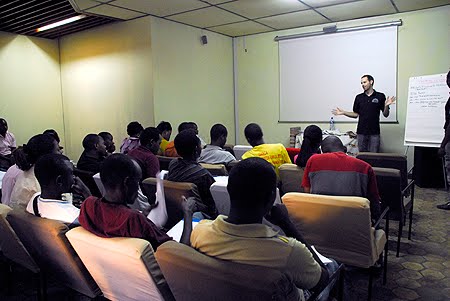
"Today was the first day of class and everything seems to have gotten off on the right foot. The room was full, my lesson plan was tight and everyone was engaged throughout. We have a new hand-painted BFC banner, T-shirts (courtesy the Sam Group in Ottawa), and a number of volunteers who were helping me with attendance and presentation notes. Things were, dare I say, professional. Or at least that’s what I’m told.

...

The students this year, however, seem to have a lot more experience than in 2007. Once again, we went around the room asking everyone to tell us about themselves and give us a sense of their skill-level. Almost two thirds identified as a “cameraman”, which I should have expected based on the type of people who have contacted me over the years asking to participate. But there are also a number of novices, actors and a few journalists again, which should make for a nice mix.

...

All the preparation I had done in collecting French books and lesson plans has also been a huge relief. I was honestly learning half of the technical film terms the day before I’d teach them the first time. Now, with the benefit of not only having taught everything once, but also having worked on at least half a dozen bilingual TV commercials in Montreal, I’m fairly confident in sharing the basics. So today, we started from the start – the different types of films (fiction, documentary, animation, experimental), the major steps of creating a film, film genres, and a number of other general overview points to get everyone on the same page. Even the volunteers were often scribbling down notes, enjoying both the refresher and probably the new clarity I brought to the material.

...

When class was done, a volunteer came up to me saying he overheard a few people calling their friends telling them the class is really good, they should try to get in. Too much interest is a problem from 2007 I won’t mind having again."


You can follow the rest of Christopher's BFC blogposts at CitizenShift's Media for Social Change, including a recent brush with the police. But other than that, his trip is going well — especially since his BFC partner and wife, Bridget — has joined him on their journey.

Next week on Burundi Monday: A love story.

Monday, July 26, 2010

Burundi Mondays

For the next few weeks, every Monday's post will be dedicated to following the African exploits of Acart Videographer Christopher Redmond as he teaches film and advertising in Burundi.


Christopher is a co-founder of the Burundi Film Center, a non-profit media development project that "helps Burundian citizens to learn essential 21st century mass communication skills from international filmmakers and documentarians, while engaging those same media experts in African issues".

Christopher arrived in Africa last week, and immediately set about sharing what he has learned working at our ad agency for almost 3 years.

From his blog:

Today was the final day of the Rwanda Film Festival and I was asked to teach a TV advertising workshop to about a dozen students. As I explained to them, even directors in Hollywood work on commercials between projects to help them make a living. The fact Rwanda only has one national television station was beside the point. The tips I gave could all translate into making good short films – keeping the message simple, telling the story visually and making sure every shot says something.

I walked them through the entire process of creating commercials using samples from my work at Acart Communications in Ottawa. So I broke down what makes up an advertising agency in North America (creatives and client services), then showed them the steps and format to write for TV, create animated storyboards and finally the finished product. The fact I used mainly Government of Canada commercials as samples, like our Elder Abuse and 72 Hours “Get Prepared” campaigns, also made them laugh. “Wow, your government cares so much about your people,” one student told me. “It is very different here.”

Overall, I tried to keep things basic and relevant, giving them ideas for how to break into an industry that otherwise seems exclusive and, well, alien. I explained that creating spec TV spots (fake commercials) or exciting “pitch” videos for clients is a good way to start. See there’s often a “catch 22” for working in film and TV –you need to have already done it in order to do it. But everyone has to start somewhere. And knowing how to take that first step yourself can end up being a giant leap in your career.


Best of luck to Christopher and his students, from all of us here at Acart. You see? Doing work that matters is more than a slogan to us. It's a way of life.