Showing posts with label design taxi. Show all posts

Friday, August 24, 2012

"Sleeping Beauty" art installation is kinda creepy


Design Taxi reports that right now (Aug 22 - Sept 9, 2012), Ukrainian women are lying in a museum, pretending to be asleep, waiting for a male vistor brave enough to "wake them" with a kiss and marry them.

What?

Ukrainian-Canadian artist Taras Polataiko, with support from the Art Foundation of Alberta and the University of Lethbridge, created the installation to examine “The tension of the performance" in the "seductiveness and fear of the ultimate moment.”

This is no kissing booth. Before puckering up, the men must sign a contract, promising to marry the woman if she opens her eyes during the kiss. The women have previously agreed to the marriage as well— unless the keep their eyes closed.
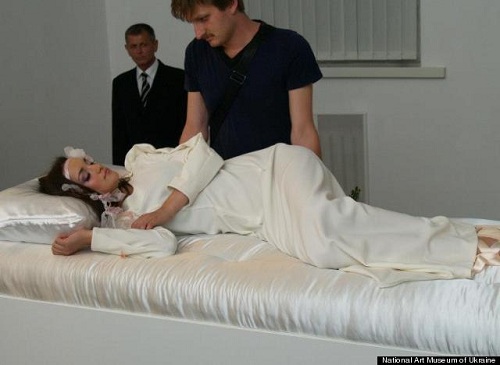

There are many things here to be disturbed about, including the nature of male-female relations in the Ukraine (including bride trafficking), but I guess that what "art" does.

What I find particularly unsettling is the fact that the "kiss" in Sleeping Beauty was a bowdlerization by Charles Perrault, whose version is the basis for modern fairy tales. The "kiss" was originally an act of rape.

Here's a synopsis of the original 1634 story, Sole, Luna, e Talia, by Giambattista Basile:
After the birth of a great lord's daughter, Talia, wise men and astrologers cast the child's horoscope and told the lord that Talia would be later endangered by a splinter of flax. To protect his daughter, the father commands that no flax would ever be brought into his house. 
Years later, Talia sees an old woman spinning flax on a spindle. She asks the woman if she can stretch the flax herself, but as soon as she begins to spin, a splinter of flax goes under her fingernail, and she drops to the ground, apparently dead. Unable to stand the thought of burying his child, the lord puts Talia in one of his country estates. 
Some time later, a king, hunting in nearby woods, follows his falcon into the house. He finds Talia, tries unsuccessfully to wake her up, then has sex with her while she is unconscious. Afterwards, he leaves the girl on the bed and returns to his own city. 
Still deep in sleep, she gives birth to twins (a boy and a girl). One day, the boy cannot find his mother's breast; and instead he begins to suck on Talia's finger and draws the flax splinter out. Talia awakens immediately. She names them "Sun" and "Moon" and lives with them in the house. 
The king returns and finds Talia is awake – and a mother of twins. However, he is already married. He calls out the names of Talia, Sun and Moon in his sleep, and his wife, the queen, hears him. She forces the king's secretary to tell her everything, and then, using a forged message, has Talia's children brought to court. She orders the cook to kill the children and serve them to the king. But the cook hides them, and cooks two lambs instead. The queen taunts the king while he eats. 
Then the queen has Talia brought to court. She commands that a huge fire be lit in the courtyard, and that Talia be thrown into the flames. 
Talia asks to take off her fine garments first. The queen agrees. Talia undresses and utters screams of grief with each piece of clothing. The king hears Talia's screams. His wife tells him that Talia would be burned and that he had unknowingly eaten his own children. 
The king commands that his wife, his secretary, and the cook be thrown into the fire instead. The cook explains how he had saved Sun and Moon. The king and Talia marry; and the cook is rewarded with the title of royal chamberlain. 
The last line of the fairy tale – its moral – is as follows: "Lucky people, so 'tis said, He who has luck may go to bed, And bliss will rain upon his head."

The symbolic rape is still there, in this art installation, as far as I am concerned, with its dangerous game of sexual power struggle and marital stakes. But whether that potent message ends up enlightening people or taking them into the dark side is up for debate.

Tuesday, May 1, 2012

Beauty and the beastly business of quantifying it

The speed and temporary nature of social media feeds lead to some interesting contrasts.

In my Facebook newsfeed yesterday, I first took note of a Design Taxi link posted by Marc from Osocio about "The World’s Scientifically Most Beautiful Woman".

Here she is:


18-year-old student Florence Colgate has the most naturally perfect face, according to a British lifestyle show's nationwide search.
“Florence has all the classic signs of beauty,” Carmen Lefèvre, of The Perception Lab at the University of St Andrews’ School of Psychology, told The Daily Mail. “She has large eyes, high cheekbones, full lips and a fair complexion. Symmetry appears to be a very important cue to attractiveness.”
Along with — apparently — blonde hair, blue eyes and light, unblemished skin.

I won't even get into the Nordicism of all this. (The Mail actually called her "'Britain's most beautiful face".) There have been enough blogposts about that issue already. I'm more interested in the parts that sociobiologists have tried to rationalize.

For example, symmetry is seen as a sign of good genes and good health. Maladaptive mutations, as well as childhood disease and injury, can affect symmetry. It's seen as a way to advertise good health and disease resistance — in other words, that person is a good source of healthy babies.

The other features are ethnically specific. Blonde hair and big blue eyes are what are known as "neoteny" — that is, babylike features kept into adulthood. All humans are very neotenic apes, retaining our round-headed juvenile chimp features throughout our lives.

Via pbase
The loss of pigment that gave northern people lighter skin is also an adaptive mutation to absorb more vitamin D from less sun exposure. I personally believe that lightening of skin and eyes in parts of those populations came along for the ride, then got amplified by sexual selection because youth is attractive.

But Darwin I ain't.

The other link I was going to mention was actually directly above Marc's "beauty" link. It was a CBC story titled, "Ugly Meter app worries cyber bullying activists"

A smartphone app allows users to assess their own symmetry based on some unknown standards. It's like "Hot or Not", but without the subjectivity of human feedback.

According to uglymeter.net:
"How ugly are you? For over 3 million users, Ugly Meter has been the go-to iPhone App that won’t lie when it comes to determining how attractive or ugly you are. Just snap a picture of yourself (or someone else) in the app and hit the scan button. The Ugly Meter will scan your face and determine just how ugly you are and dispense advice accordingly. Ugly Meter then allows you to post the results to Facebook or Twitter."
I wonder about the ethnic standards of beauty behind this, too. Although my own northern Euro ancestry doesn't seem to have helped much:

I blame the lighting.
I tried a few more times, and found that the insults got pretty creative.

To test the baseline, I tried scanning a screenshot of Miss Colgate:


Clearly, the creators of this app and the people behind the British talent search read the same books. Or something.

But then what happens when I scan a head-on glamour pic of Iman, a woman so ethereally beautiful, she got David Bowie to settle down:


I must have held the camera funny. I'll try again:


Ummm...

But hey, there was nothing scientific about this (mostly because I don't have all day to fart around with my iPhone). If you don't mind giving them your 99¢, you can find out for yourself what "beautiful" really means.

(I'll update this post with more scans, as I get a chance.)


George Clooney (a reader request by Rachel)


Sometimes, it just seems random. Watch what happens when I scanned the face of late-'70s David Bowie, two different times.


Was it the misplaced cursor that made all the difference? (Good thing I didn't shoot him in full Aladdin Sane makeup.)