Showing posts with label art. Show all posts

Monday, April 27, 2015

This organic tomato sauce may or may not contain severed head


My friend Gord sent me a link from Good that points out a pretty hilarious packaging gaffe. Or is it?

Tropical Traditions, originally a coconut oil importer in the US, has branched out into organic packaged foods. One of them is an Italian pasta sauce line, with labels showing women from Renaissance Italian paintings.

Organic Spicy Tomato & Roasted Garlic, for example, features Botticelli's The Birth of Venus, but without the breasts:


Organic Tomato & Basil uses Raphael's Woman with the Veil:


Organic Tomato and Grilled Eggplant gets one of my favourite portraits, Lady with an Ermine by Leonardo:


OK, the weasel is a little weird for a food label. (Assuming the sauce doesn't have much weasel in it.) 

But let's move on to the final jar, Organic Tomato & Porcini Mushroom:


What is with that woman's face, anyway? She doesn't look too impressed. Perhaps we should have a look at the uncropped painting, which is Caravaggio's... Judith Beheading Holofernes?!?


That's right, it's a decapitation. In the apocryphal Book of Judith, the eponymous heroine is a righteous Hebrew who saves Israel by talking her way into the tent of Assyrian general Holofernes, then hacking off his head after he passes out drunk. Since Christians love them a good grisly death, this scene has been portrayed by several artists over the centuries.

But why choose it for a food label? Especially a food that itself kind of resembles gore?

There is no way the designer was unaware of the painting's context, as she or he would have had to research a public domain version of the whole work from which to crop the label.

In fact, I believe what we are seeing here is a clever little prank. A designer who counted on his or her client to be ignorant of the source material. The Botticelli and Leonardo portraits are well-known enough that they probably sold the idea of using Renaissance Italian paintings of women to give the sauces a note of "old-world authenticity." But a severed head, spouting arterial blood, is probably one of the last things I want to think about when I pour this on my spaghetti.

Wednesday, June 25, 2014

Examining regional beauty standards through Photoshop


Buzzfeed's content has been going downhill lately, but this post is a refreshing exception. It tells the story of Esther Honig, a self-described "human interest reporter" based in Kansas City.

Ms. Honig sent her raw portrait (above) to 40 people in 25 different countries with one simple request: "make me beautiful."

Here a few results:


Germany (via Buzzfeed)


Morocco (Via Buzzfeed)


India (1 of 3, via Buzzfeed)


USA (1 of 2, via Buzzfeed)
It's interesting to note that while several PSers lightened her skin, few darkened it much. The participants were not all professionals. Hired through Fiverr, an international freelancing website, they were each paid a maximum of $30 for the work. Some of the results are quite weird. And there is no indication whether the "artist" was male or female.

What are we to take from this? Ms. Honig leaves it up to the viewer, simply stating that "each one is a reflection of both the personal and cultural concepts of beauty that pertain to their creator." But cycling through all the images at her site is both fascinating and disturbing.


Tuesday, March 11, 2014

Italy would rather not have its Renaissance masterpieces used to sell American guns


AdFreak reports:
Italy's culture minister, the Historical Heritage and Fine Arts Board curator, and the director of Florence’s Accademia Gallery (where "David" is currently on display) have all denounced the ad, and ArmaLite has been issued a legal notice to retract the image because the statue is considered government property and can't be used commercially without the proper rights and fees.
But as the author, David Kiefaber, points out, would Italy have been so upset if the ad hadn't been for a big American gun?  (Note also the difference in cultural sensitivities, as the America company censors David's penis.)

Here are a couple of other examples of Michelangelo's David in advertising:

Via Ads of The World

AOTW

Wednesday, March 5, 2014

Realistic "Barbie" ready to hit stores


Remember Nickolay Lamm's "real woman dimensions" Barbie? After scoring viral gold, he's decided to actually produce his  "Lammily" doll commercially.

From Policy Mic:
Lamm decided to take matters into his own hands after being bombarded with questions about where to buy a Barbie of normal size. The entrepreneur is offering prototypes of his toy to the first people to donate to his Kickstarter campaign, but his plan is to eventually be able to distribute the doll widely online and in retail. The longer term vision also includes embracing diversity by creating dolls with different ethnic backgrounds and body types.
Here's his video:


The final Lamily is brunette, not blonde, and she also fully-articulated, allowing "her" to do a lot more than standing around stiffly:


Would you prefer this doll for your kids? Or will she end up being a real world "Lisa Lionheart"?

Tuesday, September 24, 2013

Not your mother's milk calendar

aurumlight.com

Despite what you may have heard on the internet, these images are not for any of the upcoming Milk Calendars produced by dairy farmers' organizations. They're part of a series of "Milky Pinups" by photographer Jaroslav Wieczorkiewicz.

aurumlight.com

Mr. Wieczorkiewicz is somewhat of a specialist in liquid effects, which he teaches in a touring workshop. Of this series, he says "This time I thought it will be cool to approach the liquid theme in a more relaxed and funny way. So we threw some colours into the mix and came up with a personal Milky PinUp tribute to my favourites pinup style artists."

aurumlight.com

If you're concerned about the overt and antiquated sexism in the images (especially the clichés of ironing and weight-watching) I can at least say that the photographer was true to his source material:

aurumlight.com

Most of the reference pin-ups are by Gil Elvgren, who was a master of the genre. Whether these interpretations, with their biologically-correct yet somehow unsettling combination of breasts and milk, are great homage, technically interesting, sexually objectifying or just plain weird... is up to you. But there will be a 2014 calendar. Just not an industry-sponsored one.

Thanks to Ivan for sharing Behance coverage of this.

Wednesday, July 3, 2013

One of the better "realistic" Barbie dolls I've seen


Recently, I wrote a piece on Osocio about the may attempts people have made to bring attention to Barbie's exaggerated proportions — elongated legs, tiny waist, and huge head.

They ran from the thought-provoking:


To the absurd:


This latest entry, from 3-D printer artist Nickolay Lamm, stands up with the best of them:

Via 3D Prints of The World

Here is its backstory (via ONTD Political on Livejournal):
Artist Nickolay Lamm of MyDeals.com used CDC measurements of an average 19-year-old woman to create a 3-D model, which he photographed next to a standard Barbie doll. Lamm then photoshopped the 3-D model to make it look like a Barbie doll.  
"If we criticize skinny models, we should at least be open to the possibility that Barbie may negatively influence young girls as well," Lamm said in an email to the Huffington Post. "Furthermore, a realistically proportioned Barbie actually looks pretty good." 
Considering how peculiar a Barbie body would look in real life, Lamm concluded: "If there's even a small chance of Barbie in its present form negatively influencing girls, and if Barbie looks good as an average-sized woman in America, what's stopping Mattel from making one?"
Via ONTD Political

But is this a realistic portrayal? As you can see above, I maintain a healthy skepticism about these things. I finally found the original source link, and here is the artist's explanation:
This white model was made using measurements that match up closely with CDC measurements of the average 19 year old woman in America. The end result is what Barbie would look like if she was a healthy, beautiful, 19 year old woman.
Via MyDeals.com


Mr. Lamm adds:
Some people say that we shouldn't pay attention to the body proportions of Barbie because she is just a toy. On the surface, that sounds like a valid argument. But a closer look, through research, suggests that Barbie may lead to the following…
- Heightened body dissatisfaction among young girls (Dittmar)- Unhealthy eating behaviors (Dittmar)-  A desire to achieve a slim body and therefore eat less (Anschutz)
Via Daily Mail

 Thanks to Ivan at 3D Prints of The World for the tip!

Related Posts:
My favourite Barbie photo in the history of ever
Beauty and the beastly business of quantifying it
How would ad agencies prefer to depict women's body issues?
Humans don't look like fashion illustrations
Please stop sending me this "banned" voluptuous Barbie ad
Lingerie models look just like Barbie
This Disney Princess knockoff is accidentally brilliant
Barbie? Is that you?
Barbie 2012
Barbie's big gay Malibu wedding?
Life in plastic, it's fantastic!
Australia's "Barbie Girl" is not sheepish about shilling for meat
Lady BaBa performs for Nokia

Barbara, we have to stop meeting like this!

Tuesday, February 19, 2013

iTunes censors Nick Cave's new album cover


See that? It's the new Nick Cave album. It has a naked lady on it.

Here's how it appears on Apple's iTunes site and app:


That's right. Censored for your safety.

It's not the first time. When I bought Daniel Lanois' second solo album from iTunes, they used the "American" version of the cover with the famous Jan Saudek nude's nipples covered by lettering.

Oddly, however, if you go back and look for other famously banned/censored album covers, iTunes is not so prudish.

Here's Roxy Music:


Even last year's Bat For Lashes release gets to go au naturel:


Granted, the Blind Faith album with the topless adolescent girl is not even on iTunes, and Virgin Killer by The Scorpions uses the non-creepy version of the cover. But what the hell, Apple? Why are you so concerned about some examples of artsy nudity and not some others?

BONUS: This ad has been following me around the internets all day, mocking me:


Tuesday, January 29, 2013

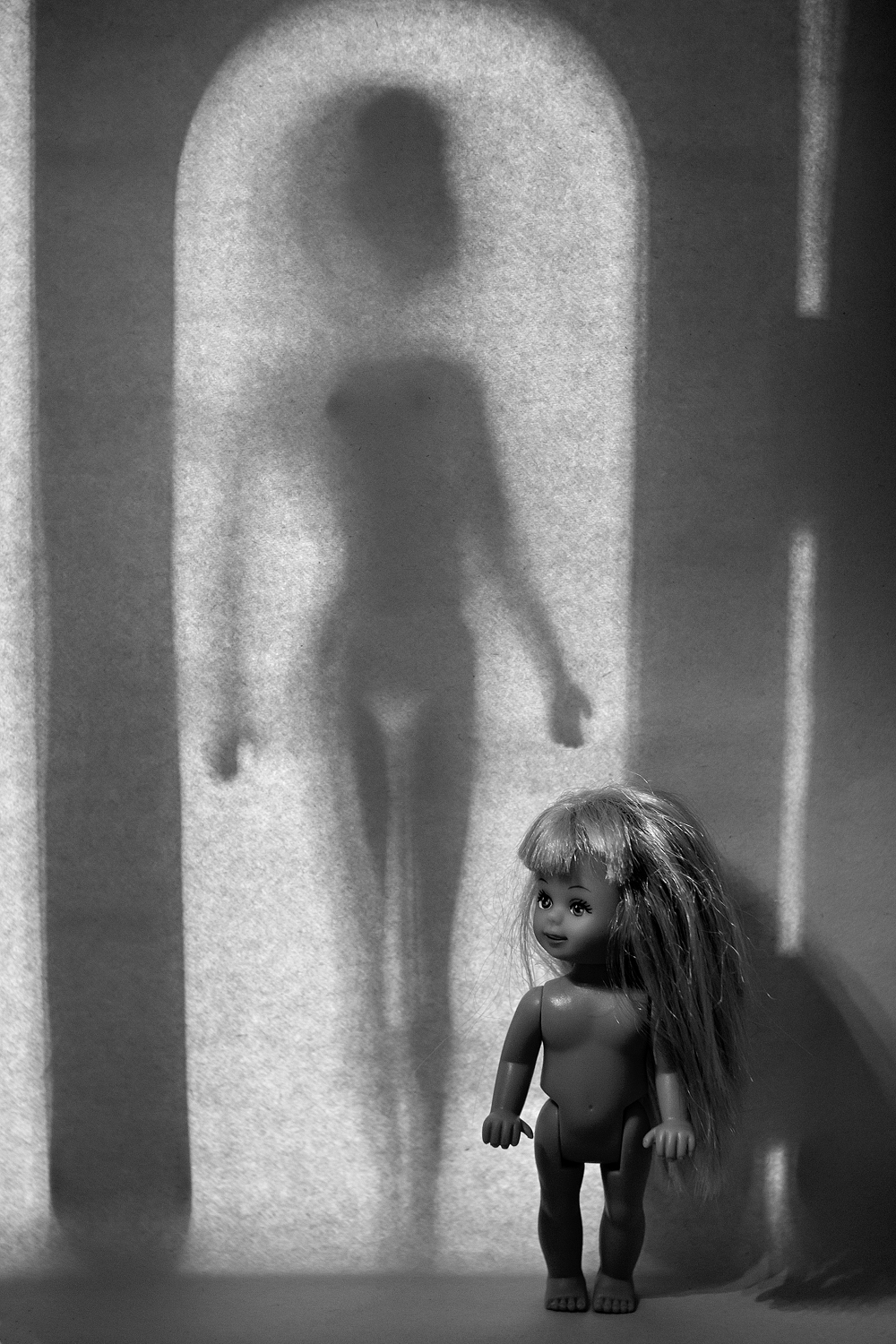
My favourite Barbie photo in the history of ever

Copyright Julie Lauren. via julielaurin.com

No, it's not one of Mariel Clayton's psychotic Barbie shots. Or even this old Body Shop ad. It's a photo just published by a Facebook friend, Ottawa photographer Julie Lauren.

Julie's pictures tend to explore the awkwardness of human bodies, held in contorted poses or expressions by other people, duct tape, or plastic sheeting. Her new series on dolls, however, is particularly interesting. Laurie has been gleaming thrift shops for old Barbies and related dolls and accessories, then creating interesting compositions with them.

Of all of them this one struck me as particularly meaningful. It says so much about the spectre of body image that looms over young girls as they consume magazines, fashion ads, and of course gendered Barbie play.

The setup of this shot was dead simple, all done in camera with backlight, paper and toys. For those interested, Julie explains the "making of" on her blog


But I'm more interested in the final effect: the pudgy little girl casually glancing over her shoulder, but not yet fully aware of the impossible perfection forming in her subconsciousness, with special emphasis on her sexual parts. 

I could go on and on, but this picture is worth more than a thousand words. Well-done, Julie.

Monday, January 7, 2013

Advertising is not art, and this art is not advertising

Via Ads of The World

The concept for this Brazilian lingerie ad is simple enough: Even famously-topless mermaids can't resist a Nonsanta bra. But the execution? The illustration is dark, desperate and utterly unpersuasive.

I am always baffled when art directors take the first part of the titles too seriously. The "art" of advertising is about clear and memorable visual communication, not forcing the viewer to work to develop their own interpretation of its deeper meaning.

Art is a wonderful thing. Advertising is not. But it has an important job to do.

What examples of ads overshadowed by their art have you seen recently?

Saturday, December 29, 2012

My Top Five Posts of 2012


It's been a weird year for me, but I keep coming back to this blog as a way to think out loud about my complicated relationship with the advertising industry (on which I depend to pay my half of the mortgage). Luckily for me, quite a few people have decided that these thoughts are worth reading. Thank you for that. Here were your five favourites.

#5: FHM presents "The 100 sexiest women in nonexistence"
June 18


This was a silly self-parody of FHM's "100 Sexiest Women in the World" list, but open to user nominations and votes featuring imaginary women of fiction, legend, pop culture and advertising. The contest site is no longer live, so I have no idea who won.


#4: Jesus has a quickie with Lady Liberty in Ukrainian shock ad
November 20


This was a joke ad, by someone named Alexander Bozhko for "Altai Fake Festival" — something akin to the Chip Shop Awards. But that didn't stop it from being taken as real, once it showed up on Ads of The World.

Thanks to my Ukrainian friend Eugene Smirnov helped me get to the bottom (heh heh) of this one. Also to Mark Duffy ("Copyranter") who posted my debunking on Buzzfeed, leading to big analytics.


#3 Classic Venus nudes altered for today's beauty standards
February 7


This was a look at how Italian social issues artist Anna Utopia Giordano put classic Venus nudes under the harsh knife of photoshop to make a point about changing beauty standards in media. The post got a lot of viral lift after being linked on Sociological Images.


#2 Topless Female Trampolining World Championships
September 6


What can I say? Certain keywords always lead to high readership.

In this case, the post was a teaser for a campaign by Britain’s CoppaFeel! and Male Cancer Awareness Campaign (MCAC) about male breast cancer. I followed it up on Osocio.


#1 Train etiquette campaign parodies are "super simple stuff"
June 26


My most-clicked post of 2012 was a bit of a surprise to me, as it had no naked ladies in it whatsoever. It's about how a public transit etiquette campaign by Queensland Rail became a popular parody meme. I guess I need more like that.


Well, that's all for me in 2012. This year, I have give this blog a little more focus on the issues that are of most professional interest to me, particularly ethics. (Which is why the name is changing.)

But what would you like to see more of? I'd love to hear from you in the comments below.

Friday, November 23, 2012

Sex dolls recycled into wearable art


Vice recently featured works by Dutch artist Sander Reijgers, who "has created a number of wearable items – including jackets, gloves and hats – by mixing old, cut-up bits of sex dolls with other bits of clothing from big sportswear brands like Nike and Reebok, so you stay stylish while creeping people out."


Here is what he says the art represents:
"... the woman is a product nowadays – they must be attractive and seductive. For example, in advertising, a carton of milk has to be sold with a horny-looking or half naked woman. The woman is subordinate and the man is dominant. I use those roles and imagery in my work."
Those aren't pockets...

He says his mother helps him sew the designs.

Thursday, November 8, 2012

My encounter with a religious extremist


Do not scroll to the bottom of this post if you are offended by sexualized religious imagery.

Via Fox News

A friend posted an image on his Google+ account. It is a provocative image, currently making the viral rounds, of an artwork that took a religious symbol and transformed it into a realistic portrayal of human genitalia.

Immediately, and predictably, there were complaints from  his circles. Here are some excerpts from one unhappy G+er in particular — a person from a country, language and culture very different from mine (as I was soon to find out):

"What is the intention of this? Bring attention?  Pretend to be artistry? Some symbols should be respected, believing or not...  Some world symbols should be treated with great care."
Some other people in the thread, myself included, talked about the need for free speech in art, and how a provocative work can inspire new thoughts and conversations about old ideas. Plus, the link between ancient fertility symbols and later religious imagery is an old and learned idea.

He kept going:
"Why do something that will offend a lot of people? When we put down and idea or principle we should put other in its place. Not all are evolved, not all like this kind of thing.
But believe or not, this symbol is the comfort of millions of people. In the serious and desperate moments of our life we can pray for [...] help. And it works with millions! So, this is a matter of ethics too. Respect others first. What kind of conclusion do you think that who made this want to provoke on the viewer? There are thousands of other ways to bring attention much better and safer [bolding mine] than this one."
He claimed not to be religious, but went on to explain why religion needed special protection from criticism:

"The need of God do not originate from supernatural sources but from our inner, our fragility in life. The human race have not been so much desperate as now. Drugs, pornography, lack of values, egotism. All this are a "testimony" of our superiority... Com on give a look at a newspaper and see TV news for just a few minutes and think." 
"There is no reason to put down religious symbols. No matter if we believe or not, they help millions!" 
"You are really offending millions that believe on this. Put this on your house wall but you have not the right of publish this. You are offending!  [...another insistence he is not religious...] You should remove this." 
"One wrong thing do not justify the other. We can not compare all the wrong things in the world because we would be here forever. ---- The fact is that this image offend a lot of people. ----- This is a public place and it exist for sharing. It gives no one the right to offend others. Every one have the right of keep his concepts PRIVATELY."
Most of the original thread had dropped out at this point, including the original poster. I gave another explanation of what I saw as the artist's message, and gave a link to similar portrayals throughout history, with the philosophical question of who gets to decide what is "sacred".

He started to get internet angry:

"What you consider sacred or not do not concern here as long as you keep it private. This is a public place! YOU want to impose an image on a public place. YOU are defending something that you knows is wrong. This is no place for it." 
I tried to end the conflict peacefully but firmly, concluding, "I don't know you, but I do know I that I'm glad you are not in charge of censoring art and speech where I live."

That's when he threatened me:

"Yes you do not know me. I am not a censor and yes, you are lucky I am not where you live. You are the aggressive person here not me. I am just defending a symbol so caring by millions. Defending from an idiont tentative of make ridiculous one of the best examples of a decent human being. If you have or not faith I do not give a shit. But this image DO HARMS."

I should point out, again, that all of my comments were simply academic and artistic rationales for why the artwork was useful to public discourse about religion and philosophy. The only reason I have not quoted myself in full is because my descriptions of the artwork would spoil the reveal. And you're dying to know what the image was, aren't you?

Be forewarned that this image can and will offend the pious. I chose not to share it openly on my professional and family social networks because it is polarizing, and without proper explanation it could make me seem as if I were either prejudiced against a certain religious group, or simply a great big pervert.

Still want to see it? Oh, come on... you know where this is going by now.


Okay, here:


The artist is unknown to me, as is the artist's statement. But it's a rather graphic take on the iconography of the mandorla ("almond" in Italian), a traditional way of portraying Mary (and sometimes Jesus) that uses a shape reminiscent of an open vulva as a female fertility symbol. The hood piercing as halo is a clever modern touch, but I would not be surprised if the artist is revealed to be a woman, and a deeply spiritual woman at that.


The extremist was a young, male Latin American commercial photographer from Rio de Janeiro. His latest post is a quote from Oscar Wilde, "Art is the most intense mode of individualism that the world has known."

Was I trolled? If so, I congratulate him. But if not, I think we have a good example here about how the passions of religious belief can easily be provoked into more violent feelings — regardless of country or culture.


Thursday, October 11, 2012

"Bush is back in fashion" - Crude pun, beautiful illustration


Marc posted this interesting Romanian campaign on Osocio today. It's for Mai Mult Verde ("More Green"), and environmental group holding a fashion show to raise funds for tree planting.

\

I'll have to assume that comparing female pubic hair to shrubbery works in Romanian, too. It's a rather crude and childish pun, but I still find the illustration by Annabella Orosz enchanting.


The work is by G2