Showing posts with label photoshop. Show all posts

Wednesday, June 25, 2014

Examining regional beauty standards through Photoshop


Buzzfeed's content has been going downhill lately, but this post is a refreshing exception. It tells the story of Esther Honig, a self-described "human interest reporter" based in Kansas City.

Ms. Honig sent her raw portrait (above) to 40 people in 25 different countries with one simple request: "make me beautiful."

Here a few results:


Germany (via Buzzfeed)


Morocco (Via Buzzfeed)


India (1 of 3, via Buzzfeed)


USA (1 of 2, via Buzzfeed)
It's interesting to note that while several PSers lightened her skin, few darkened it much. The participants were not all professionals. Hired through Fiverr, an international freelancing website, they were each paid a maximum of $30 for the work. Some of the results are quite weird. And there is no indication whether the "artist" was male or female.

What are we to take from this? Ms. Honig leaves it up to the viewer, simply stating that "each one is a reflection of both the personal and cultural concepts of beauty that pertain to their creator." But cycling through all the images at her site is both fascinating and disturbing.


Monday, March 10, 2014

Target's pathetic Photoshop disaster


What were they thinking? This swimsuit from Target is featured on their site with some of the worst Photoshop "slimming" you will see today:


That's right! Really, really poor job at cutting into the waist and arm, as well as a hamfisted attempt at cropping out an artificial thigh gap on the model. 

If it weren't part of an ongoing attempt to mould unrealistic bodies in fashion marketing, it would almost be funny.


H/T Photoshop Disasters (@adamzea claims credit for tipping them off.)

More awkward Target PSed thigh gaps here, here and here.

Update: After this was shared on Jezebel and Buzzfeed, target pulled this picture and apologized. (You're welcome!)

Tuesday, January 21, 2014

Is this really "redefining beauty"?

There's a quite a bit of backlash against excessive Photoshopping of models over the past few years. From snarky comments by subjects who don't recognize themselves post-PS and anti-Photoshop marketing campaigns to outright bans on excessive photo alteration, retouching has never been more in the public eye. In some cases, the backlash can even be accused of going too far.

Some magazines, like Seventeen have responded to public pressure by promising to stop airbrushing models to death. And of course some fashion brands are jumping onboard.

Which brings us to this:


The "all natural" approach by aerie, the lingerie brand associated with American Eagle, is understandably getting noticed. AdFreak's Roo Ciambriello calls them "Simple, Revolutionary Lingerie Ads." But as Adrants' ever-subtle Steve Hall points out, "Of course we're never going to see girls in these campaigns that aren't already naturally hot."


While it's laudable that the models don't have artificial thigh gaps or plasticized skin, they are not exactly ordinary people. Not that we should entirely expect them to be, I suppose. Models are hired based on their looks. But attempting to take the higher ground by saying the brand represents "the real you" can expose it to greater scrutiny as well.

Remember when a Dove "Real Beauty" casting call was leaked? It specified "BEAUTIFUL ARMS AND LEGS AND FACE WILL BE SHOWN! MUST HAVE FLAWLESS SKIN, NO TATTOOS OR SCARS! Well groomed and clean...Nice Bodies..NATURALLY, FIT Not too Curvy Not too Athletic." (Caps theirs.)

Underwear models, like swimsuit models, tend to have pretty "flawless" appearance to begin with. I get it. Fashion is aspirational, and people want to believe that the clothes will make them seem sexy, or beautiful, or powerful, or cool, or whatever the brand promises. It always has, even long before Photoshop existed.

However, the question for me is whether a lingerie brand that features beautiful young women lounging around provocatively in underwear should be celebrated for not gilding the lily (so to speak) by altering them to remove their few "flaws."

Maybe just a little bit, but not too much. It's still feeding into female stereotypes of what acceptably sexy bodies look like, and how their sexuality is presented to the world.

Tuesday, March 26, 2013

This vintage ad illustration makes photoshopped ads look realistic by comparison


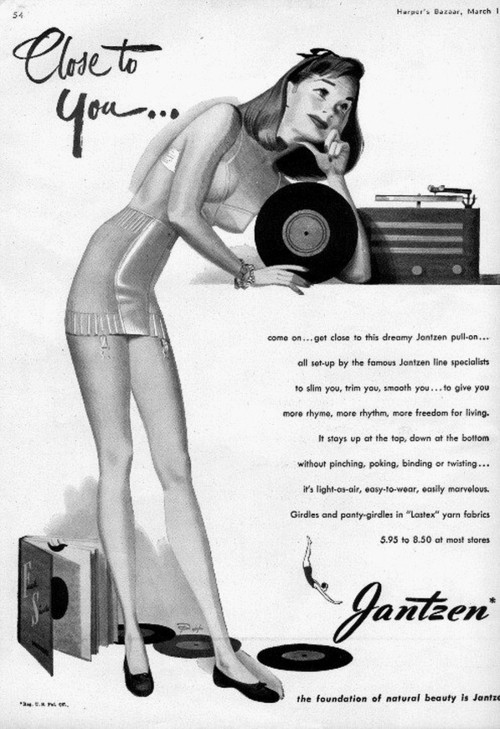
Retrogasm recently posted this old Jantzen girdle ad from the 1940s. 

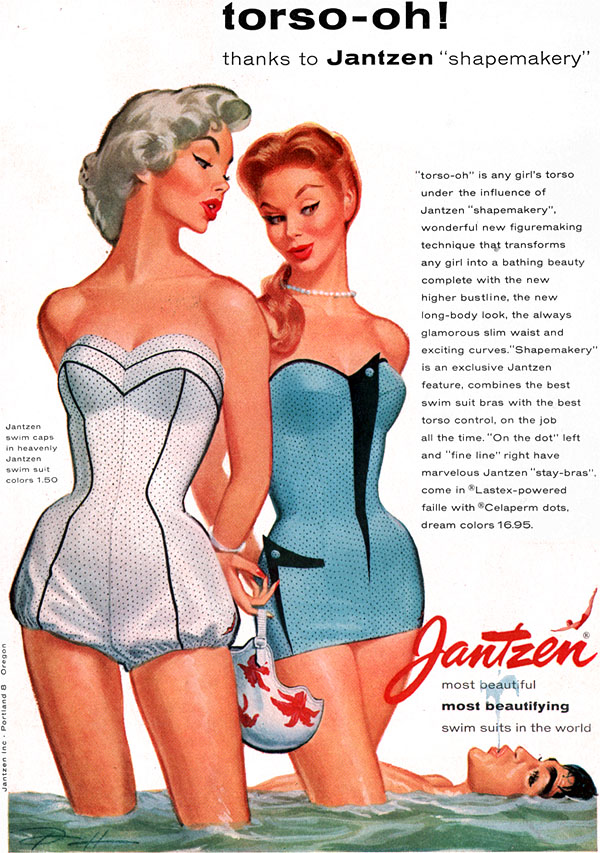
Here are a couple more, via allgraphically.com (the second is fromt he '50s):


Portraying unrealistic body types in ads and fashion is nothing new. The difference between fashion illustration and manipulated photos, however, is that it is easy to mistake the latter for reality. 

The impossibly long and slender ladies in the ads above can more easily be dismissed as cartoons.

Ralph Lauren ad, via Photoshop Disasters

Via ynaija.com

Miu Miu ad via The Frisky

And that's the problem with digital image manipulation: It lets impressionable young minds believe they're looking at reality, rather than fantasy.

Jantzen was originally a swimsuit company. It's interesting to note that its ads for swimwear around the same time celebrated the way it exaggerated "curves":


via allgraphically.com

Here, the hourglass shape (itself a challenging, if more biologically useful beauty ideal) is the thing. And once again, it is exaggerated.

And it still is...


Via Joe Crazy


Friday, March 1, 2013

Jennifer Lawrence on her Photoshopped self: "people don’t look like that"


Oscar winner Jennifer Lawrence may be selling out for fashion, but at least she's honest:

"Oh my god, I haven’t seen this. That doesn’t look like me at all. I love Photoshop more than anything in the world. Of course it’s Photoshop, people don’t look like that." 

Images via Huffpo

Jennifer Lawrence is the new face of Dior handbags. And now the star of this popular fake Dior ad:


About the fall, Ms. Lawrence told reporters, "What went through my mind when I fell down? A bad word that I can't say that starts with 'F'"

So, she's celebrated for being great at what she does, and yet she's self-effacingly funny. That's pretty cool.

Thursday, February 14, 2013

Bad Valentine's Marketing #1: I scream @DairyQueen


I can't decide what the worst part of this DQ Twitter pic is — the pun, the classroom note concept, or the shitty photoshop...

Wednesday, July 4, 2012

The Photoshop Workout, with Jennifer Lawrence

UPDATE: Fake


Suck in that gut! Suck in that butt! Suck in those... arms? Talk about a hunger game!

BuzzFeed contributor blckgifs shared this disturbingly hypnotic gif created by comparing a shot of the 20-year-old actress as she appeared in GQ and an anonymous "source" photo.

Tuesday, January 10, 2012

"Fotoshop by Adobé" merges the world of cosmetics and retouching


Jesse Rosten says, "I was watching TV one sleepless night and stumbled upon an infomercial for some beauty product. The commercial showed before and after portraits, that to my eye, looked like the same photo just photoshopped. I laughed to myself. Then I made this video."


Fotoshop by Adobé from Jesse Rosten on Vimeo.


And there it is. A little long, maybe, but pretty bang on.

Via Viral Videos

Thursday, September 22, 2011

A Photoshop disaster in the House of Commons

This is a little off blog topic, but my last post regarded sex and politics, and this is too ridiculous not to share.

This is the official profile page for one of Canada's new MPs, Rathika Sitsabaiesan. The honourable member was elected in the riding of Scarborough—Rouge River on May 2, standing for the New Democratic Party.


Do you notice anything strange about her picture?

Let's blow it up a bit:


Contrarian reader Mark Austin thought it looked a little odd, and was able to find the original at OpenParliament (it has since also been replaced):


As a 29-year-old Millennial woman, The Honourable Ms. Sitsabaiesan probably felt the top she wore to her portrait sitting was just fine. It is fine, as a matter of fact, and no different than what any other woman would wear in a modern business situation.

But somebody thought otherwise. Whether she herself had second thoughts, or whether someone behind the scenes at the House of Commons had a moment of extreme prudishness, the completely awful photoshop cleavage-ectomy has now made the pages of Jezebel.


And that's far more embarrassing than seeing the modest bits of your Member of Parliament's breasts.

Nonetheless, I post this to mock prudishness and bad Photoshop—not the rookie MP, who has taken on a thankless job in public service that I would never want. I wish her and her colleagues the best of luck in the new session.

Monday, August 29, 2011

Lazy Photoshop at La-Z-Boy

While browsing furniture on the weekend, I happened upon this in-store ad at La-Z-Boy in Ottawa:


From enjoying countless Photoshop Disasters, I could tell immediately that something wasn't right. So I looked closer:

De agony of de-feet.
Feet crudely chopped off. Bum flattened. And a chair that is apparently stuffed with concrete.

Why do major brands continue to find such shoddy work acceptable?

Wednesday, July 27, 2011

Lancome ad banned in Britain for heavy-handed Julia Roberts Photoshop

AdWomen reports that the UK's Advertising Standards Authority (ASA)  has ordered pulled a make-up ad starring Julia Roberts because "these campaigns don’t show the real results that L’Oreal’s products can achieve."

When did Britney Spears get such a wide mouth?
As I've stated before, despite my objection to many harmful images in advertising, with the exception of really egregious "thinning", photo retouching is not a big issue for me. It's just digital illustration, and should be treated as such. If we can teach that to our impressionable youth, we won't have to worry about them doing tragic post-production work on their own bodies.

I far prefer the Photoshop Disasters approach of exposing and mocking overdone manipulation. In this case, "Pretty Woman" Roberts is not even recognizable as herself.

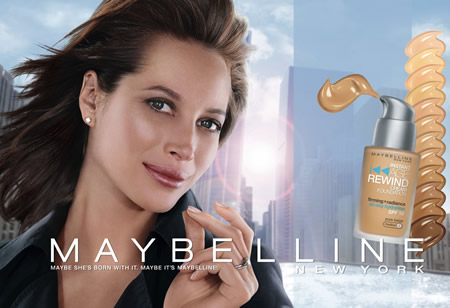
A Maybelline ad with Christy Turlington was banned for similar reasons.

Maybe she's born with it... maybe it's Photoshop CS5 Extended

Monday, January 3, 2011

More filters than a T-Pain album

That's the caption on this "Photoshop Rap Tutorial" created by College Humor, and featured today on BoingBoing:


"CMY Killer" ("Killa"?) ... awesome.

Wednesday, September 29, 2010

Joannie's too curvy for London Fog

I really loves me some photoshop fail, but the one posted today by Sociological Images really takes the cake... or rather "cheesecake":


That's Christina Hendricks of Mad Men, but you can be forgiven for not recognizing her, because — both in reality and on TV — she looks like this:


That's right! Not even the "Sexiest Woman Alive" (according to Esquire) has a good enough body, according to some Art Director and/or client who is missing out on the renaissance of curviness. (Of which Ms. Hendricks is a reluctant champion.)

With all the PR problems advertisers are having lately with photo manipulation of women's bodies, it's ironic that they were so obsessed with "improving" on nature that they ended up taking away the very attributes that made their expensive spokesmodel — in many people's opinion, the Marilyn of the Now — so very talked about.

And yes, Christina Hendricks is first and foremost a great actor. But curves still rock.

Friday, February 26, 2010

Should fashion models come with warning labels?


(Image taken from a PhotoShop contest on freakingnews.com)

First it was the American Academy of Pediatrics calling for a redesign of the hot dog . Now Britain's Royal College of Psychiatrists is demanding truth in advertising. Is nothing sacred?
“There is a growing body of research that shows the media plays a part in the development of eating disorder symptoms – particularly in adolescents and young people," says Consultant psychiatrist Dr Adrienne Key, of the RCPsych Eating Disorders Section. "Eating disorders, such as anorexia nervosa and bulimia nervosa, are serious mental illnesses. Although biological and genetic factors play an important role in the development of these disorders, psychological and social factors are also significant. That’s why we are calling on the media to take greater responsibility for the messages it sends out.”

What they suggest is a forum "to collaboratively develop an ethical editorial code that realistically addresses the damaging portrayal of eating disorders, raises awareness of unrealistic visual imagery created through airbrushing and digital enhancement, and also addresses [sic] the skewed and erroneous content of magazines.”

This is part of an ongoing battle with the fashion industry in particular, who can easily be accused of glamourizing unnatural or even unhealthy thinness. Back in October I blogged about a Ralph Lauren ad that was making the rounds, showing a model with an impossibly small waist. So embarrassing was the backlash against the House of Lauren that their lawyers tried to remove the image entirely from the internet, even sending a legal notice to bloggers (bigger ones than me, obviously) who posted it. (Oh yeah, and they fired the model for being too fat as well.)


One of those blog sites, Boing Boing, not only disregarded the notice (fair use, after all) — they used their reach to dig up the dirt on the ad. People thought at first thought it might be a prank, but Ralph Lauren finally came clean:
"For over 42 years we have built a brand based on quality and integrity. After further investigation, we have learned that we are responsible for the poor imaging and retouching that resulted in a very distorted image of a woman's body. We have addressed the problem and going forward will take every precaution to ensure that the caliber of our artwork represents our brand appropriately."

There are signs of contrition all over the industry, as popular demand for healthier models has led to beanpole beauty bans at fashion shows in places like Madrid, Milan and Montreal. The Times of London even declared the beginning of a "body revolution" in fashion.

I don't buy it. Fashion advertising will always be aspirational. The curves of the ideal body shape may ebb and flow over time, but it will always be just that: an ideal.

We like to think things are getting worse over time, but I think the difference is a technological, rather than a sociological one.


In the mid 20th century, advertising often used illustration to show the ideal — whether it was food, cars or fashion. That's because photography and printing technology of the time couldn't always capture the aspiration that the advertisers were trying to sell. But first airbrushing, then PhotoShop, gradually allowed art directors to get a photographic image "just so".

The thing is, so much work goes into retouching an ad photo of anything that it should no longer be considered a photograph. It is really a digital illustration. Those of us in the industry know this, but consumers apparently don't.

The Girl Scouts surveyed more than a thousand American girls ages 13 to 17, and found:
"A substantial majority of those surveyed say they would prefer that the fashion industry project more 'real' images. Eighty-one percent of teen girls say they would prefer to see natural photos of models rather than digitally altered and enhanced images. Seventy-five percent say they would be more likely to buy clothes they see on real-size models than on women who are super skinny."

So what can we do?

The BBC says:
"According to some in the advertising world, that would mean putting a kite mark [disclaimer] on every poster. Better perhaps for a kite mark to be applied to those ads that have not been digitally enhanced or airbrushed. After all, isn't advertising all about selling dreams? Is it not part of the human condition to aspire? It's no coincidence that several notable movie directors have come from working in advertising. Both jobs involve fictions and expertise in story-telling."

And I agree. Advertising is fantasy. You wouldn't want to see a model's blemishes and love handles any more than you would want to see what a real Big Mac looks like on TV. If you don't believe me, think of the last time you untagged an unflattering photo of yourself in Facebook. Reality never looks quite right once it's captured by any medium. My profile picture on Acart's corporate site is on a digital diet. Even the Dove "Real Beauty" campaign was heavily touched up. But just as fictional movies, TV shows and video games are taken more seriously by the young and impressionable, so is the imaginary world of advertising images.

As far as I'm concerned, it's a matter for education — at home and at school — to "foolproof" kids against the trickery of ALL media. Even the pranksters who made the model below look skeletal to prove that runway models are too waif-er thin:


Here's my warning label: Kids, don't believe everything you see in the media.

Thursday, October 8, 2009

The fashion ad that makes people want to Ralph

Ralph Lauren is in Dutch with the Internet, thanks to this bizarrely-proportioned model who appeared in an ad:


No, she doesn't look like that in real life. It's a Shoop.

According to Yahoo's Shine blog, the image was first posted on Photoshop Disasters, then picked up by Boing Boing.

And here's where it gets really stupid:

"Ralph Lauren responded by filing a Digital Millennium Copyright Act (DMCA) complaint against Boing Boing and Photoshop Disasters, claiming that their use of the image was a copyright infringement that fell outside of the Fair Use laws which allow the media to reproduce creative content for the purposes of commentary and criticism."


PS Disasters caved (they say Blogspot actually pulled it out from under them), but Boing Boing did not:

"...to Ralph Lauren, GreenbergTraurig, and PRL Holdings, Inc: sue and be damned. Copyright law doesn't give you the right to threaten your critics for pointing out the problems with your offerings. You should know better. And every time you threaten to sue us over stuff like this, we will:

a) Reproduce the original criticism, making damned sure that all our readers get a good, long look at it, and;

b) Publish your spurious legal threat along with copious mockery, so that it becomes highly ranked in search engines where other people you threaten can find it and take heart; and

c) Offer nourishing soup and sandwiches to your models."


God love Boing Boing. But to be honest, I'm much more bothered by the attempted stifling of criticism than I am by the pic itself.

I realize that unrealistic body images are a real issue with girls, and I'm not trying to negate any of the complaints against the practice. I just feel, as a righteous adman, that we would be better off educating young people in school not to believe their eyes when they see photographs in ads.

Unrealistic body imagery in fashion has always been there:


The real challenge is that, while nobody thought those illustrations were real, altered photos of models and actresses are deceptively realistic.

I really wish they taught media awareness in public school. I'd love to write in their textbook: "Assume that nothing you see in ads is real. The ice cream is mashed potatoes, the hamburger is foam rubber, and the model wouldn't look like that if she starved herself dead."

Hell, they're even smoking herbal cigarettes in Mad Men...

Tuesday, August 25, 2009

Microsoft: Hopeless

I guess it's "awkward ethnic outreach" week on Change Marketing...

Yesterday, I mentioned how McDonald's is going to great lengths to ingratiate itself to the African American market.

Well, Microsoft has taken a different approach:


Can you spot the difference? (Click for full size.)

The left one is for Microsoft's English-language "business productivity infrastructure" site. The left one is the Polish version.

In a bizarro-world version of "Black guy photoshopped in", MS has decided that Poland is okay with Asian people, but not black people.

It's now making the rounds of the social media.

And while some people may forget Poland once in a while, it's doubtful that this will go unnoticed.
(thanks to Patrick for the tip/links)

Followup: You can watch the fallout here.