Showing posts with label law. Show all posts

Monday, September 14, 2015

The right way to mock #KimDavis' ignorant bigotry

I know, I know. She's an easy target. She's been married four times, with at least one marriage ending because of her infidelity. She has old-fashioned hair. And her husband dresses like the Scarecrow from Wizard of Oz. (OK, I've been guilty of that one too!)

But if you really want to tell Kim Davis off for the hypocrisy of her so-called Biblical literalism, you need to knock off the personal attacks and take that literalism at face value.

That's how Planting Peace did it:


Twitter

I'm not sure they got the parallel right, though. If they are referring to Exodus 21:7 (“When a man sells his daughter as a slave, she shall not go out as the male slaves do") it's more about slavery or indentured servitude than what we would call marriage. However, a DailyKos writer describes the same verse as "selling your daughter as a slave to be given to her owner or owner's son for sexual exploitation as a 'wife,' so I could be wrong.

There are lots of horrible definitions of marriage in the Bible, but perhaps this one was chosen for the pure absurdity of it in the modern west. But as far as I know, there is no real consistency of how marriage is defined in the Bible. Parts were written when polygamy was still standard, and others exhort married couples to ensure "the marriage bed kept pure, for God will judge the adulterer and all the sexually immoral."

Of course, all of this is moot because Kim Davis doesn't have a legal leg to stand on. But it's such a shame that people like her have become the face of American Christianity in the 21st century. I'm not a believer, but I still believe that Jesus the philosopher was all about love and acceptance.


Wednesday, April 15, 2015

McDonald's Italy disses pizza, causes gastronomic outrage


Insulting pizza is a big deal in Italy. Especially if you're an American fast food goliath.

Business Insider reports that the the Associazione Verace Pizza Napoletana (AVPN), representing the pizza chefs of Naples, the food's birthplace, are threatening to sue McDonald's for pizza defamation.

And it's all because of this ad:


You don't need to speak Italian to follow the story: Parents of a picky child are at a pizzeria, anxiously awaiting their child's choice from the menu. The waiter asks the boy what he wants, and he says "a Happy Meal." So the family leaves and takes him to McDonald's where he is happy.

The AVPN's VP is quoted in this imperfectly-translated statement:
Di porzio states that it is ignoble comparing two products very different from each other, especially if it is for discrediting those restaurants most loved by Italian families: pizzerias. Also, it is already well known that children love pizzas, especially for the taste. It is obvious that the American colossus is trying to discredit its main competitor, but speculating on children’s health is just too much. Furthermore, it is not the first time that Mc Donald attacks our culinary traditions, but this time we are willing to take some legal countermeasures.
North Americans may find it odd for pizzerias to attack burgers on nutritional standards, but only if they haven't had authentic Italian pizza. Unlike our doughy, salty and cheesy delivery versions, Italian pizze are all about fresh ingredients and restraint. Even though the dough is made from highly-refined flour, the Italian tradition of much stricter portion control makes the pizza less of a calorie bomb:
A standard margherita (with 250g of dough) has around 800Kcal, but children do not usually eat a whole pizza. So, if we reduce the size of a standard pizza and then we add a drink (without gas), we will reach 700Kcal per meal. A Happy meal has 600Kcal, which for a children are just too much. However, it is not about “how many Kcals there are per meal”, but it is a matter of “what kind of quality” they are! What kind of meat do they use to prepare their hamburgers and how many fats they have? What kind of oil do they use to prepare their potatos: colza oil? How much mayonnaise do they put on their hamburgers? And how about the preservatives contained in their bread? The true napolitan pizza, which is a product guaranteed by our international regulations, it is a “handcrafted” product which only uses selected raw materials, like mozzarella di bufala, fiordilatte, tomatos from Campania and extra virgin oil. In this way, pizzas results in a complete and balanced meal from a nutritional point of view. It is time for parents to control what their children eat: junk food might be ok if consumed now and then, but they should teach their children to eat clean everyday. They must. And eating clean means to follow the culinary culture offered by our wonderful Mediterranean Diet: it will supply parents with the right tools to choose among a great number of meals which are not only tasty and healthy but, above all, Italians.
If you're sensing a certain cultural pride here, you're not mistaken. McDonald's has only been in Italy since 1986, and its arrival in Rome's historic core was greeted with outrage. Designer Valentino even threatened legal action against his new neighbours over the smell:
According to Valentino, who this week began legal action aimed at closing the restaurant, which backs on to his Rome headquarters, the McDonald's created a ''significant and constant noise and an unbearable smell of fried food fouling the air.'' He has asked Italian magistrates to order it closed immediately on the ground that it is a nuisance.
McDonald's stayed, and expanded. Now, it can be found among the historic attractions of Venice, Florence, Milan, and —yes—Naples.

I live in Italy for several months-long stints in the 90s, and McDonald's by then had become a shibboleth for whether one was "cultured" or not. Since food is a massive part of Italy's many regional identities, the arrival of American fast food was bound to cause a reaction. In fact, that Roman McDonald's was the barbarian at the gates of Italian culture that caused Carlo Petrini to found the now-international Slow Food Movement.

There is a certain amount of pretentious Anti-Americanism in the AVPN complaint, but I can see why they are so upset. Defaming pizza in Italy (especially in Naples) is a really obtuse move by McDonald's marketers. Especially since the corporation has been trying so hard to adapt to the demand for more local foods elsewhere in Europe.

Thursday, June 26, 2014

By participating in "hot criminal" memes, are we ruining these people's lives forever?

Facebook


 Jeremy Meeks, a 30-year-old California man who is the accidental subject of the ridiculous #FelonCrushFriday meme, is just the latest victim of the internet's casual dehumanization of people whose images go viral.

Arrested for felony weapon charges by the Stockton Police Department on June 18, he ended up having his mugshot featured on the police Facebook Page. Things rapidly spun out of control, with his face being photoshopped all over the place. While there have been mentions of modelling contracts later on, in reality he will probably be forgotten about in a couple of weeks.

NY Post

Speaking of which, does the name Meagan McCullough (now Simmons) ring a bell? Two years ago, she was given the same treatment when her mugshot, for drunk driving in Florida, also went viral. A legal line was crossed, however, when her image was used (without permission) for advertising. She ended up suing checkmate.com, an online background check service, for using her face on a banner ad.

Why do we feel the need to participate in these free-for-alls at someone's expense? Is it any better if you're paying them a compliment, rather than denigrating them?

Well, here's the thing. While internet users have the short-term memory of drunken goldfish, the internet itself never forgets. Popular images get indexed and brought up in search after search. Both Mr. Meeks and Ms. Simmons will appear whenever someone is doing searches about "convicts," "mugshots," or "criminals" — especially if keywords about looks are added. No matter what they may try to do to clear up their lives, these mistakes have the kind of permanence that you're unlikely to experience outside of a small town.

Just today, this showed up on my Facebook feed, from an unscrupulous advertiser:


It won't be the last time.


Monday, January 27, 2014

Teen who posted "Blacks for Sale" ad is "not racist"


An ad posted on a popular Brazilian online marketplace, offering "Black for diverse uses" for 1 Real (41¢ USD), has been traced to an angry 15-year-old.

The ad suggested that the human beings for purchase could "serve as carpenters, masons, cooks, security guards, nightclub bouncers, janitors, garbage collectors or housekeepers."

According to NDTV, the ad, which was pulled from Mercado Livre after massive online protest, was tracked by police to a teen living in "a northern Rio slum."
Rio police said it had been posted by a 15-year-old who was frustrated because he felt he had been shut out of a computer course by a quota system set up to encourage black students.  
Local daily O Dia quoted Police Inspector Gilson Perdigao as saying the boy had been held for questioning for two hours but would not be charged as he had no previous history of racist aggression. 
The youth's mother, a 43-year-old teacher, told the paper: "He regrets what he did. My son is not racist and asks black people for forgiveness. 
"This was a thoughtless act because he failed the first phase of the exam," she added.
First of all: yes, you're racist. Second, what is a teacher doing living in a "slum"?

In Brazil, this is more than a case of insensitivity. It's criminal.

Veja (Portuguese, translated by Google) cites The National Ombudsman of Racial Equality,
Carlos Alberto Silva Júnior, who explains that Article 20 of Law No. 7.716/1989,  provides for imprisonment from two to five years and fines for people convicted of practicing, inducing or inciting discrimination or prejudice based on race, color, ethnicity, religion or national origin.

Apparently, those who share the offensive material in blogs or social networks with intent to denigrate or discriminate can answer the same crimes. (Yikes!)

NDTV adds that in 2012, Brazil enacted a law that reserves 50% of university placements to students from public schools, with priority given to black, mixed race and indigenous people.

This case is an important reminder of how racism often manifests itself as the anger and frustration of one socioeconomically disadvantaged population against another, who they believe are receiving unfair privilege.


Tuesday, October 15, 2013

Islamophobic? Not in those heels!

Via Belgian Elle
BBC reports that shoe designer Christian Louboutin has won a court case to prevent Flemish far-right party Vlaams Belang from using his shoes in one of their anti-islam campaigns.

The legs, belonging to Vlaams Belang Senator Anke Van dermeersch, are marked at intervals of exposure from "Sharia-compliant" at floor level, to "moderate Islam," "provocation" "slut," "whore," "rape," and finally "stoning." The headline reads "Freedom, or Islam?" (All translated via Google.)

A judge at the Antwerp court gave the party 24 hours in which to take down the posters. They replaced it with this one, which replaces Louboutin's iconic red soles with Flemish yellow:

Via The Telegraph
(I'm not sure if that's Ms. Van dermeersch posing again. It seems an odd thing for a politician to do, but she is also a former professional model and Miss Belgium 1991.)

While it isn't surprising that a luxury fashion brand would not want to be associated with this kind of exclusionary political message, it's interesting to note that Louboutin has just launched a line of "nude" shoes in a variety of skin tones.

UPDATE: My Osocio colleague Tatjana (via her friend Srećko Šekeljić) informs me that this ad concept was actually ripped off from an artwork by young Canadian artist Rosea Lake:

Via Huffington Post

When she posted the piece on Tumblr in January, Ms. Lake wrote:
"Judgments"
I took this last year, but in retrospect, I think it’s my strongest piece from high school.
Working on this project really made me examine my own opinions, preconceptions and prejudices about “slutty” women and women who choose to cover all of their skin alike. I used to assume that all women who wore Hijabs were being oppressed, slut-shame, and look down on and judge any woman who didn’t express her sexuality in a way that I found appropriate. 
I’d like to think I’m more open now.
Oh, the irony.

There is now, of course, a Facebook page dedicated to this.


Thursday, September 12, 2013

Ontario healthcare recruitment ad hints at a Quebec "values" brain drain to come


This ad was Tweeted by @sarahleavitt and others. I can't seem to find it on any of Lakeridge Health's web or social channels, so I don't know whether it predates yesterday's news from Quebec, or if it's a coincidence, or even if it is a real client ad.

What the ad is, however, is a wake-up call to Quebec's provincial government, who yesterday introduced a "Charter of Values" that would prohibit the wearing of "overt religious symbols" in public workplaces, or even when doing business with the public sector. Bizarrely, while hijabs, turbans, kipas and comically-large crosses are explicitly banned by the decree of enforced secularism, existing Christian symbols in prominent places like Quebec's legislature and the provincial flag get to stay because of "historical patrimony".

Montreal Gazette

In Quebec, as in all of Canada, public education, including universities and colleges, and hospitals are provincial responsibilities. The Charter apparently will include a five-year exemption clause for municipalities, hospitals and postsecondary institutions that wish to allow their employees to continue wearing religious symbols on the job. But the xenophobic nature of the Charter is clear to targeted groups.

"We're not asking for time to conform. We're very resolute in the fact that the charter is just wrong," Glenn Nashen, Director of Public Affairs at Montreal's Jewish General Hospital, told the Montreal Gazette. (And speaking of "historical patrimony," Jewish Montrealers have been part of Quebec culture since the mid-1700s.)

Which brings us back to the ad, above. Having done professional recruitment for hospitals myself, I know that there is an HR crisis. The competition for nurses, doctors, technologists and others is fierce, with employers often aggressively recruiting in other cities, provinces, and even countries. In an increasingly multicultural Canada, many of the healthcare professionals we come in contact with are new Canadians whose cultures include these types of religious attire — for example, Islam is Canada's fastest-growing religion.

Quebec already has long had problems keeping its healthcare workforce, because of lower compensation and language law issues. Will the new "values" take the brain drain to the next level?

Dr. Sanjeet Singh Saluja, who wears a turban as part of his faith, said Wednesday that the PQ’s controversial “Charter of Quebec Values” would drive people from the Sikh, Jewish and Muslim communities away. 
“The sad thing is I don’t know if I’d be able to stay here in Quebec,” said Saluja, an emergency-room doctor with the McGill University Health Centre. 
“Even though I love my practice here in Quebec, my faith is something that’s important to me and I don’t feel comfortable giving up that part of my persona and I don’t think a lot of people would be willing to, either.”
While it might seem opportunistic for "Rest Of Canada" hospitals to use the Charter's presumed racism as an edge in poaching candidates, can we blame them?

While analysts say that the Charter is unlikely to pass, the message to people who publicly practice non-Christian religions is clear: Give it up, or move on.

UPDATE: It's real!


Thursday, February 7, 2013

Is this unauthorized use of celebs to sell burgers a "hot mess"?


I've written before about how brands are using the viral lift of Buzzfeed to generate interest in new offers. But this may have crossed a line.

Jack In The Box has sponsored a Buzzfeed list, titled "14 Of The Most Notorious Celebrity Hot Messes," to promote its Hot Mess Burger.

"Hot Mess" itself is an evolving term, but is often applied to celebrities who are sloppily out-of-control and/or/were "hot". The Jack In The Box list includes Lindsay Lohan, Mel Gibson, Tara Reid, Katt Williams, Amanda Bynes, Courtney Love, Paz De La Huerta, Charlie Sheen, Kathy Lee and Hoda, Gary Busey, Victoria Jackson, Dustin Diamond, D'Angelo and Demi Moore, all with a description of well-known embarrassing behaviours and accompanied by unflattering pictures and animated gifs. At the end of the list is the sell:


Now, here's the tricky part. Scandal mags, celebrity blogs, and humour sites pretty much get a pass on exploiting celebrity trainwrecks to gain eyeballs. But this particular list looks like an ad. It's branded, and it is selling a product.

It's a well-known tactic to use world leaders or dead celebrities for attention. And PETA will make fun of live ones who screw up. But many of these cases are not-for-profits expressing their rights to political speech.

I'm no lawyer, but it seems to me that using a celebrity's image and name without permission in a clearly commercial context (as opposed to the "fair use" in traditional media, blogs or activism) might violate those celebrities' Personality Rights.


In other words, showing a picture like this and naming names might be okay for Perez Hilton, but a corporation using it to sell hamburgers might be a bit of a... umm... hot mess?

The post has been up since February 1.

Friday, October 26, 2012

The Beatles' Apple is now Apple's Apple

Remember Apple? No, not that Apple. This one:

Via
When I was a kid, in the '70s and early '80s, finding an original Beatles album with the green apple label at a used record store was like finding gold. The iconic brand was founded by The Fab Four themselves as part of Apple Corps Ltd., and was intended not only to publish Beatles albums and singles, but also to sign unknown and deserving talent in music, fashion, even technology.

via

The original "Apple Store" in London, known as the Apple Boutique was a bust, losing so much money that The Beatles closed shop and gave away all the merchandise. The label did much better, signing notable performers such as Mary Hopkin, James Taylor, Badfinger, and Billy Preston (as well, obviously, as being home the most famous band in the world at the time).

Blank apple label signed by James Taylor.
Am I the only one who saw naughty things in it?

The original Apple brand was still going strong with Beatles reissues in 1978, when an upstart computer company, Apple Computer (now Apple Inc.) started using the fruit for its own branding purposes. Apple Corps. sued for trademark infringement, and was awarded $80,000 in 1981. Part of this judgement was Apple Computer's agreement not to distribute music.


When Apple Computers started to offer Midi music functionality in the late '80s, Apple Corps. sued them again and won $26.5 million in 1991. But when the iTunes Music Store and the iPod appeared in 2003, Apple Corps sued again... and somehow lost their case.

Finally, in 2007, the two companies announced a confidential agreement in which ownership of all of the trademarks related to "Apple" (including all  Apple Corps logos) went to Apple Inc. (as Apple Computers was now known) the Corps licensing its trademarks back for continued use. Rumours said that $500 million had changed hands.

From then on, the two brands got along. The Beatles finally came to iTunes, while their 2010 remastered CDs and records from the late '60s featured the familiar green apple.

Yesterday, Cult of Mac announced that "the Canadian IP Office has just disclosed that the Beatles’ iconic recording label is now Apple, Inc. registered trademark."

According to original source, Patently Apple:
The Canadian database records show that there was unsuccessful opposition to Apple owing the logo by a company named Apple Box Productions Sub Inc.. The Canadian IP Office database shows that Apple Inc. has since been granted the registered trademark. As we reported, Apple originally filed for the famed Apple Corps logo trademark in Europe in March 2011.
And so, a '60s brand that was known for losing money and giving stuff away is now owned by a 21st century brand known for being overpriced and proprietary.


Thanks to Boing Boing for the tip.

This post was written on a MacBook Pro, while listening to Abbey Road on an iPhone 4.


Friday, October 19, 2012

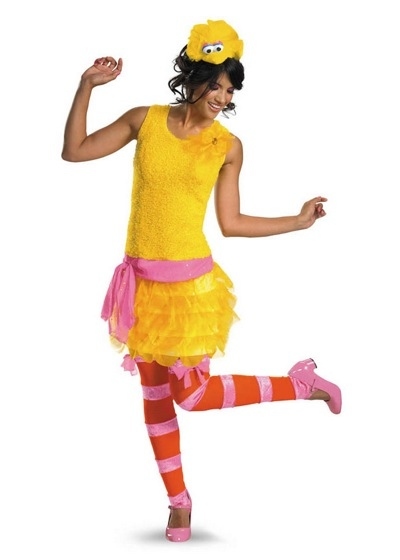
This Sexy Big Bird costume is brought to you by the letters C, E, A, S, E, A, N, D, D, E, S, I, S and T


With Big Bird the new symbol for the hate-on that Republican Presidential candidate Mitt Romney has for PBS's public funding, Big Bird Halloween costumes are selling out across the United States. But Sesame Street Workshop would like the world to know that the push-up Big Bird minidress (above) is not an officially licensed product.

Sarah Beth Erb from Sesame Street Workshop told Buzzfeed's Katie Notopoulos, “our legal team has sent a cease and desist letter to the website selling them, will monitor the site, and follow up accordingly to make sure the items in question are removed.”

This, according to the Buzzfeed post, is the official costume:


I have to admit, Flapper Big Bird seems as strange to me as Slutty Big Bird. And the latter isn't nearly as hypersexed as many other costumes being pitched to young women these days.

Interestingly, Yandy sells both costumes on its site, the official one as "Sexy Big Bird Costume" ("Learning the ABC's has never been this sexy") and the other as "Exclusive Yellow Dress and Stockings" ("Bird head piece not included"). Sure, they suggest wearing a "Big Bird Headband" with it (as modelled by a young girl). But I'm not sure SSW has much of a case.


Thursday, September 27, 2012

Anti-gay group steals men's wedding portrait for homophobic mailer

Copyright Kristina Hill
The photo above celebrates the 2010 engagement of Tom Privitere and Brian Edward. Taken (and legally owned) by Brooklyn photographer Kristina Hill, it is an intimate portrait of two men intending to formalize their life together (NY State legalized same-sex marriage the next year, but they had already wed in Connecticut).

Below is a direct mail sent to constituents of Colorado State Senator Jean White (R), a proponent of same-sex "civil unions," by Public Advocate of the United States.


From their horrible web site:


Public Advocate offers strong and vocal opposition to :
  • Same sex marriage and the furtherance of so-called "Gay Rights";
  • The National Endowment of the Arts or taxpayer supported art and the federal funding and endorsement of pornography and obscenity as legitimate forms of art from any agency;
  • The mainstream media's promotion and glorification of drug abuse, teenage sex, gangs, atheism, homosexuality and other immoral behavior and beliefs;
  • The passage of hate crimes and thought control legislation that creates inequality in our state and federal legal systems and singles out Christians or moral thinking people for persecution, fines, and harrassment by the government at any level;
  • "Pro-choice" or abortion strengthening legislation that upholds or expands the Roe vs. Wade Supreme Court decision of 1973;
  • The creation of special classes of Americans at the expense of the traditional American family.
(Bafflingly, they also claim to support "Equality under the law, regardless of one's sexual orientation")

You'll note that they have no statement on intellectual property laws. But Tom, Brian and Kristina do. They're suing PAUS (what a lovely acronym) in U.S. District Court, seeking damages, costs and attorney fees for the allegedly unauthorized use of the copyrighted photo.

When contacted by NBC News, PAUS President Eugene Delgaudio said  he was looking into it but did not elaborate.

The complaintants' attorney, the Southern Poverty Law Center's Christine Sun, told NBC:

“The use of Tom and Brian’s likenesses, or of Kristina’s copyrighted photo, was wholly gratuitous. Public Advocate could have just paid for a stock photo of a gay couple kissing but instead Public Advocate decided to take this very personal photo of this happy moment and use it to attack gay people.  … the doctrine of fair use is not intended to allow people to use copyrighted work just because it’s cheaper than paying for something.”  
A fair warning for all marketing people, homophobic or not.


Monday, September 17, 2012

How Pussy Riot became the cause of 2012


Back in January, I blogged on Osocio about a Russian punk band called "Pussy Riot" that made headlines for its guerrilla gigs against Vladimir Putin.

Here they were in Red Square with "Putin Pissed":


At the time, they seemed like another expression of post-Soviet feminine frustration with the continued male dominance of — and corruption in — politics. Like Femen, but with balaclavas instead of bare breasts.

Also in common with their Ukranian sisters-in-protest, they continued to push boundaries. After a a guerrilla performance in Moscow's main cathedral, in which they sang to the Virgin Mary to protect Russia against Vladimir Putin, Maria Alyokhina, Nadezhda Tolokonnikova and Yekaterina Samutsevich were arrested for "Hooliganism" and "Inciting Religious Hatred". In August, they were sentenced to two years' hard labour. (Two other band members fled Russia.)


And then the whole world took notice.

Amnesty International  proclaimed the group Prisoners of Conscience, and set their global membership to work demanding their release. Paul McCartney, Sting and Madonna joined the cause. (Well, they did sort of ask for her help.) Alicia Silverstone demanded they have access to vegan meals. Peaches held a concert for them in Canada.

Not to be outdone, Femen sent prominent member Inna Shevchenko out to chainsaw down a wooden memorial cross in Kiev... topless, of course. (She had to flee to France afterwards, to avoid arrest and/or angry religious mobs.)

Free riot from FEMEN Video on Vimeo.

With all this attention, mainstream reporters and news editors suddenly found themselves writing "Pussy" over and over again, sometimes with amusing results.

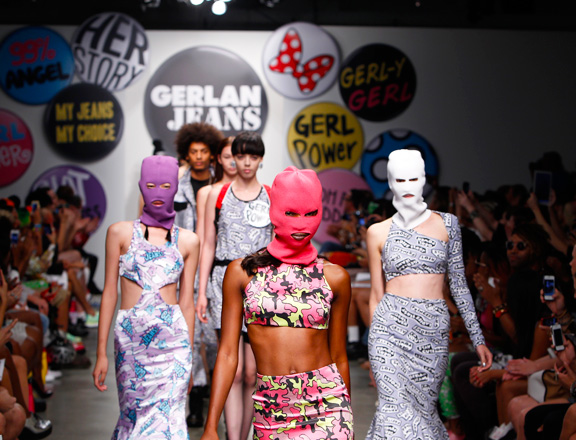
Pussy Riot even made a conceptual appearance at New York Fashion Week (see photo at top), their colourful balaclavas co-opted in the Gerlan Jeans runway show. Quite the strange journey for a anarcho-feminist collective.

There are many people in the world who suffer for free speech. Why are Pussy Riot the ones everyone got behind?

Never underestimate the power of branding. The name gets your attention, especially in a year in which frank discussion of women's sexual parts has become mainstream political conversation. "Free Pussy Riot" is one hell of a slogan, and lends itself easily to memes.


And then there are those balaclavas. 


They're anonymous and frightening, combined with the hardcore music, but also use warm colours and soft fabrics. It's a look easily copied by supporters, and make a memorable symbol of protest.

And the music. Fast, guitar-driven punk with one political barb after another. The band kept releasing new material, even with three in prison:


Sex, balaclavas and rock 'n' roll... it's a powerful combination for a fringe movement in need of popular support. And it's working.

Just last week, Russian Prime Minister Dmitry Medvedev called for the three members of the punk band Pussy Riot to be freed, saying "In my view, a suspended sentence would be sufficient, taking into account the time they have already spent in custody." They have an appeal scheduled for October first.


Branding your message matters. Always.

Wednesday, June 27, 2012

Sin tax on strip clubs to fund rape kits

Via Google Image Search
Here's one for you to think about: Houston's city council has passed a new tax on strip clubs within the city, adding a fee of $5 per patron to their cover charge.

The author of the ordinance, Councilwoman Ellen Cohen, put the motion forward as a way to subsidize the processing of the city's massive backlog of rape kits for sexual assault victims.

“We have to do something to help the 4,000-plus women, children and men who have been sexually assaulted,” said Councilwoman Cohen. “I think we’ve waited long enough.”

The victims certainly have waited too long for justice that has been delayed due to tight law enforcement budgets. But the tax also makes an official link between the above-ground sex industry and sexual assault, which is troubling for some (especially those who make money from it).

According to the Houston Chron:

A study Cohen relies upon to make the link states: “Are sexually-oriented-businesses, alcohol, and the victimization and perpetration of sexual violence against women connected? An exhaustive review of the literature says yes.” 
Several paragraphs later, though, the same study states: “However, no study has authoritatively linked alcohol, sexually-oriented-businesses, and the perpetration of sexual violence.”
Sin taxes are popular and profitable tools of social engineering when it comes to vices like cigarettes and alcohol. But whether you like them or not, do you think that consumers of legal sexual entertainment should be legally compelled to adjust their karma by paying to help sexual assault victims?


The Texas rape kit issue is a government funding issue. Last year, at the State level, Wendy Davis, D-Fort Worth, introduced a bill that would require a police department to submit a rape kit to a crime lab within at least 10 days, and complete the DNA analysis no later than 90 days after the sexual assault was reported. But it has since been stalled by police departments' inability and/or reluctance to do the inventories that would inform the legislators.

Councilman C.O. Bradford also called the nexus into question. He said that according to Houston Police Department, apartment complexes are the most common location for sexual assaults, and that sexually oriented businesses are 10th.

Still, said Bradford, a former police chief: “Victims have waited too long.”

Indeed they have. But is this what they were waiting for? Or did they want their government to pay to fix the problem?

Via Texas Tribune


Tip via Consumerist
Related: Houston Strip Club Accused Of Racism


Wednesday, May 16, 2012

What really creates social change?

Cross-posted with Change Marketing

In an interesting post on Toronto blog The Grid, Edward Keenan disparages TO Mayor Rob Ford for wanting to scrap the city's 2009 requirement that all shops charge 5¢ per plastic bag.


Edward writes:


"I think the reason people resent the bag fee so much is that it forces them to think about something they do not want to think about. “Do I need a bag?” They know, as we all do by now, that these little things are bad for the environment in many ways—they’re made of oil, they clog up landfills if they’re thrown out, they use up a whackload of energy if they’re recycled, they kill wildlife and produce unsightly litter if they get loose, as they historically and iconically do—and so the fee asks them to think for a split second whether they want those bags and if so, how many they want. The tiny, inconsequential fee forces both the retailer and the customer to spend a few seconds discussing the issue of bags.

[snip]

As it turns out, of course, that this has been effective, reducing the number of plastic bags used in Toronto by 53 per cent since it was introduced. Because when people have to think about it at all, when it costs them even a few seconds’s worth of income, they realize they can do without so many. When asked, they’d prefer to do right by the planet. But if you don’t ask, they don’t think about it."


(He's a very funny writer, BTW — I strongly encourage you to read the whole thing.)

As social issues marketers, reading about this kind of radical behaviour change should make us stand up and take note. Not that everyone will be supportive of government-imposed financial disincentives to negative behaviour (which goes against the beliefs of anyone with a strong libertarian bent), but simply because it puts the results of individual, unsupported social marketing efforts to shame.

This is where self-interest trumps community-mindedness. I stopped speeding so much, on the highway, after Ontario significantly raised fines. A similar effect has been noted as a result of the cell-phone handset ban — Health and Safety Ontario reports a self-reported 40% drop of in drivers reported talking on handheld and hands-free phones since the ban was enacted.

It's the same thinking behind Federal and Provincial "sin tax" on alcohol and cigarettes, aimed at reducing consumption. Or Provincial and Municipal smoking bans, which really do work.

Social changes are not always the result of intentional effects. While there are heavy sin taxes on gasoline in Canada, market forces also push the price of gas up, leading to less single-passenger driving and more use of sustainable transportation like buses, bikes and carpools.

Great news for environmentalists and public health promoters. But if the answer is so simple, why even bother with social issues marketing?

I would like to argue my professional case on two strong facts:

1) Regulation follows public will

Think about the fight against tobacco. Two or three decades of massive social marketing campaigns gradually moved the needle on public opinion about smoking. When the bans came up, they had enough support to give legislators a strong mandate.

Social issues marketers are the advance guard on change. We work with governments, consumer groups, industry, and not-for-profits to introduce the issue and provide rational and compelling reasons for support. You can see it happening right now with the issue of indoor tanning.


That PSA was from 2008. Since then, tanning has become a subject of disdain and ridicule, and more and more jurisdictions are placing increased regulations on the industry (especially with teens). Cause promotion, pop culture and regulation are inextricably tied into this change.


2) Industry follows consumer opinion

McDonald's, Wendy's and Burger King have all stopped sourcing pork from producers that use gestation cages on their pigs, after successful campaigns by PETA and the Humane Society of the United States. This is a big deal. A similar effect was seen when food safety advocates branded "boneless lean beef trim" as "pink slime". This resulted in a massive drop in demand by fast food retailers, and caused a major producer (Beef Products Inc.) to shut down three of its plants.

In short, no big change — legislative or commercial — happens without a sea-change in public opinion. And public opinion change is the whole point of social issues marketing.

Scary, eh? It's actually a big responsibility for those of us in "the business". And it's why there's so much outcry when corporate social responsibility campaigns or products try to "greenwash" or "astroturf" — people want information they can trust. It's also why smart consumer marketers team up with credible not-for-profits who can provide objective and trustworthy information to support the campaigns.

What social issues would you like to see begin the long trek from cause to normalization? Maybe we can help...

Thanks to Josh Rachlis for the inspirational tip.

Friday, November 4, 2011

F'd Ad Fridays: Human rights for sale... cheap

George Takei's equal rights group shared a link that led me to this:


That's right. All you have to do is get five of your fellow citizens to throw gay people under the bus in the next election, and you'll be entered in a draw for a $100 Visa card!

According to Minnesota for Marriage:
"Recently, a bi-partisan majority of the legislature voted to place the Minnesota Marriage Amendment on the 2012 statewide ballot to ensure that the people of Minnesota have a voice on this important issue. Please join us today to preserve marriage!"
But the Minnesota Independent points out:
"Bribery, advancing money, and treating prohibited. A person who willfully, directly or indirectly, advances, pays, gives, promises, or lends any money, food, liquor, clothing, entertainment, or other thing of monetary value, or who offers, promises, or endeavors to obtain any money, position, appointment, employment, or other valuable consideration, to or for a person, in order to induce a voter to refrain from voting, or to vote in a particular way, at an election, is guilty of a felony."
So in this case, perhaps the "F" for this campaign could also stand for "felonious"...

Friday, October 14, 2011

F'd Ad Fridays: Free set of knives with Amanda Knox issue!

In Italy, where open air magazine stands are still on every other corner, the competitive market leads publishers to continually try to top each other with novelty giveaways. Often it's a CD or DVD.

But as AdFreak reports, the issue of gossip mag Oggi with Amanda Knox on the cover features a set of knives (and inexplicably, a pizza cutter):


Knox spent four years in an Italian prison after being convicted of killing her roommate with a black-handled kitchen knife. She was just recently released after much legal wrangling, but The Daily Mail says that Oggi continued to imply she was guilty and that prosecutors had flubbed the case.

Via The Telegraph
One thing is for sure: Oggi is guilty of insulting the memory — and the family and friends — of a young murder victim.

Thursday, October 13, 2011

UK to treat ambush marketers like terrorists at London 2012?

"Ambush Marketing" is a popular stunt by underdog brands who hire people to infiltrate public and sporting events, then do something provocative to get attention. One of the most infamous is Golden Palace, who sent a male streaker out on the field during the 2004 Super Bowl broadcast.

Not that I want to see this, mind you.

Some of us find this amusing. Official sponsors who have paid to be upstaged by some naked guy do not. And when it comes to the Olympic Games, with multi-million dollar international sponsorships at stake, the lack of amusement can have an impact on the very fabric of the legal system.

The Dim Dim Girls must be stopped at all costs!


According to The Drum:

Revised legislation has been issued this week stating that exhibitionists baring their flesh for marketing stunts in and around 2012 Olympic venues could face criminal charges and fines of up to £20,000 in the magistrates court.

CEOs, marketing directors and other senior staff of brands appearing in "ambush marketing" in the vicinity of Olympic venues will be presumed guilty unless they can prove their innocence by proving that they had no knowledge of the activity or that they took reasonable steps to prevent it happening.

The Department for Culture, Media and Sport (DCMS) noted the risk of human bodies being used for ambush advertising following concerns raised in a recent consultation process. It has promised to "make additional changes to prohibit advertising on the human body". It says the legislation is "reasonable and proportionate", and that the matters a person is required to prove in their defence are "entirely within their knowledge".
Prove your innocence? Are they serious?

Now anyone with a financial or personal reason to cause legal trouble for marketing high-ups can just draw a logo on their bum, whip off their pants, and let the charges fly. London-based advertising lawyer Nick Johnson is quoted: "Exactly how is a CEO, a marketing director or a legal director supposed to prove they had no knowledge at all of an infringing act featuring their brand?"

And what happened to The Man having to prove guilt? Usually these kinds of draconian legislation are enacted to fight terrorists, not to protect brand integrity or sponsorship deals.

via
I'm not defending ambush marketing. It is not playing fair. But this kind of legal pandering to the Olympics and big brands? Bullshit.

Friday, September 30, 2011

F'd Ad Fridays: F'd Law Association Ad

I couldn't find a non-flash version of this ad for The Association of Finnish Lawyers, which just went up on Copyranter, which is too bad because it's a little embarrassing for desktop viewing at work. (Turn down the sound and keep an eye out for passers by.)


Goodness me. And I thought it was the lawyers who kept the admen in line...

And I think I know why they misspelt "Finnish"