Showing posts with label sesame street. Show all posts

Friday, October 19, 2012

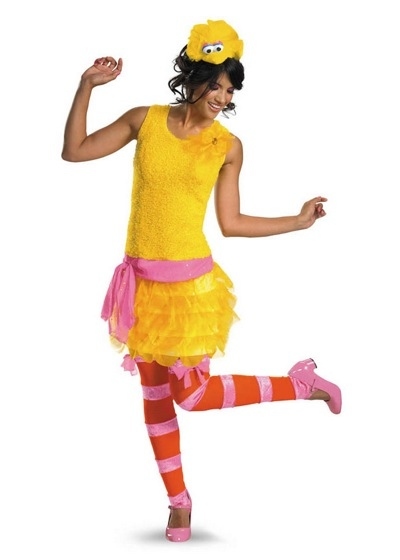
This Sexy Big Bird costume is brought to you by the letters C, E, A, S, E, A, N, D, D, E, S, I, S and T


With Big Bird the new symbol for the hate-on that Republican Presidential candidate Mitt Romney has for PBS's public funding, Big Bird Halloween costumes are selling out across the United States. But Sesame Street Workshop would like the world to know that the push-up Big Bird minidress (above) is not an officially licensed product.

Sarah Beth Erb from Sesame Street Workshop told Buzzfeed's Katie Notopoulos, “our legal team has sent a cease and desist letter to the website selling them, will monitor the site, and follow up accordingly to make sure the items in question are removed.”

This, according to the Buzzfeed post, is the official costume:


I have to admit, Flapper Big Bird seems as strange to me as Slutty Big Bird. And the latter isn't nearly as hypersexed as many other costumes being pitched to young women these days.

Interestingly, Yandy sells both costumes on its site, the official one as "Sexy Big Bird Costume" ("Learning the ABC's has never been this sexy") and the other as "Exclusive Yellow Dress and Stockings" ("Bird head piece not included"). Sure, they suggest wearing a "Big Bird Headband" with it (as modelled by a young girl). But I'm not sure SSW has much of a case.


Thursday, October 4, 2012

Muppets against Mitt


After last night's Presidential Debate started a feud between Republican candidate Mitt Romney and PBS, an anonymous Tweeter took on the role of an angry Big Bird, to the great mirth of those second-screening the TV coverage.

Today, the Pro-Obama Super PAC American Bridge 21st Century released a number of (obviously non-licensed) captioned image "ads" to highlight the views of the candidate who wants to cut funding for public broadcasting.


Fun stuff, but ABC News points out that Sesame Street is relatively safe from PBS cuts because it receives “very, very little funding” from the network. However, it notes, "fans of other PBS programs such as Frontline and Antiques Roadshow may not be so lucky."

Via BuzzFeed

Wednesday, January 4, 2012

Bring the boobs back to Sesame Street

No, I'm not talking about that Katy Perry fiasco a couple of years back. This is something altogether more innocent: breastfeeding.

Back in the '70s and '80s, Sesame Street included breast feeding promotion as part of its educational mandate to American kids.

Here's Canada's own Buffy Sainte-Marie doing it with her son Dakota "Cody" Starblanket Wolfchild in 1977:


And here's the character Maria (played by Sonia Manzano) nursing her real-life daughter, Gabriela, in 1988:


It's practically the same scene. But something happened on Sesame Street, as it grew out of its baby boomer roots and started becoming a corporate merchandising goliath. Breastfeeding somehow became something inappropriate for a kids' show.

The most damning piece of censorship is a touching musical segment called "You're My Baby".

In the original '70s version, the camera lingers on a nurseling:


Twenty-plus years later, when it was remade for a new generation of kids, the breast was replaced:


While certainly reflecting the reality, for many America parents (especially moms with very limited maternity leave!) the very deliberate substitution irked breastfeeding advocates such as Lani of the Boobie Time blog, who has started a petition to try to convince Sesame Street to promote breastfeeding again.

Why is this a big deal? Back in the earlier days, the show was actively promoting a behaviour that was in the interest of American babies. Breastfeeding rates were going up overall, but the increases were mostly accounted for by affluent "white" women. Rates among Hispanic and African Americans remained low. Sesame Street, the great social leveller, was doing its part to normalize the practice among all its viewing families — it was one of the show's many embedded bits of social marketing.

Zoom forward to the present, and American women continue to experience anti-breastfeeding sentiment, in public places, despite many legal protections. To put it bluntly, there are many who consider breasts to be sex-only organs, and who consider their public exposure in breastfeeding to be obscene.

In the latter "you're my baby" video, Sesame Street may have been reacting to the way many of its viewers really feed their babies — being descriptive rather than prescriptive. After all, the revolutionary show has focus groups and organized "decency" mobs to worry about now.

But can't they take a leadership position again? To model a better world than the one some viewers find themselves in?

I'd love to hear your thoughts.

Thanks to my sister, Mary Jo, for sharing this story with me.

Tuesday, November 29, 2011

Sesame Street's catchiest tune was stolen from Italian porn

"Vorrei manamanarti!"

The most infectious tune ever written was apparently revisited in the new Muppet Movie (which I have yet to see) but I recall it best from the golden age of Sesame Street:


Slate tracked down the original song to, of all places,  a 1968 Italian soft-core movie called Sweden: Heaven and Hell by Luigi Scattini.

From Amazon: "Edmund Purdom narrates a pseudo-documentary about sexuality in Sweden. It shows contraceptives for teen girls, lesbian nightclubs, wife swapping, porno movies, biker gangs, and Walpurgis Night celebrations. It also examines Sweden's purported drug, drinking and suicide problems. It features the original appearance of the Piero Umiliani's nonsense song 'Mah Nà Mah Nà' which was later popularized by 'Sesame Street' and 'The Muppet Show'"

Piero Umiliani, according to Wikipedia, "composed the scores for many exploitation films in the 1960s and 1970s, covering genres such as spaghetti western, Eurospy, Giallo, and soft sex films. Although not as widely regarded as, for example, Ennio Morricone or Riz Ortolani, he helped form the style of the typical European 1960s and 1970s jazz influenced film soundtrack, that later experienced a revival in films such as Kill Bill, and "Crepuscolo Sul Mare" in Ocean's Twelve."

In other words, he may be the most awesome composer you've never heard of. But Henson heard it when it briefly charted on US radio, and gave it eternal life.

Here's the original clip. It is pretty uncontroversial.

Thursday, November 10, 2011

Bert & Ernie tell you where to go


Cute spot. Although I miss Jim Henson's voice.

What would make it really funny is if the totally not gay couple argued so much over which way you were supposed to turn that you ended up in a ditch.

Via Illegal Advertising

Wednesday, May 11, 2011

Brought to you by the letters "H", "I" and "V"

Sesame Street has always been about inclusiveness. And it will be even more so on May 21 (assuming the world does not end as scheduled) when Nigerian Kids are introduced to Kami, an inquisitive female Muppet living with HIV.

She's on the left.

According to MTV Canada reporter Aliya-Jasmine Sovani,

"Nigerian Sesame Street (Sesame Square) will address the biggest challenges faced by Nigerians…in addition to HIV/AIDS, also religion, gender inequality, AND Malaria. In one episode muppet ZOBI gets caught up in a mosquito net to teach kids how to use them and prevent a malaria infection because according to the World Health Organization, a child dies from the disease every 45 seconds."
Zobi, by the way, is an African version of Cookie Monster — except that he craves yams.

Kudos to Sesame Street for continuing to address uncomfortable issues that kids nonetheless have to deal with (I still remember when Mr. Hooper died). Although I was a little disappointed when they caved to uptight parental pressures on the bouncy Katy Perry musical number.

Tuesday, November 23, 2010

Generation Sesame

That's really what they should call us, rather than "Gen X". After all, we were the first cohort to grow up with Children's Television Workshop as our preschool.

And CTW knows it. First they start appealing to us with our own generation's music, like Feist. Then they manufacture naughty outrage with the "banned" Katy Perry cleavage number. And then, of course, came the Grover "smell like a monster" parody of the already-ironic Old Spice Guy campaign.

Now they continue to cater to parents who were once Sesame Street kids with this amusing social media campaign (inspired, no doubt, by the grassroots Betty White movement) to get Cookie Monster to host Saturday Night Live:


It's a little slow-paced, but Cookie has a bit of a speech impediment. I'm just happy that he's back to being obsessed with cookies, rather than pretending he's still on a health kick. (He even makes a sly drug reference that would fly way over kids' heads.)

At 40, I guess I'll never stop being a Sesame Street kid.


"Like"

Saturday, October 9, 2010

I am thankful for Sesame Street


I doubt preschoolers will know the backstory, but Sesame Street has always worked on more than one level. Awesome.

Thursday, September 23, 2010

Sesame Street loses its innocence

AP reports that a musical segment guest starring Katy Perry will not be shown on TV due to excessive cleavage:


AP: "Sesame Street said in a statement Thursday that in light of the “feedback we’ve received” after the bit was aired on YouTube, they won’t include it on the show."

Personally, I'm on the side of this comment on YouTube, from bcdflash:

"I don't get it! it's cute. the kids wouldn't see it as anything other than a fun song to hop around to, and dance 'til they're tired. Katy has boobs, mommy has boobs and even school teachers have boobs. Do you really think this is something shocking?? What sad and pathetic people won't complain about for attention."

If showing that much is bad for preschoolers, what must the complainers think about taking their toddlers to the beach? To the art gallery? Or anywhere where a woman might be *gasp* publicly breastfeeding?


Sure, the song is kind of lame. But the outfit is no more scandalous that what most under-30 women wear in their daily lives. By making a scene about "naughty" body parts, these parents will make their kids all the more interested — and it's that combination of shame and titillation, IMHO, that really leads to lost innocence.

It's time for America to overcome its Mammophobia. You are embarrassing us all.

Tuesday, June 9, 2009

Bring Back the Jingle!

Like many hipster parents, I'm always trying to get my son to watch vintage kids' programming, because I think it's cooler than what they make now. I've actually had quite a bit of success with Sesame Street Old School and Schoolhouse Rock. My son has started walking around the house singing "J Friends" and other classics.

These shows have always been interesting to me because they use advertising strategies to get kids to learn — especially jingles. Schoolhouse Rock was famously conceived by adman David McCall when he noticed that his son could remember Beatles lyrics, but not multiplication tables. It ended up being funded by a "sin tax" on advertisers for targetting kids during Saturday morning cartoons.


Sesame Street, of course, was known for creating short, snappy segments with high production values — many of them now-famous songs. With each episode "sponsored" by a letter or number, it used advertising's language, clichés, and strategies to infest generations with incurable earworms like this:


Having grown up with educational jingles, ironically, made us more susceptible to real advertising. The '70s and early '80s were perhaps the last hurrah for the traditional jingle.

We all knew how a Big Mac was made:


And Canadian kids all knew that "Molson Light has got heart" (whatever the hell that meant):


So, why did the ad industry drop the jingle? Sure, it still turns up in cheesy infomercials and other low-end campaigns, but what about the major consumer brands? I suspect that, although we loved jingle as kids, my generation of admen take ourselves too seriously. Not many jingles win awards. (With some very notable exceptions):


The other problem is that we're a creatively lazy generation. We're consantly borrowing interest from existing pop culture to create instant likability for ads. Why write a jingle of unknown success, when you can just buy a real Beatles song?


I don't know if there's any hope for a jingle renaissance in the future. Especially in my field, where I'm more involved in social than consumer marketing.

Although, I have to say that during a recent strategy session for a health-based client, our research into successful vintage Canadian social marketing campaigns ended with a Participaction sing-along:


So there's that. Does anyone want to give me a bouncy "C"?