Showing posts with label africa. Show all posts

Tuesday, February 17, 2015

Kenyan condom ad pulled for referencing extramarital sex


This ad is entirely in Swahili, but if you look up the term "Mpango Wa Kando" you can get the gist of the story: Two women in the market discuss one of them having an affair with a man. The woman tells her friend, the "adultress" that she should use a condom to protect herself and their families from sexually transmitted infections (HIV in particular).


From the YouTube comments:

The “Weka Condom Mpangoni” advert which features two women who openly admit something we fight to put under the carpet that yes there are married women with mpango wa Kando. 
“One of the ladies inquires about the other’s husband and then immediately seeks to find out how her mpango wa kando is doing. The first lady then goes ahead to explain that even though her husband may be away, that does not mean that she miss out on “fun” since the other guy is readily available to provide it. The second lady then counsels her to always use condom whenever she’s having “fun” with her mpango wa kando”.


The Anglican Church and the Council of Imams and Preachers of Kenya protested the ad, claiming it was promoting promiscuity and infidelity rather than preventing HIV, and Kenya's Ministry of Public Health cancelled the ad's TV broadcast.

In response, columnist Lucy Maroncha wrote:
Had the clergy not interfered with it, the message would have reached millions of Kenyans and would have benefited even the youth and people already living with HIV.
Whether you are married or not, using condoms in Kenya is challenging for most people as it carries the weight of stigma and many shy from buying them from shops. 
Gladys (name changed) a married woman who admits having an extra marital affair tells me that sometimes she and her lover opt to have unprotected sex for fear of stigma in the community if anyone saw them buying condoms. "With or without the advert, thousands of married people have extra marital affairs and the clergy should not bury their heads in the sand. They should team up with the government to promote the prevention campaign," she asserts.
Kenya is the 4th most HIV/AIDS-affected nation in the world, with at least 100,000 new infections in Kenya annually. But heaven forbid we talk about safer sex, even outside of marriage. 

Tuesday, December 2, 2014

International ad archives accused of ignoring African creative


My friend Ivan Raszl, curator of Ads of The World posted this image on Google+ (as well as AOTW) with the comment, "Now, this is embarrassing."

Indeed. There are many ironies at work here. The submission to AOTW by apesobey.com stated "Even though we know they are always objective and fair, the impression of every single African that has had his work turned down by a prominent advertising curator is: 'They killed it!' Ivan Raszl of Adsoftheworld is represented as a chainsaw killer of ads."

How could Ivan not post it after that? Ivan wasn't the only "ad slayer" so portrayed. Michael Weinzettl of Lürzer's Archive also gets it:


An African-based online ad archive is definitely a great idea, and I'll be following it to see stuff that I may otherwise have missed. But the bigger question is, are the big international ad archives anti-African, as the ads overtly suggest?

Ivan, now a Canadian resident, is Hungarian. What I always found interesting about his blog is that it provides diversity to the online discussion about advertising. For those of us in North America, it's easy to be exposed to mostly English-language advertising mostly from the United States, Canada, the UK and Australia. Following AOTW gives me insights into the very different insights and sensibilities of Eastern Europe, Latin America, and the Middle East. As well as several nations in Africa.

I've never noticed a particular lack of African creative on the site, but it's quite possible that many submissions from African agencies are being rejected. The thing about a privately-sector, curated ad archive is that it is as subjective as an international awards show. Unlike awards, though, the online archives make an effort to include not only the best creative in the world, but also what is controversial or noteworthy. 

In the interest of full disclosure, I've had a number of my ads appear on AOTW. I've also had a number of them rejected. All ad sites have a particular bias or flavour. In the case of AOTW, its taste prioritizes Art over Copy. When submitting work, you have to keep in mind whether the work will appeal to the audience. In this case, the audience is the ad editors.

But is there any racism involved in their decisions? Nothing overt, that's for sure. We all have our prejudices in deciding what we find appealing and relevant. It's possible that if the editors were African, rather than European, their tastes would be different. Which is why we need lots of different places to learn about lots of different kinds of advertising. More Adlands. More Joe La Pompes. More Inspiration Rooms. And AdFreaks and Adrants and Copyranters. In every language and culture.

In my own blogging, including for European-based social marketing review site Osocio, I make similar decisions. One of an international group of editors, I try to keep my social and linguistic biases fairly transparent when I find work from very different cultures insensitive or confusing. (To Osocio owner Marc van Gurp's credit, he's been actively trying to find more contributors from the developing world for years.)

So, in my opinion, the portrayal of Ivan and Michael as slayers of African ads is not exactly fair. But advertising is full of cynical attention-grabbing tactics. This one worked. Now show me some great African creative, guys!

Friday, September 21, 2012

Skin whitening ad in Senegal provokes anger

Via France 24
According to France 24, "The wolof expression 'Khess Petch' means 'all white.' It is also the name of a brand new skin whitening cream that has been advertised throughout Dakar in the past few days."

"All-white"? In Africa?


The writer continues:
Skin depigmentation is common in Africa, where the sale of skin whitening products is legal in many countries. People resort to using the creams out of aesthetic concerns based on the idea that fairer skin leads to greater social and economic success. Most of these cheap skin whitening products are made using corticosteroids and hydroquinone (illegal in the European Union), which are harmful and carcinogenic when applied in significant doses on skin. The regular use of these products leads to itching, varicose veins, and stains, but also to a strong dependence due to the product’s penetration into the bloodstream.
People aren't standing for it. A petition at Change.org to the Senegal Ministry of Health and Social Action states (in French), "we believe that the authorities health must seize the faster the issue of skin bleaching which is a public health problem in the same way as tobacco."

It has just over 1300 signatures.

Thanks to Osocio colleague Tatjana Vukic for the tip.

Related: Skin whitening ads from Hong Kong and vulva-bleaching campaign from India.

Friday, July 29, 2011

F'd Ad Fridays: Killer condoms


Found on Buzzfeed, this unprovenanced imgur is captioned "Found it while eating pizza at my Nannas. I almost choked."

The political context of the publication is blatant, but I thought I'd give Dr. Green the benefit of the doubt.

Here's what he really said:

In 2003, Norman Hearst and Sanny Chen of the University of California conducted a condom effectiveness study for the United Nations' AIDS program and found no evidence of condoms working as a primary HIV-prevention measure in Africa. UNAIDS quietly disowned the study. (The authors eventually managed to publish their findings in the quarterly Studies in Family Planning.) Since then, major articles in other peer-reviewed journals such as the Lancet, Science and BMJ have confirmed that condoms have not worked as a primary intervention in the population-wide epidemics of Africa. In a 2008 article in Science called "Reassessing HIV Prevention" 10 AIDS experts concluded that "consistent condom use has not reached a sufficiently high level, even after many years of widespread and often aggressive promotion, to produce a measurable slowing of new infections in the generalized epidemics of Sub-Saharan Africa."

Let me quickly add that condom promotion has worked in countries such as Thailand and Cambodia, where most HIV is transmitted through commercial sex and where it has been possible to enforce a 100 percent condom use policy in brothels (but not outside of them). In theory, condom promotions ought to work everywhere. And intuitively, some condom use ought to be better than no use. But that's not what the research in Africa shows.

Why not?

One reason is "risk compensation." That is, when people think they're made safe by using condoms at least some of the time, they actually engage in riskier sex.

Another factor is that people seldom use condoms in steady relationships because doing so would imply a lack of trust. (And if condom use rates go up, it's possible we are seeing an increase of casual or commercial sex.) However, it's those ongoing relationships that drive Africa's worst epidemics. In these, most HIV infections are found in general populations, not in high-risk groups such as sex workers, gay men or persons who inject drugs. And in significant proportions of African populations, people have two or more regular sex partners who overlap in time. In Botswana, which has one of the world's highest HIV rates, 43 percent of men and 17 percent of women surveyed had two or more regular sex partners in the previous year.

These ongoing multiple concurrent sex partnerships resemble a giant, invisible web of relationships through which HIV/AIDS spreads. A study in Malawi showed that even though the average number of sexual partners was only slightly over two, fully two-thirds of this population was interconnected through such networks of overlapping, ongoing relationships.

So what has worked in Africa? Strategies that break up these multiple and concurrent sexual networks -- or, in plain language, faithful mutual monogamy or at least reduction in numbers of partners, especially concurrent ones. "Closed" or faithful polygamy can work as well.

In Uganda's early, largely home-grown AIDS program, which began in 1986, the focus was on "Sticking to One Partner" or "Zero Grazing" (which meant remaining faithful within a polygamous marriage) and "Loving Faithfully." These simple messages worked. More recently, the two countries with the highest HIV infection rates, Swaziland and Botswana, have both launched campaigns that discourage people from having multiple and concurrent sexual partners.

Don't misunderstand me; I am not anti-condom. All people should have full access to condoms, and condoms should always be a backup strategy for those who will not or cannot remain in a mutually faithful relationship. This was a key point in a 2004 "consensus statement" published and endorsed by some 150 global AIDS experts, including representatives the United Nations, World Health Organization and World Bank. These experts also affirmed that for sexually active adults, the first priority should be to promote mutual fidelity. Moreover, liberals and conservatives agree that condoms cannot address challenges that remain critical in Africa such as cross-generational sex, gender inequality and an end to domestic violence, rape and sexual coercion.

No, I didn't expect the Christian Right to read all that either.

Wednesday, May 11, 2011

Brought to you by the letters "H", "I" and "V"

Sesame Street has always been about inclusiveness. And it will be even more so on May 21 (assuming the world does not end as scheduled) when Nigerian Kids are introduced to Kami, an inquisitive female Muppet living with HIV.

She's on the left.

According to MTV Canada reporter Aliya-Jasmine Sovani,

"Nigerian Sesame Street (Sesame Square) will address the biggest challenges faced by Nigerians…in addition to HIV/AIDS, also religion, gender inequality, AND Malaria. In one episode muppet ZOBI gets caught up in a mosquito net to teach kids how to use them and prevent a malaria infection because according to the World Health Organization, a child dies from the disease every 45 seconds."
Zobi, by the way, is an African version of Cookie Monster — except that he craves yams.

Kudos to Sesame Street for continuing to address uncomfortable issues that kids nonetheless have to deal with (I still remember when Mr. Hooper died). Although I was a little disappointed when they caved to uptight parental pressures on the bouncy Katy Perry musical number.

Tuesday, December 14, 2010

Kiddieland

Copyranter posted this PSA by D’adda, Lorenzini, Vigorelli, BBDO in Milan.

In this scenario, Zimbabwe is an adult-free playground for kids. But the fantasy is actually a nightmare.


No, it's not an ad for the new Logan's Run remake. It's an appeal by Italy's Associazione Amici di spagnolli, who work to help people in Africa, to do something about the AIDS epidemic that is killing Zimbabwe's future.


Pretty hard hitting stuff.

Monday, September 13, 2010

Coke adds life?

There's a bit of a debate going on Osocio's comments thread about this post regarding Kia Canada's new "Corporate Social Responsibility" campaign. Some readers are pointing out (and not without justification) that a car campaign dressed up as goodwill has no place on a social marketing blog.

Ironically, whenever I read the comments, I am confronted with this banner ad just below:


On surface, ColaLife is  an interesting concept:

We are working to get Coca-Cola to open up their distribution channels in developing countries to carry 'social products', such as oral rehydration salts to save children's lives. You can by a Coca-Cola virtually anywhere but one in five children die before their fifth birthday. This moratlity rate has not changed significantly over the last three decades which indicates that we need to look for new options like ColaLife.

The problem is, they haven't done anything yet. But here's how it works:


And, while ColaLife associates itself with Coca-Cola, it's actually lobbying Coke to sign on to this project, open up their distribution channels, and provide seed funding. And they're looking to public fundraising for sustainability.

It's a brilliant idea, piggybacking on one of the most robust distribution systems in the world to get medical supplies to the far corners of the third world with an elegantly simple solution:


They're driven. They're very organized. But I wonder just how much Coke is going to want to take them along for the ride.


If you'd like to help these social entrepreneurs, you can donate online.

Monday, August 30, 2010

Burundi Monday 4: T.I.A.

According to Acart Videographer Christopher Redmond, this TLA* means "This Is Africa". It's an expression the foreigners at the Burundi Film Center use when confronted by extreme culture shock.

And that's what they're getting, now that the new crop of Burundian home-grown films is in production.

The BFC was established to develop media and filmmaking skills in post-conflict Burundi, so that the people of this nation few in the west have heard of can show their stories to the world.

Those stories can get a little brutal.

For example, in a film about a man who is down on his luck and ends up working at a slaughterhouse, the most practical thing to do was use a real set and bloody ex-cow props, even though it attracted scavengers:


Then, while filming in a marketplace, a vodka company representative decided to give out free samples, an action that in a place like Kigali can end up in bloodshed. Christopher tried to distract the crowds from the shoot by telling them they were extras in some fake second unit work. This gave them time to finish the shot and GTFO.


TIA indeed!

You can follow Christopher's international development work at BFC in his blog on Citizenshift.


(*old tech. industry joke: "TLA" is a three letter acronym for "Three Letter Acronym")

Monday, August 23, 2010

Burundi Monday 4: Moving Pictures

Well, I'm back from a week in the wilds of Northern Ontario, and eager to re-enter the blogosphere.

This being the first day of the working week, and Acart Videographer Christopher Redmond still teaching film in Africa, it's time for another Burundi Monday.

Today, I'd like to share some still images from the field, captured by Artistic Director Bridget Redmond. (She and Christopher are married.) The pictures are lifted directly from the BFC blog, and give us a foretaste of some of the cool stories we're sure to hear on Christoper's return.


That's Mr. Redmond, eating local.


This is lunch.


This is inside.


This is outside.


And this is a wall.

Pretty wild stuff. You can see more pics, and follow Christopher and company as they begin shooting a new series of Burundian stories, at the BFC site.

Monday, August 9, 2010

Burundi Monday 3: Love in the Time of Cholera Shots

In this third installment of my followup on Acart Viedographer Christopher Redmond's African journeys, I'd like to get a little mushy.

You see, Christoper has recently been joined abroad by his Burundi Film Center partner, Bridget. And by "partner" I mean "PARTNER". And also partner.

The story goes back a few years, to when BFC was first getting started. As Christopher blogs:

"I asked Bridget to come to Burundi in 2007, first and foremost, to document the pilot-project through pictures. As a professionally trained and award-winning photographer, I knew she could find a beauty in the chaos over here that might help us get the attention we needed to continue. It was no small bonus that she’d also been making films for 10 years and has design talents that we continue to exploit in all our promotional materials. She deserves far more credit than she gets for her BFC work, for sure, but I also preface her many talents to save face a little. A love affair was indeed born, but luring her deep into Sub-Saharan Africa to do so certainly wasn’t the calculated ploy many of my friends joke it must have been. At least I don’t think it was…"

Bridget, whose last name is now also Redmond, married Christopher last year in a ceremony at the Mayfair Theatre that was true to their film geek roots.


Bridget is also a committed media nut, but in her case the passion has led to a career in photography and film. In addition to her "regular" job, Bridget runs a wedding film business called First Kiss Films. Now, Bridget is back in Africa fulfilling her role as BFC photographer, documenting the group's work teaching video media skills to Burundi's next generation of documentarians and filmmakers so that they can share their stories with the world.

It's nice to see those film-crossed lovers reunited doing the work they love. And, as always, you can follow their story through regular updates in Christopher's blog.

Monday, August 2, 2010

Burundi Monday, part deux

As promised, I am bringing the second instalment of Burundi Monday, following Acart Videographer Christopher Redmond's international educational outreach through the Burundi Film Center. But since it's a holiday here at home in Canada, I'm going to do the laziest thing possible and just excerpt his latest blog entry about teaching hopeful young filmakers how to tell their own stories to the world through video media:


"Today was the first day of class and everything seems to have gotten off on the right foot. The room was full, my lesson plan was tight and everyone was engaged throughout. We have a new hand-painted BFC banner, T-shirts (courtesy the Sam Group in Ottawa), and a number of volunteers who were helping me with attendance and presentation notes. Things were, dare I say, professional. Or at least that’s what I’m told.

...

The students this year, however, seem to have a lot more experience than in 2007. Once again, we went around the room asking everyone to tell us about themselves and give us a sense of their skill-level. Almost two thirds identified as a “cameraman”, which I should have expected based on the type of people who have contacted me over the years asking to participate. But there are also a number of novices, actors and a few journalists again, which should make for a nice mix.

...

All the preparation I had done in collecting French books and lesson plans has also been a huge relief. I was honestly learning half of the technical film terms the day before I’d teach them the first time. Now, with the benefit of not only having taught everything once, but also having worked on at least half a dozen bilingual TV commercials in Montreal, I’m fairly confident in sharing the basics. So today, we started from the start – the different types of films (fiction, documentary, animation, experimental), the major steps of creating a film, film genres, and a number of other general overview points to get everyone on the same page. Even the volunteers were often scribbling down notes, enjoying both the refresher and probably the new clarity I brought to the material.

...

When class was done, a volunteer came up to me saying he overheard a few people calling their friends telling them the class is really good, they should try to get in. Too much interest is a problem from 2007 I won’t mind having again."


You can follow the rest of Christopher's BFC blogposts at CitizenShift's Media for Social Change, including a recent brush with the police. But other than that, his trip is going well — especially since his BFC partner and wife, Bridget — has joined him on their journey.

Next week on Burundi Monday: A love story.

Wednesday, July 28, 2010

Breast Ironing in Cameroon. Yes, I said "breast ironing"...

This ~8 minute documentary by the Current focuses on a weird but tragic new cultural trend in Cameroon called "breast ironing".

If that term itself doesn't already have my female readers cringing, here is a description from the accompanying article:

The 'ritual' is performed by massaging the girls' chests with heated objects like stones, in order to reverse their pubescent development. The mums say it's driven by fear of unwanted male attention, rape and pre-marital pregnancies.


Now that you've been duly warned, here's the video. It's appropriately graphic and disturbing:


This is one of those situations, like genital mutilation, that tests our respect for cultural differences among humanity. How could any mother do that to her daughter? How could anyone think that the masking of secondary sex characteristics is proof against sexual activity — or, for that matter victimization?

There is something you can do about it. The African National Network of Aunties Associations, RENATA, is campaigning against the practice.

From their campaign site:

Problem:

- 24% have experienced breast ‘ironing’
- It includes the use of hot objects (spoons, herbs, stones or leaves) or salt and petrol
- The risk of having the breasts ‘ironed’ is twice for girls who develop breasts before the age of nine years

Why are the breasts of adolescents ironed?

Many people think:

- That the breasts will attract men
- That the breasts make girls sexually active early and that they risk to become pregnant
- That the girls can grow up normally and can continue their education when their breasts are ‘ironed’

Consequences:

- Massaging the breasts of girls with hot objects terribly hurts and can completely destroy the breasts
- Breast ‘ironing’ can traumatize and negatively affect the girls for the rest of their lives
- It can have negative influence on their sexual behavior
- Physical consequences of breast ‘ironing’ are: horrible pain, abscess and itching, leakage of milk, cysts, picks on the breast, infection of the breasts and strong fever, asymmetric breasts, total disappearance of breasts
- This practice can favor the risk of developing breast cancer


RENATA takes donations of as little at $10 online. Let's just leave it at that.

Monday, July 26, 2010

Burundi Mondays

For the next few weeks, every Monday's post will be dedicated to following the African exploits of Acart Videographer Christopher Redmond as he teaches film and advertising in Burundi.


Christopher is a co-founder of the Burundi Film Center, a non-profit media development project that "helps Burundian citizens to learn essential 21st century mass communication skills from international filmmakers and documentarians, while engaging those same media experts in African issues".

Christopher arrived in Africa last week, and immediately set about sharing what he has learned working at our ad agency for almost 3 years.

From his blog:

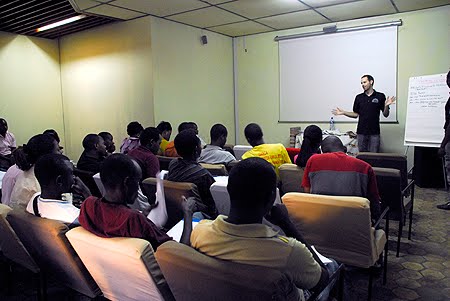
Today was the final day of the Rwanda Film Festival and I was asked to teach a TV advertising workshop to about a dozen students. As I explained to them, even directors in Hollywood work on commercials between projects to help them make a living. The fact Rwanda only has one national television station was beside the point. The tips I gave could all translate into making good short films – keeping the message simple, telling the story visually and making sure every shot says something.

I walked them through the entire process of creating commercials using samples from my work at Acart Communications in Ottawa. So I broke down what makes up an advertising agency in North America (creatives and client services), then showed them the steps and format to write for TV, create animated storyboards and finally the finished product. The fact I used mainly Government of Canada commercials as samples, like our Elder Abuse and 72 Hours “Get Prepared” campaigns, also made them laugh. “Wow, your government cares so much about your people,” one student told me. “It is very different here.”

Overall, I tried to keep things basic and relevant, giving them ideas for how to break into an industry that otherwise seems exclusive and, well, alien. I explained that creating spec TV spots (fake commercials) or exciting “pitch” videos for clients is a good way to start. See there’s often a “catch 22” for working in film and TV –you need to have already done it in order to do it. But everyone has to start somewhere. And knowing how to take that first step yourself can end up being a giant leap in your career.


Best of luck to Christopher and his students, from all of us here at Acart. You see? Doing work that matters is more than a slogan to us. It's a way of life.