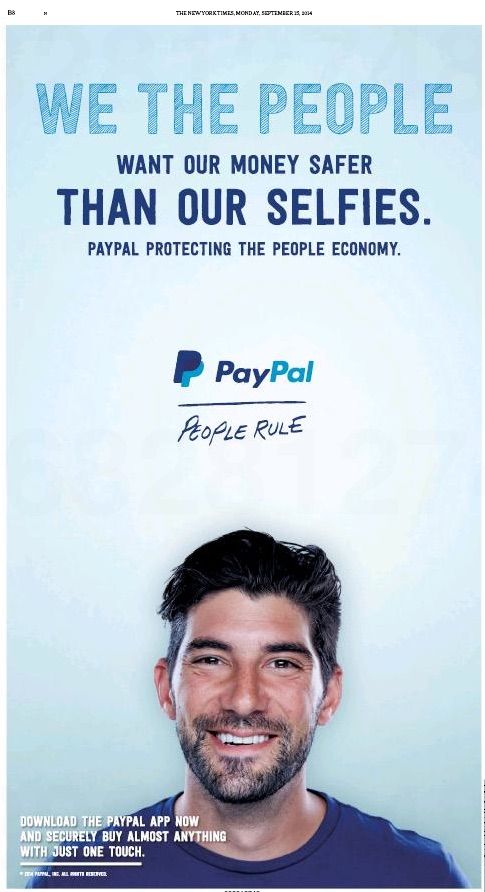
According to Cult of Mac (**shudder**) this ad ran as a full page in the New York Times last week. While Apple isn't specifically mentioned, the reference to stolen nudes is an obvious hit at the company, whose iCloud security was questioned in the breach. (Apple denies this.)
Paypal obviously feels the heat from the new iPhone's Apple Pay feature, so casting doubt on Apple's general security might seem like a great idea. But it seems pretty underhanded to me.
Yes, I've seen those TBWA Paris ads that are an Art Director's wet dream. But this one from Heye Group, Munich, is more of a nightmare.
What is the message, really? That you should have fewer friends, so that you get to keep more fries? Just seeing those hands reach in like that kills my appetite anyway.
There it is, in all its oddly-centred, fake-ad-looking headline glory.
I'll quote the body copy in full:
For over 127 years, people have been coming together over Coca-Cola products to refresh, to celebrate, and to enjoy a moment with something they love. One reason why is that people have always been able to trust the quality of our products and everything that goes into them.
That’s something that will never change.
But changing with the times and people’s tastes is something we’ve always done. Today, that means offering more great-tasting, low- and no-calorie choices. And while nearly everyone can agree that providing choices to help people manage the calories they take in is a good thing, we understand that some people have questions about the use of low- and no-calorie sweeteners.
Our use of high-quality, low- and no-calorie sweeteners, including aspartame, allows us to give people great-tasting options they can feel good about. Time and again, these low- and no-calorie sweeteners have shown to be safe, high-quality alternatives to sugar. In fact, the safety of aspartame is supported by more than 200 studies over the last 40 years.*
Today, we’re proud to offer a wide range of Coca-Cola products that fit different people’s life- styles. Because we believe that when people come together with more choices that are right for them, good things happen.
For more information, including third-party studies on the benefits and safety of low- and no-calorie sweeteners, go to beverageinstitute.org
*International Food Information Council Foundation. 2011. Everything You Need to Know About Aspartame. Magnuson, B.A., et al. 2007. Aspartame: A safety evaluation based on current use levels, regulations, and toxicological and epidemiological studies. Crit Rev Toxicol. 37: 629_727. Aspartame is safe for use by nearly all populations. The only exception is people born with phenylketonuria (PKU) who cannot metabolize phenylalanine. But, this does not mean aspartame is unsafe for other consumers.
Ad Age says the campaign will run in USA Today in Atlanta, the Atlanta Journal Constitution and the Chicago Tribune. Then again, media buys are just proof it's a real ad. Many more people will see it online.
Ad Age also quotes a Coke news release:
"We believe there is a real opportunity to bring people together to educate them about low- and no- calorie sweeteners. Low- and no-calorie sweeteners offer a great way for people to manage their calories while still enjoying the sweet taste that they love. We understand, though, that some people have questions about these ingredients, especially aspartame. We felt it was important for us to answer these questions and reinforce that these are ingredients people can feel good about."
I'll try not to write anything I could get sued for. I'll just say that, as a parent, I do not believe "diet" soft drinks are a healthy choice for me or for my son, and we will not have them in our house. We promote drinking water as the #1 thirst quencher for him, followed by milk and limited fruit juice. We even allow the occasional sweetened "pop" in the house, but prefer real sugar over corn syrup. That's just us.
Intuitively, people choose non-caloric artificial sweeteners over sugar to lose or maintain weight. Sugar provides a large amount of rapidly absorbable carbohydrates, leading to excessive energy intake, weight gain, and metabolic syndrome. Sugar and other caloric sweeteners such as high fructose corn syrup have been cast as the main culprits of the obesity epidemic. Whether due to a successful marketing effort on the part of the diet beverage industry or not, the weight conscious public often consider artificial sweeteners “health food”. But do artificial sweeteners actually help reduce weight?
Surprisingly, epidemiologic data suggest the contrary. Several large scale prospective cohort studies found positive correlation between artificial sweetener use and weight gain.
They didn't claim is was good for you. They just said it was "safe" and that you can "feel good about it". If you want a better look at their arguments and sources, there's a handy infographic at their advocacy site.
As a parting thought, however, I wonder if drawing attention to the issue is going to backfire.
Cute little gum campaign, eh? Gum "made for kissing". Okay, maybe it's a little weird, but the idea is clear enough.
The ads are by Leo Burnett Tailor Made, Brazil. Now, Brazil also has a sizeable population of African decent. We wouldn't want to leave them out, would we?
"But"... I'm sure someone at the agency said, "if we have a black man kissing a pink bubble, then it looks like an interracial thing, and that might distract people from the simple campaign message."
"Does Topline make any brown flavours?" someone else might have replied, in a frantic search for a quick-fix that would keep the campaign on deadline.
Whatever the conversation, this is what they ended up with:
Well, okay then. I guess Captain Kirk isn't the only one into green women.
Just saw this on the cover of today's Ottawa edition on Metro. Live 88.5 also promises to be "Katy Free" and "Kardashian Free", but the Nickelback hate is particularly poignant in their home country.
This magazine ad, by by OgilvyOne in Dubai, apparently provides a taste of the product without actually requiring a sample:
Not something you'd want to try with a magazine in your doctor's waiting office. This kind of insert probably ended up costing the client more than actual sampling ever has, but its newsworthiness probably more than makes up for it.
It may be a reminder that Fanta's flavour comes out of a test tube. But that's hardly what Fanta drinkers are looking for.
In 2003, Norman Hearst and Sanny Chen of the University of California conducted a condom effectiveness study for the United Nations' AIDS program and found no evidence of condoms working as a primary HIV-prevention measure in Africa. UNAIDS quietly disowned the study. (The authors eventually managed to publish their findings in the quarterly Studies in Family Planning.) Since then, major articles in other peer-reviewed journals such as the Lancet, Science and BMJ have confirmed that condoms have not worked as a primary intervention in the population-wide epidemics of Africa. In a 2008 article in Science called "Reassessing HIV Prevention" 10 AIDS experts concluded that "consistent condom use has not reached a sufficiently high level, even after many years of widespread and often aggressive promotion, to produce a measurable slowing of new infections in the generalized epidemics of Sub-Saharan Africa."
Let me quickly add that condom promotion has worked in countries such as Thailand and Cambodia, where most HIV is transmitted through commercial sex and where it has been possible to enforce a 100 percent condom use policy in brothels (but not outside of them). In theory, condom promotions ought to work everywhere. And intuitively, some condom use ought to be better than no use. But that's not what the research in Africa shows.
Why not?
One reason is "risk compensation." That is, when people think they're made safe by using condoms at least some of the time, they actually engage in riskier sex.
Another factor is that people seldom use condoms in steady relationships because doing so would imply a lack of trust. (And if condom use rates go up, it's possible we are seeing an increase of casual or commercial sex.) However, it's those ongoing relationships that drive Africa's worst epidemics. In these, most HIV infections are found in general populations, not in high-risk groups such as sex workers, gay men or persons who inject drugs. And in significant proportions of African populations, people have two or more regular sex partners who overlap in time. In Botswana, which has one of the world's highest HIV rates, 43 percent of men and 17 percent of women surveyed had two or more regular sex partners in the previous year.
These ongoing multiple concurrent sex partnerships resemble a giant, invisible web of relationships through which HIV/AIDS spreads. A study in Malawi showed that even though the average number of sexual partners was only slightly over two, fully two-thirds of this population was interconnected through such networks of overlapping, ongoing relationships.
So what has worked in Africa? Strategies that break up these multiple and concurrent sexual networks -- or, in plain language, faithful mutual monogamy or at least reduction in numbers of partners, especially concurrent ones. "Closed" or faithful polygamy can work as well.
In Uganda's early, largely home-grown AIDS program, which began in 1986, the focus was on "Sticking to One Partner" or "Zero Grazing" (which meant remaining faithful within a polygamous marriage) and "Loving Faithfully." These simple messages worked. More recently, the two countries with the highest HIV infection rates, Swaziland and Botswana, have both launched campaigns that discourage people from having multiple and concurrent sexual partners.
Don't misunderstand me; I am not anti-condom. All people should have full access to condoms, and condoms should always be a backup strategy for those who will not or cannot remain in a mutually faithful relationship. This was a key point in a 2004 "consensus statement" published and endorsed by some 150 global AIDS experts, including representatives the United Nations, World Health Organization and World Bank. These experts also affirmed that for sexually active adults, the first priority should be to promote mutual fidelity. Moreover, liberals and conservatives agree that condoms cannot address challenges that remain critical in Africa such as cross-generational sex, gender inequality and an end to domestic violence, rape and sexual coercion.
No, I didn't expect the Christian Right to read all that either.
Found on imgur with the caption, "I found this in my country's newspaper. Bad ad placement!"
Ummm... no. They obviously bought the whole page as a **ahem** package and controlled the surrounding fake editorial. It's brilliant, really, if rather cheeky.
Over the course of writing a blog, you notice certain trends evolving. Looking back on the past year, I realize that I seem to feature more campaigns I hate than ones I love. This is natural, I guess, because it's easier to criticize than to praise someone else's work, and readers reward me with more hits on the snarkier posts.
To try to keep this tendency from getting out of control (as the ad blogosphere already has Copyranter), I am going to try to save my vitriol for one special day a week: Fucked Ad Fridays.
For my inaugural F'd Ad, I present for your displeasure what is quite possibly the work of India's worst (and most sexist) Copywriter:
"Glad as we are to know the term "dirty tummy," this ad is depressing on several levels. Retrograde sexism? Check. Man-centric universe? Check. Snake-oil "remedy"? Check. And let's not forget the denigration of exercise!"
And this was not some random flyer that arrived in the junk mail. It appeared front page on The Hindu, a respected national newspaper.
And then there's the actual copy, which appears to have been gone through at least three rounds of Google Translate, and the complete lack of art direction. But those are just details. The most disturbing thing is that this product marketing strategy is obviously considered popular enough to justify such a massive media spend.
It's been at least five years since I last subscribed to a newspaper. I still read magazines, but mostly when travelling. So I wasn't all that surprised when the news we've been waiting to hear for the past 10 years came rattling through the tubes:
New York - Spending on digital advertising in the US will overtake print for the first time this year, according to new figures.
The report from marketing analyst Outsell forecasts that marketers will spend $119.6bn on digital strategies and $111.5bn on print, including ads in newspapers and magazines and all direct mail.
Overall, US ad spend is expected to return to growth and increase 1.2% to $368bn. Despite the growth of online, magazine advertising is expected to increase by 1.9% to $9.4bn after falling 26% last year.
Chuck Richard, vice president and lead analyst at Outsell, said: "Advertisers are directing dollars toward the channels which generate the most qualified leads and most effective branding.
"As they emerge from the recession, they need more accountability, and they're spreading their spending over a widening set of options."
The Outsell report surveyed more than 1,000 US marketers online in December.
Last September, a report from the Internet Advertising Bureau (IAB) suggested that online had usurped TV to become the biggest advertising medium in the UK after rising 4.6% in the first half of 2009.
According to the biannual IAB report, internet UK ad spend generated £1.75bn pounds and accounted for 23.5% of all spend. This compared with 18.7% in the first half of 2008. Elsewhere, Television accounted for 21.9%, press display for 18.5% and direct mail for 11.5%.
So there you go. Print is on its way out, at least as far as advertisers are concerned. Is anyone really shocked?
The major publications, seeing which way the wind was blowing, long ago added online versions. Some are for subscribers only, but many are free. Instant, free, and tree-free. That's how I like my news.
But there is some question as to whether the "papers" are giving too much away online. Publicis bigman, Maurice Levy, recently told the Abu Dhabi media summit that news organizations are already giving too much away, and are therefore over-dependent on advertising(!):
"Analogue media has to find a new model ... content has value and that's something for which I have a strong point of view. I think media giving away their content is not a good service to themselves. It's a shame, a pity. This content has a lot of value and it has to be valued reasonably."
Silly me. I always assumed that the nominal charge for a newspaper was to cover printing and distribution expenses. And the only ones I pick up these days are the free commuter ones anyway. How do they do it?
I'm not even an early adopter, and I get much of my news sent my way through my social networks. The rest, I get through paper-free sites like cbc, or news aggregators like Google or Fark.com (for the weird stuff).
"The wider availability of nearly instantaneous micro newsfeeds has changed the very notion of our news consumption. Younger generations and technological savvy individuals are relying on news sources that are delivered in the form of community-sourced information. These "news sources" are often supplied in the form of friends status updates, blogs, trending topics and retweeted news headlines."
The only part I'd argue with is the headline's use of the word "future". It's happening right now (even as you read this humble blog).
So I agree with Google, who recommended to generalist newspapers to modernize their approach and engage readers directly during their leisure hours, rather than trying to charge them for generic news they can get everywhere.
Conceived and produced by your favourite Change Marketeers here at Acart, "Winning Kids" includes a TV PSA/Web video series, posters, and print and internet ads.
Those of you who follow the blog have already had a sneak peek at the videos, but fairweather friends can see them here (click through to YouTube and follow the playlist):
What you may not have seen yet is the print part. Here it is:
The ads were all presented at a gala launch in the Museum of Nature. I was gutted that I couldn't be there, but according to other team members who attended, it was a moving sight. Apparently the ads had some people in tears (in the good way).
The one that hits me where I live, though, is this one:
When we were brainstorming the campaign, we wanted everything to look user-generated. So to give the client an idea of the snapshot-style photos we were envisioning, we raided our own Facebook pages for family and friend photos.
All of the ads were professionally re-shot with volunteer models except this last one. That's my own son, on a Saturday fishing trip to neighbouring New Edinburgh last spring. Nobody could figure out how to re-create the scenario believably, so we just made due with my 5 megapix personal shots. (It was strictly catch-and-release, BTW.)
Thanks to Chris at Photolux Studio for a great job. And thanks to our team and all the volunteers.
I'll blog the rest of the campaign later this week.
Nielsen's Global Online ‘Trust in Advertising’ study shows that consumer trust in admen is down, and faith in word-of-mouth is still on top:
Compare this to the same survey results from two years ago:
Bad news for strictly traditional advertising, great opportunity for plans that successfully integrate buzz and social media.
Branded corporate communications, however, also made considerable gains. But it's interesting to break this down regionally and compare it to how authoritarian you believe each of these cultures to be:
Brand websites, globally the most trusted form of advertiser-led advertising, hold the greatest sway in China (82 percent). Following China are Pakistan (81 percent) and Vietnam (80 percent). However, brand websites tend to be trusted least amongst Swedish (40 percent) and Israeli (45 percent) Internet consumers. In the US, 62 percent of Internet consumers said they trusted brand sponsorships, placing the United States 21st out of the 50 countries surveyed.
While brands hold great sway in China, it's interesting to note that yesterday the BBC reported a Chinese internet survey showing that prostitution is now considered to be the third most trustworthy "profession", placing sex workers behind only farmers and the clergy.
"Enhance your advertising with the Peel 'n Taste® Marketing System. Using patent-pending technology, the flavor of your product is replicated in quick dissolving edible film strips which are distributed through individually packaged pouches to prospective customers. Peel ‘n Taste® is easily integrated into all of your promotional marketing programs as a means of driving product trial."
They've done taste-test ads for Welch's grape juice, Campbell's soups, SKYY Vodka, and even a disgusting-tasting anti-smoking ad for Tobacco Free Florida. They made Adweek's Media Plan of the Year '08 and are starting to get buzz in the media and blogosphere.
This is an obvious opportunity for print ads to find a niche that Internet advertising cannot fill: sampling. But is it really worth the cost? And is this just another smell-o-vision type fad? Or will it be the next perfume sample, ubiquitous in magazines, direct mail and outserts?
All I know is I'm really scared about what these new ads might do if they fall into the hands of advertisers of questionable taste. American Apparel anyone? Ummm... (Could be considered not safe for work)