Showing posts with label cigarettes. Show all posts

Sunday, December 23, 2012

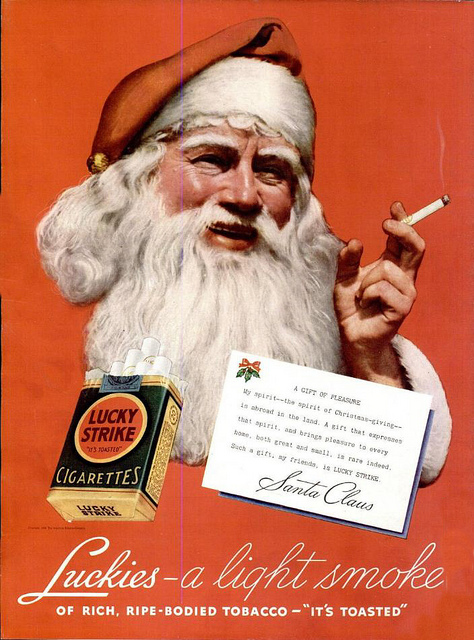
The "good old days" when Santa sold smokes


The Guardian reported last October that a new edition of Clement C Moore's 1823 poem A Visit from St. Nicholas, which is widely attributed with popularizing the modern image of Santa Claus, has censored all references to the visitor's pipe:

"The stump of a pipe he held tight in his teeth, 
And the smoke, it encircled his head like a wreath"

Canadian publisher Pamela McColl released the bowdlerized poem through her own company, Grafton and Scratch.

Ms. McColl explains:
"I have edited out a few words and lines that reference Santa smoking and removed the cover illustration of his pipe. The omission of these few words do not change the material intent of the author nor do they infringe on the reader's understanding or enjoyment of this historically-rich story, but by removing these words we may save lives and avoid influencing new smokers," she says. "I think these edits outweigh other considerations. If this text is to survive another 200 years it needs to modernise and reflect today's realities. I want children to celebrate the spirit of giving and to reflect proudly on the holiday traditions that shape their childhood, and the best way to honour Santa and this story is to make him smoke-free."
When my parents were kids, Santa didn't just smoke a pipe. Through the magic of big tobacco advertising, he also enjoyed promoting several brands of cigarettes:


Source

Source

Source
Source


I'd just like to add that I totally disagree with what Pamela McColl did to the old poem. 

I am also very much anti-smoking, but I am also anti-censorship. Old works are expressions of their time, and they provide an opportunity to talk with kids about why certain things were considered okay in the past, and why they are not now. In my opinion, this helps prepare kids for a world in which "normal" is a constantly moving target. By sheltering them, you only make them believe that the world was always as it is now. And how are they supposed to cope with change then?


Monday, November 26, 2012

Can you shame a pregnant woman into quitting smoking?


It's a beautifully-executed ad, by Kelliher Samets Volk for the Vermont Department of Public Health (via Adrants).

It's also an approach that has been done before, by Different for the NHS:


Original or not, however, I don't think it will make a damn bit of difference.

All too often, public social marketing campaigns are based on the assumption that "if only those people knew that what they were doing is harmful, they'd stop."

I'll put it out there that most people who have a drug problem know it is harmful to them, and possibly to others. I doubt many smokers, problem drinkers, or street and prescription drug abusers are so deluded as to think they are doing no harm. But they are addicted, and addiction overrules self preservation. If it didn't we wouldn't have the problems we do.

This ad, as beautiful as it is, only serves to add to the public shaming of pregnant women who smoke by the general public. But shame is not a great motivator to change, especially when you have already made the shamed one an outcast.

The ads above are subtle, but it is part of a train of thought that includes these:

Via Wordpress

Via Wordpress

Via Google

Via DeviantArt
Via HazellCottrell

Via Coloribus

And then there's this:


I want to make it clear that I don't want women to smoke while pregnant. My problem with the prevailing attitude among social marketers is the insistence that you can shame and blame people with drug problems into behavioural change.

The other issue I have is how much these campaigns can take on the visual vocabulary of the anti-abortion movement:

Via World Health Organisation
With that approach comes the implicit message that a pregnant women's body does not belong to her, it belongs to society at large. And that is not okay.

Pregnant women who smoke need encouragement and help to quit, without being judged or frightened.   They need our support and understanding, not our looks of disdain. When is someone going to stop treating addicts like "rational consumers" of social policy, and actually take this issue on from a harm reduction point of view?

I'm ready whenever you are.