Showing posts with label mining. Show all posts

Friday, September 28, 2012

Is Buyral Marketing good CSR?

I just made up that term. I needed something to describe the proliferation of campaigns that buy social spread by promising to donate for each "like" or "RT" received.

Here's today's example:


"Zinc Saves Lives" is the corporate social responsibility brand of Teck Resources, a mining company that specializes in copper, coal and zinc. So by retweeting this post, you're acting as a free social media promoter for the mining company, as well as potentially saving a child's life.

When I see these campaigns, I can't help but by cynical. That's because I know how they work.

You see, most big corporations have a social responsibility strategy, both to enhance their brand and to earn social licence (that is, community support) in the regions in which they operate. These activities have a set budget, a chunk of which is earmarked for conspicuous corporate giving to a relevant cause.

In the case of Tek, it takes the form of "We Day":


You can see the actual donation budget if you look at the fine print:
Teck will donate CAD$0.50 for every retweet of the designated We Day tweet, up to a maximum total for each We Day event (CAD$20,000 for Toronto, CAD$20,000 for Vancouver, CAD$10,000 for Alberta, CAD$5,000 for Montreal and CAD$5,000 for Ottawa). The total donation from Teck for the entire campaign is capped at CAD$60,000.
So, Tek has budgeted a $60,000 gift to "Zinc Saves Kids, an initiative of the International Zinc Association in support of UNICEF." But instead of just giving their trade association the money (to enhance its reputation, too) Tek is emotionally blackmailing Twitter slacktivists to do their advertising for them — for free. Instead of the limited PR they get for just handing over a lump sum, they engage large numbers of social media do-gooders to spread their goodwill all over the internet.

Here's another example of buyral marketing, from the pharmaceutical industry (via Osocio):


In this case, a simple repinning of the image gets a hefty $10 donation to the Breast Cancer Society of Canada. All you have to do is help Bayer spread their one-a-day brand all over Pinterest.

And once again, there is a maximum. The donation cap is $30,000.

This isn't a particularly bad thing. Charities need private donations, and people love to feel like they're saving the world. But people need to know what they're being asked to do, and by who.

Are you concerned with the ethics of buyral marketing? Add your comment below.

Monday, May 28, 2012

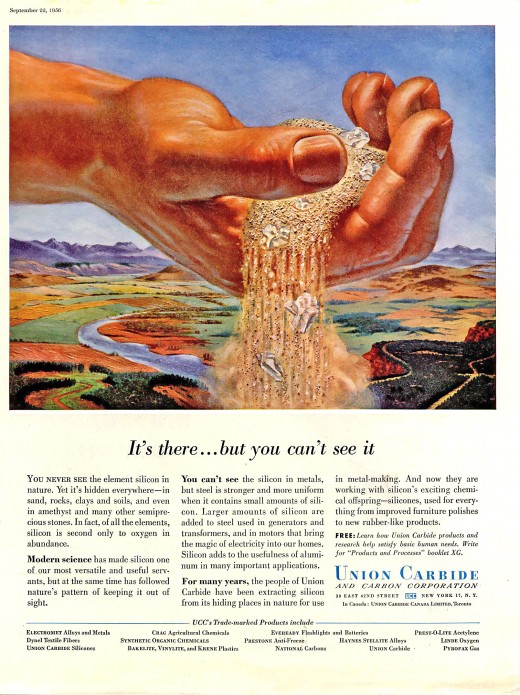
Union Carbide's 1950s promise of "...a hand in things to come"

How d'ya like them apples?

Retronaut recently featured this amazing gallery of Big Brother-ish ads from Union Carbide. Besides the classic 1950s illustration and long copy, they are fascinating for the postwar arrogance of the whole thing.

This was an era when science was on the march, and anything was possible if we had the right men on the job. From pesticides to energy, petrochemicals to bionic parts, this company promised to shape the world of tomorrow.

The real question is, how many of these were positive developments, and how many contributed to the sad state of the world today?

Chemicals from coal. Check out the green mist.
Yikes!
This environmental destruction is supposed to be inspiring, not terrifying.
My elbow was recently rebuilt with stuff like this.
sand... I mean SAND!
Fabricated building materials. Dig the sexy lede.
The original Green Revolution.
Weatherproof materials and treatments.
Oscar-winning arc lighting.
Plastic landscape fabric.
God complex much?
Maybe se should go back to the word "atomic".
People are much less likely to mispronounce that.
Powering the modern housewife...

...and the jet set.
Of course, the optimism couldn't last forever. In December 1984, Union Carbide ended up having a "hand" in killing 3,787 people in Bhopal, India, when one of their pesticide plants leaked deadly toxins into the air of the nearby slums.

Among their other handiwork are the dioxins in Sydney Harbour, Australia, that have made all fish there unsuitable for human consumption, death by silicosis of 476 West Virginia miners in the 1920s, and buildings with lots and lots of asbestos.

 I wonder if these two later turned on, tuned in, and dropped out?

Friday, May 11, 2012

The most obscure sexist marketing you will see today #FdAdFriday


Vibrating grizzly feeders, according to Thailand's Dove Mining, "are designed for continuous and efficient classification, separation of the ore and aggregate for sizing, removing the unwanted and oversize materials and bypassing the smaller particles for the Crusher, or Trommel, and the processing plant, which results in maximizing the plant capacity."

They are also, these models remind us, a product for which the target market is men who spend weeks in isolation mining the far reaches of nowhere:


So while the use of attractive, lightly clad women to provide "eye candy" in the product shots may be obscure, it is not really surprising. It's part of the long tradition of pin-up calendars from the hardhat days of yore.

Via Reluctant Paladin
Tip via boingboing