Showing posts with label drugs. Show all posts

Monday, February 24, 2014

Should cold medicines sponsor Olympic athletes?


That's the question I asked myself when I saw this ad on TV (or was it preroll? Hard to remember anymore):


 I was immediately reminded of the tragedy of Andreea Răducan, the young Romanian gymnast who had her gold medal taken away in the 2000 Australian Summer Games when she tested positive for pseudoephedrene—a common decongestant which was also a banned stimulant. The story was that her team doctor had given her medication for sniffles. The drug was not banned by the international gymnastics federation, but is on the IOC "doping" list.

According to Wikipedia, pseudoephedrine was removed the banned substances IOC list in 2004, when the IOC adopted the World Anti-Doping Agency (WADA) list. Although WADA initially only monitored pseudoephedrine, it was put back on the banned list for WADA/IOC in 2010.

Fast Forward to Sochi in 2014, and pseudoephedrine is back in Olympic news:
Sweden’s star center Nicklas Backstrom wasn’t allowed to play in the gold medal game against Canada after testing positive for a banned substance. 
An NHLPA source told Yahoo Sports that Backstrom violated anti-doping rules after tests showed an elevated level of pseudoephedrine, a banned substance by the IOC and the World Anti-Doping Federation. 
Backstrom has taken Zyrtec-D for several years for allergies. He said he takes on pill per day.
Zyrtec-D contains cetirizine and pseudoephedrine. And Sweden lost the Gold Medal game to Canada, 3-0.

I can't believe that national team doctors are not aware of a banned substance that is in many, many, cold remedies that can easily remove a star athlete from the games. I find it even more odd that a cold medication is promoting its use by athletes.

But there's a loophole here. Because pseudoephedrine is the main ingredient used to synthethize street meth, the United States government restricts its sales. Vick's was forced to replace the pseudoephedrine with phenylephrine. Everywhere else, including Canada, the over-the-counter cold meds still have the (in my experience, much more effective) pseudoephedrinePhenylephrine is also a stimulant, but it is only "monitored" by WADA.

So these American ads show an athlete taking a brand medication where everywhere except his home country would disqualify him from the Olympics (if, for example, he picked some up while competing abroad). Is that really a good idea, Vicks? Is it?

Ted Ligety earned Gold in the men’s giant slalom at Sochi. Presumably, he didn't take the wrong medicine.

Monday, January 6, 2014

Another campaign tells young women "don't get raped"

Image via Ads of The World

You just have to shake your head. No matter how often people speak out against well-meaning social marketing campaigns that unintentionally (or not) normalize rape culture, people keep making them.

This one comes from Calderdale Council in West Yorkshire, produced in-house by the creative team of Stuart Kerray and Dave Follon. The Council told The Mail they hoped their campaign "will reduce crime and shock revellers into thinking twice about how much they drink."

Writing in her Wordpress blog, Karen Ingala Smith saw it differently. I'll let her take it from here:
Though the poster doesn’t explicitly mention rape,  the lines “when you drink too much you lose control and put yourself at risk” together with an image of a dishevelled young woman in a short dress, make clear that the risk is that of sexual violence. The article was picked up widely re-reported including in The Independent and Daily Mail and eventually discussed in a piece by Sarah Vine under the title “Sorry sisters, but girls who get blind drunk ARE risking rape” in which she stated her  refusal to join “the chorus of feminist disapproval” and argued that women need to take responsibility for their own safety, going on to mention “one or two nasty brushes” that made her realise how important it was to not willingly put herself in the path of danger and “stupidly” becoming a victim. 
The concept of a victim of violence ‘willingly and stupidly putting themselves in the path of danger’ is judgemental victim blaming.  Whether though an act of choosing  or not choosing to do something, a victim of sexual violence is never responsible for what is done to them. Rapists and abusers are the only ones responsible for rape and abuse. 
Rapists and abusers use excuses to justify their actions,  to discredit their victims and to shift responsibility for their choices away from themselves and on to their victims.  They use exactly the kind of excuses encapsulated in the Calderdale poster and Vine’s piece, in short: “She didn’t take care. “ or “She was asking for it.”
Is she reading too much into it? Let's look at how the same campaign advertises to male bingers:

Via Ads of The World

Via Ads of The World
Same playful concept, but no hint of sexual consequences. Instead, the ads talk about the danger of hurting yourself and others. Women as victims, men as aggressors. You've seen it all before.

The council’s Cabinet member for economy and environment, Coun Barry Collins, told the Yorkshire Post (in a classic non-apology) that the images "were not intended to cause offence."
We have used images of both men and women to raise awareness of the impacts on anyone of taking drugs and drinking too much. The aim of the campaign is to expose as many people as possible to timely advice to enjoy a safe night out.
He said the same images were used 
last year, with no complaints until now.

So perhaps some progress has been made?

Tuesday, October 8, 2013

Pro-pot ads address the hypocrisy of legal booze


Don't get me wrong — I like the drink. But since I was old enough to understand such things, in the '80s, I have railed against a legal system in which alcohol and tobacco are perfectly legal drugs for adults and something as soft as marijuana is not.

As a matter of fact, my very first paid writing job was a full-page 1990 op ed in the Kingston Whig-Standard in which I looked at the history of drug legislation as one of socially accepted versus not-accepted drugs. It's a history that often had to do more with racism and industry than with medicine or other sciences.


So I have to admit that I like this bold campaign by The Marijuana Policy Project in Portland, Maine. According to NY Daily News, the organization spent $2,500 on a transit campaign that support's the city's ballot measure to legalize recreational adult cannabis use.


Despite complaints from people who claim the ads will encourage pot smoking by youth, the transit system says they have no choice but to leave them up, because they are genuinely political. “If we’re going to allow one type of political advertising, we have to allow it all,” a spokesperson told the Portland Press Herald. It is also notable that Greater Portland District Transit allows alcohol ads on their buses (but not tobacco), rendering the "won'tsomeonepleasethinkaboutthechildren" argument another double-standard. Medical marijuana use is already legal and regulated in Maine.

But is pot safer than booze? The death toll of alcohol through overdose, liver damage, drunk driving and alcohol-fuelled violence is well documented. Pot's potential harms, besides  are barely understood.

According to the US National Institutes of Health, the problems with alcohol are simple (if sometimes devastating) but well-understood:
Alcohol affects every organ in the drinker's body and can damage a developing fetus. Intoxication can impair brain function and motor skills; heavy use can increase risk of certain cancers, stroke, and liver disease. Alcoholism or alcohol dependence is a diagnosable disease characterized by a strong craving for alcohol, and/or continued use despite harm or personal injury. Alcohol abuse, which can lead to alcoholism, is a pattern of drinking that results in harm to one's health, interpersonal relationships, or ability to work.
The same organization takes a lot longer to explain the harmful effects of marijuana, partly because the research is sparser and less conclusive:
Marijuana use can have a variety of adverse, short- and long-term effects, especially on cardiopulmonary and mental health. 
Marijuana raises heart rate by 20-100 percent shortly after smoking; this effect can last up to 3 hours. In one study, it was estimated that marijuana users have a 4.8-fold increase in the risk of heart attack in the first hour after smoking the drug. This may be due to increased heart rate as well as the effects of marijuana on heart rhythms, causing palpitations and arrhythmias. This risk may be greater in older individuals or in those with cardiac vulnerabilities. 
Marijuana and Driving 
Because it seriously impairs judgment and motor coordination, marijuana also contributes to accidents while driving. A recent analysis of data from several studies found that marijuana use more than doubles a driver’s risk of being in an accident. Further, the combination of marijuana and alcohol is worse than either substance alone with respect to driving impairment. 
Marijuana smoke is an irritant to the lungs, and frequent marijuana smokers can have many of the same respiratory problems experienced by tobacco smokers, such as daily cough and phlegm production, more frequent acute chest illness, and a heightened risk of lung infections. One study found that people who smoke marijuana frequently but do not smoke tobacco have more health problems and miss more days of work than nonsmokers, mainly because of respiratory illnesses. 
A number of studies have shown an association between chronic marijuana use and mental illness. High doses of marijuana can produce a temporary psychotic reaction (involving hallucinations and paranoia) in some users, and using marijuana can worsen the course of illness in patients with schizophrenia. A series of large prospective studies also showed a link between marijuana use and later development of psychosis. This relationship was influenced by genetic variables as well as the amount of drug used and the age at which it was first taken—those who start young are at  increased risk for later problems. 
Associations have also been found between marijuana use and other mental health problems, such as depression, anxiety, suicidal thoughts among adolescents, and personality disturbances, including a lack of motivation to engage in typically rewarding activities. More research is still needed to confirm and better understand these linkages. 
Marijuana use during pregnancy is associated with increased risk of neurobehavioral problems in babies. Because THC and other compounds in marijuana mimic the body’s own cannabinoid-like chemicals, marijuana use by pregnant mothers may alter the developing endocannabinoid system in the brain of the fetus. Consequences for the child may include problems with attention, memory, and problem solving. 
Finally, marijuana use has been linked in a few recent studies to an increased risk of an aggressive type of testicular cancer in young men, although further research is needed to establish whether there is a direct causal connection.
In my opinion, every drug — whether recreational or medicinal — has the potential to be good, bad or ugly. It's all a matter of how it is used.

You can read the campaign's own comparative argument for legalization at marijuanaissafer.org.


Tuesday, July 2, 2013

Nasty UNICEF campaign trashes "sluts", "dealers" and "drunks"


I couldn't believe my eyes when I saw this UNICEF campaign by Prolam Y&R, Chile, on Ads of The World. I can see where they came from — children need a good education to get out of poverty and the cycle of crime, sex work and substance abuse — but is this really the best way to show that?


First of all, the ads show a "negative" rather than a "positive" outcome. I guess the message is, "if you don't help these kids, where will their education come from?" 

But it does it in such a way as to assume that people in poverty end up in the underworld simply because of bad influences around them, rather than because their socioeconomic circumstances leave them few options. To blame the "slut" (I assume they mean "prostitute"), the dealer and the substance abuser in this way is not helping. It's shaming.


UNICEF does good work in education. But if they did actually approva this ad (one never knows, these days) they could do a much better job on educating the public about the political, social and economic causes and outcomes of poverty.

Friday, June 21, 2013

Is Miley's ode to MDMA the best anti-drug PSA ever?


"Molly" is the powdered or crystal form of MDMA, a more potent form of ecstasy.

Effects include...

Increased feelings of intimacy:


Derealization:


Depersonalization:


Altered perceptions:


Positive basic mood:


Anxiety:


Loss of thought or body control:


Hallucinations:


And thought disorder:


In other words, kids, "Just Say No".

Stills via Vice.

Wednesday, May 15, 2013

This is how you do sex in advertising


It can be done. Just watch:


I was a little worried at first, with the lesbian fetish cliché of the two women kissing, but when bethonged spokesman Brandon Allen gets in bed with the threesome, the ad achieves a kind of self-deprecating charm and irony.

The point is that sex in advertising isn't bad by itself. The problem is when the sex is all about objectifying women's bodies and sexuality for men's viewing pleasure. Sexual humour that treats everyone equally isn't a problem when the context and the audience are appropriate.

There are two other ads in the series. One deals with BDSM:


The other, dope:


These ads are all about brand over product. It's the sort of unpretentious marketing that goes over well with the growing numbers of undemanding new wine drinkers.

Tip via AdFreak

Monday, April 15, 2013

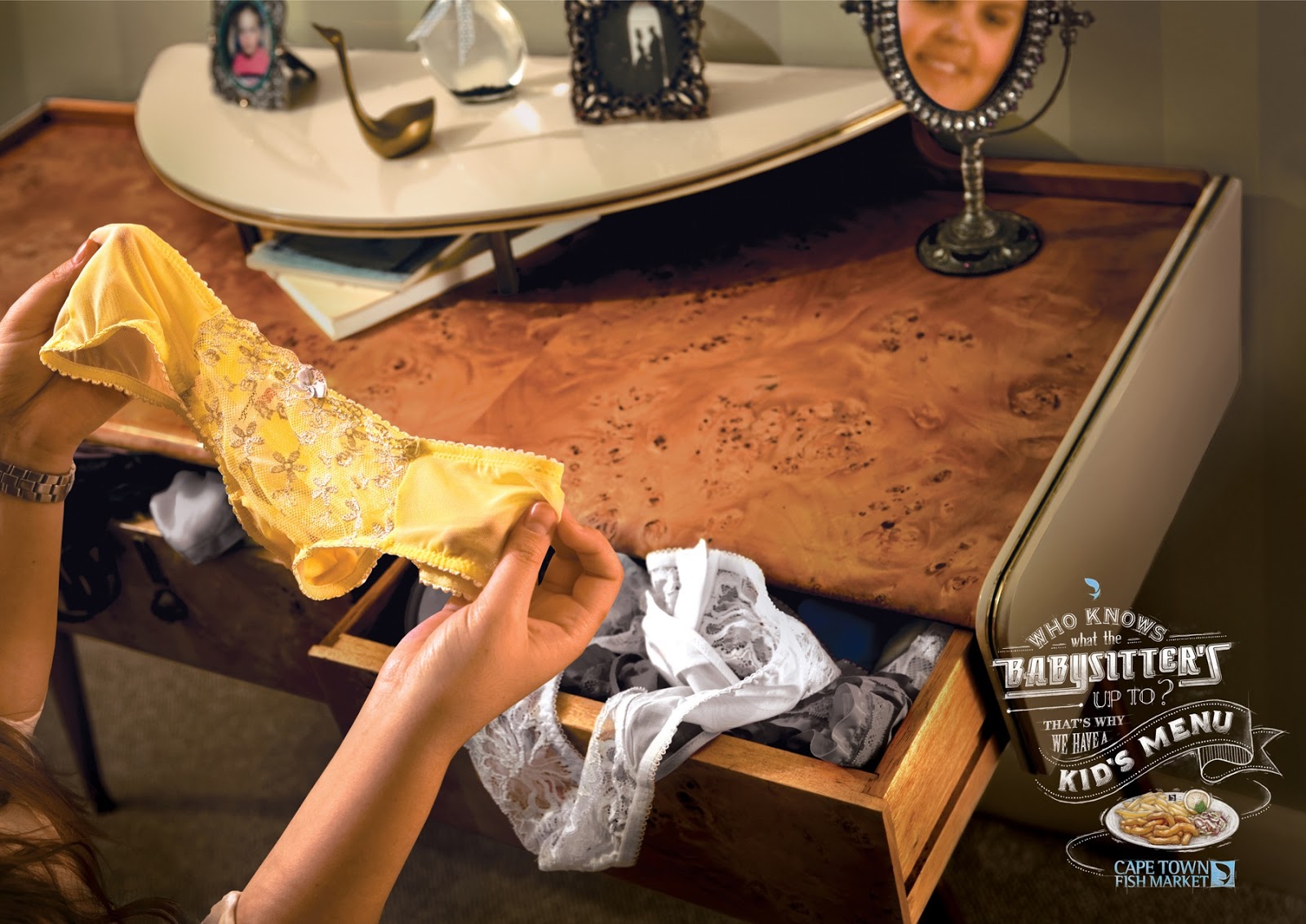
The most inappropriate "kids menu" ads ever


These ads are such obvious awards bait, I had to make Google Cape Town Fish Market to assure myself that the restaurant exists.

It does, but it's unlikely that any restaurant would pay for this many executions of such an unsettling concept. So it's either another "ghost ad" (to use Adland's terminology) or else the agency secured the account by putting up  a lot of extra work as compensation for the client allowing the creatives to do whatever they felt like.

There's a third alternative, that a family-oriented restaurant actually did think a campaign of teen sex, drugs,  baby burning and the occult was a great way to sell fish fingers. Hmmm...


All images via Ads of The World

Friday, January 4, 2013

The US Navy launches one of the world's worst anti-drug campaigns


Business Insider writes, "The U.S. Navy produced this public service announcement warning recruits against using bath salts for all the obvious reasons -- vomiting, paranoia, brain swelling and violent behavior. Plus, you might see demons!"


Sort-of-cool Exorcist references aside, it commits many of the cardinal sins of drug awareness social marketing: It overstates the danger (showing a first-time use as immediately deadly); it's laughably cheesy; and it ends with a big lecture from "the man".

"Bath salts" are a nickname for a family of designer drugs typically containing substituted cathinones. According to Wikipedia, they have effects similar to meth and cocaine.

Not that that's a good thing. But these drugs are in widespread use among youth. When you only show the worst-case scenario for a recreational drug, you risk losing all credibility with any new user who experiences a good trip — or even knows someone who has had a few.


Friday, December 21, 2012

An obituary for the War on Drugs

According to Boing Boing, this ad ran full-page in yesterday's New York Times. It's from the Drug Policy Alliance. Its honourary Board of Directors includes Harry Belafonte, Former Surgeon General Joycelyn Elders, U.S. District Court Judge Robert Sweet, Richard Branson and Sting.

Here's the text:

80 Years After the End of Prohibition, Prohibition is Finally Coming to an End 
Voters in Washington and Colorado made history on Election Day when they voted to legally regulate and tax marijuana. Their votes signaled the beginning of the end for the costly and unjust war on drugs. 
Thank you to the citizens of Washington and Colorado. 
The Drug Policy Alliance is especially proud of this milestone, as we worked for years to make this historic day happen. 
We’d also like to thank: President Bill Clinton for acknowledging the drug war’s futility and failure; President Jimmy Carter and Pat Robertson for saying it’s time to legalize marijuana; Governor Christie for calling the drug war a failure and Governor Cuomo for working to end New York’s racially discriminatory marijuana arrest crusade; Congressmen Ron Paul and Barney Frank for introducing the first bill to end federal marijuana prohibition; Presidents Santos (Colombia), Pérez Molina (Guatemala) and Mujica (Uruguay) for breaking the taboo on alternatives to drug prohibition; and, most of all, our many allies around the world for demanding no more drug war. 
We strive for the day when drug policies are no longer motivated by ignorance, fear and prejudice but rather by science, compassion, fiscal prudence and human rights, with education and treatment available for everyone. Help us fight the good fight by making a tax deductible donation.

The DPA is currently hosting a petition to President Obama not to interfere with the state-level legalization.


Thursday, November 29, 2012

Domino's 420 special is back (on the viral circuit)

Hey, didn't I blog about this in 2011? Well, it's back:


Via Buzzfeed
420, 4:20, or 4/20 (pronounced four-twenty) is a term used primarily in North America to refer to the consumption of cannabis and, by extension, a way to identify oneself with cannabis subculture. Observances based on the number include the time (4:20 p.m.) as well as the date (April 20). 
The earliest use of the term began among a group of teenagers in San Rafael, California in 1971. Calling themselves the Waldos, because "their chosen hang-out spot was a wall outside the school," the group first used the term in connection to a fall 1971 plan to search for an abandoned cannabis crop that they had learned about. The Waldos designated the Louis Pasteur statue on the grounds of San Rafael High School as their meeting place, and 4:20 p.m. as their meeting time. The Waldos referred to this plan with the phrase "4:20 Louis". Multiple failed attempts to find the crop eventually shortened their phrase to simply "4:20", which ultimately evolved into a codeword that the teens used to mean pot-smoking in general. 
High Times editor Steven Hager wrote "Are You Stoner Smart or Stoner Stupid?" in which he called for 4:20 p.m. to be the socially accepted hour of the day to consume cannabis. He attributes the early spread of the phrase to Grateful Dead followers, who were also linked to the city of San Rafael. (Wikipedia)

Thursday, November 15, 2012

These heroin ads are not a PSAs


From Wikipedia:
In 1895, the German drug company Bayer marketed diacetylmorphine as an over-the-counter drug under the trademark name Heroin. The name was derived from the Greek word "Heros" because of its perceived "heroic" effects upon a user. It was developed chiefly as a morphine substitute for cough suppressants that did not have morphine's addictive side-effects. Morphine at the time was a popular recreational drug, and Bayer wished to find a similar but non-addictive substitute to market. However, contrary to Bayer's advertising as a "non-addictive morphine substitute," heroin would soon have one of the highest rates of dependence among its users.

Yes, that Bayer. The story of how Heroin was first marketed as a treatment for opium addiction is a popular one. But this is the first time I've seen an actual ad for it (via Retronaut).


There was soon also competition to the German drug, in this case from the Martin H. Smith Company of New York:


New York University at Buffalo's Addiction Research Unit writes:
Heroin was widely used not only as an analgesic but also as a remedy for asthma, coughs, and pneumonia. Mixing heroin with glycerin (and often adding sugar or spices) made the bitter-tasting opiate more palatable for oral consumption. 

 Candied heroin. What could possibly go wrong?

Friday, April 27, 2012

1980s War on Drugs PSAs do not age well #FdAdFriday

He is pitying the living fuck out of that fool.

Especially when they feature Mr. T and New Edition. (Although I'm not sure Bobby Brown should be giving any lectures about drugs.)


Via Buzzfeed

Thursday, February 9, 2012

Whippets on demand

This was on Buzzfeed:


To repeat: these nitrous oxide ("laughing gas")  cartridges are not for inhaling to get high. The service is for people who have whipped cream emergencies in the middle of the night.

The link directs to a Facebook Page, which explains:
"2 box minimum boxes of 24 $30 a box delivered to your door.
...................................Cases for $650.........................................
-------------------1.415.592.4070----------------------

This is the highest quality European nitrous oxide whip cream chargers available. Ultra-Purewhip is produced by an Austrian company using the latest filtration technology for unmatched purity. Ultra-Purewhip is offered with the idea of offering the purest, highest-quality nitrous oxide cartridge at an economical price.
Ultra-Purewhip is always guaranteed to arrive with a full, 8 gram charge of 100% pure nitrous oxide. You will not discern any off-taste in even the most subtle whips. Try this brand and see for yourself!"

Plus, of course: "We do NOT condone any miss use of our product!!!!!!!"

Demi Moore, take note...

Monday, February 6, 2012

Meanwhile in Canada, cup sizes are increasing rapidly


I'm talking about coffee, pervs. My brother David shared this snapshot of Tim Horton's newly- recalibrated coffee sizes.

The extra large is now 710 ml, or 24 ounces. That's over three cups of coffee in one.

According to City TV:
The change brings Tim Hortons sizes more in line with American chains, that have phased out the 236 mL “small” cups, and competitors including Starbucks, Second Cup and McDonalds.


They are, obviously, responding to customer demand. But is it really a good idea? I've had that much coffee in one sitting before, sure. But I drink mine black. Imagine the amount of cream and sugar it takes to make one of these as sweet and creamy as the traditional "double double" — quadruple quadruple? Quintuple quintuple?

Hey, do what you want with your life. But please don't fool yourself into thinking that getting a coffee like this every day, with the fat and calories that go with it, isn't going to weigh heavily on your health. (While we're at it, I guess we had better recalibrate clothing sizes again too.)

Monday, December 19, 2011

A CSR ad with teeth


Rotten teeth. Ewwww...

It's for Industrial Strange Clubwear in Austria, by P&P Medien.

I don't thing they thought the English copy tthrough very well, though. (You don't need teeth to make the "B" sound, for example.)

Via Ads of The World

Friday, December 2, 2011

F'd Ad Fridays: Won't somebody PLEASE think about the PAs?


This crappy anti-bootlegging PSA by the US Bureau of Justice accuses people buying pirated DVDs of supporting child labour, drug trafficking, organized crime, gang violence, and worst of all...

The laying off of Hollywood Production Assistants
Please, people. Think of the PAs.

Via BoingBoing

Tuesday, November 29, 2011

1 in 5 teenagers will experiment with art

An illustrator friend, Marc A., shared this on Facebook:

Hosted by the Philbrook Museum of Art

Considering how much dope gets smoked in art schools, though, the comparison may be a little too close for comfort.

Friday, November 25, 2011

F'd Ad Fridays: The Pope shills for cocaine wine

Via Cracked

19th century Pope Leo XIII was such a big fan of Mariani wine (a patent medicine made of Bordeaux and coca leaves) that he awarded a Vatican gold medal to the wine, and also appeared on a poster endorsing it.

Talk about high holiness...

Friday, November 4, 2011

F'd Ad Fridays: Throwing your own poo (it's not a good look)

Copyranter shared this one from Belfast:


'ranter points out that the URL is for the city's anti-littering site. It's actually a satirical art hack of this campaign: