Showing posts with label rape culture. Show all posts

Thursday, June 23, 2016

#canneslions bronze winner for Bayer makes fun of consent


I first saw this ad on Twitter, shared by marketer Cindy Gallop, with the comment "Don't use this to sell aspirin, male-dominated ad industry, & don't award it, male-dominated juries. #canneslions"

Seriously. I'm a male Creative Director in this industry, and I think it's awful.

The ad is part of a series by AlmapBBDO of Brazil for Bayer. It won a Bronze Lion at Cannes 2016 in the Outdoor category.

The other two in the winning entry were a little less explicit:


These are part of a over-arching campaign that describes situations that might give the listener/victim a headache. They play all kinds of stereotypes about ex-wives and protective fathers, and are mostly harmless.

But not "'Don't worry, babe, I'm not filming this'.mov"

I see a lot of regressive ads coming out of Brazil, and I'm used to a certain kind of humour in them. But this one, translated into English for an international awards show, is really bad timing for a joke about non-consensual filming of sex.

Yeah, yeah. Call me an "SJW" if you want. But I'm trying to raise a son into a man who doesn't exploit and abuse women. The idea of filming and possibly sharing an intimate sex tape of a woman without her consent is just not funny anymore. It's the kind of bro-attitude that we should be denormalizing, rather than normalizing, along with jokes about other kinds of sexual violation.

Bayer, BBDO, and Cannes should do better than this. It's 20-effing-16.

UPDATE: Cindy Gallop added, via Facebook, some further context as to why this ad's timing is so bad.

UPDATE 2: Adweek reports that BBDO global creative chief David Lubars, who stated: "I learned last night that one of our very own agencies had a pretty scammy ad in the festival, and it won a Lion, I told them to return it. Because I don't want that kind of Lion. BBDO doesn't want that kind of Lion."

It turned out that the sexism was one thing, but what the global ad giant couldn't stand was that AlmapBBDO had paid for their own media placement. Even though Bayer had signed off on the ad, the agency paying to make it official is against the rules.

Tuesday, April 28, 2015

Bud Light's #UpForWhatever campaign raises Congresswoman's ire


Oh, Bud. What were you thinking?

My friend Lyndsay just drew my attention to the marketing line on a Bud Light label that is accidentally(?) anti-consent.

The campaign, which features young people doing stupid things after drinking away their inhibitions, includes beer labels with throwaway lines like "The perfect beer for singing out loud, even if you don't know the words," and "The perfect beer for going without a ticket and still getting into the show."


Unfortunately, one of these lines was “The perfect beer for removing 'no' from your vocabulary for the night.”

As Chris Morran writes at Consumerist,
"Given the role that alcohol plays in many things that would have been a 'no' without a night a drinking — driving under the influence, sexual assault, vandalism, public urination, random “woot-woot”-ing as you ping-pong down the sidewalk — it’s probably not the best idea for a multinational multibillion-dollar business like Bud Light’s parent company AB InBev to publicly acknowledge that its product can lead users down a path to stupid consequences."

A storm in a beer stein? Hardly. The mistake has motivated US Congresswoman Nita Lowey to publicly admonish the brand on Twitter:


Twitter is lighting up with angry disapproval of the marketing and #nomeansno Tweets.

It's quite possible that this line was simply intended to be about partying without a care, but in today's media environment marketers need to be especially sensitive about miscommunication.

They also have to be responsive to disasters like this. But @budlight has not Tweeted since April 26. Double fail.

UPDATE: BuzzFeed managed to get this statement from  Anheuser-Busch vice president Alexander Lambrecht:
“The Bud Light Up for Whatever campaign, now in its second year, has inspired millions of consumers to engage with our brand in a positive and light-hearted way. In this spirit, we created more than 140 different scroll messages intended to encourage spontaneous fun. It’s clear that this message missed the mark, and we regret it. We would never condone disrespectful or irresponsible behavior.”
UPDATE 2:


Thursday, October 30, 2014

Esquire's guide to buying your way out of the "friend zone"


The "friend zone" is a myth, but it's a powerful one. It's a fantasy created and maintained by boys and men who think they have been unfairly denied sexual access to a woman who — as far as they're concerned — should be interested in them physically but isn't.

Other people have written about how problematic this myth is. It's based on some pretty primitive ideas about sexual relations, such as that "nice guys" are tragic figures who women take for granted and that women are possessions to be won. Articles about "how to get out of the friend zone" are even more insulting to women, suggesting manipulative tactics straight out of the "pick-up artist" handbook.

Enter Esquire's "THE DO'S AND DON'TS OF DRESSING TO GET OUT OF THE FRIEND ZONE" an advertising feature that tells men the best way to convince those selfish vagina-hoarders (aka "women") that their own feelings and agency have nothing to do with who they are attracted to.

It's really just a matter of buying the right clothes:


That's right, lads: For just a $350 investment, you could turn that "no" into a "yo". Who could resist a man in this shirt? (Truth be told, it's making me question my own sexuality. And I'm not even friends with expressionless Beard Guy.)


It's nice to know that all those dry spells could have easily have been solved with $500 worth of shaving gear. What was I thinking? The friend zone doesn't stand a chance against a good shave. (Don't tell Beard Guy!)


One of the more affordable ways to show her that you only hang out with her for possible sex.

I'll have to admit, I used stinky stuff as a teen. I didn't know it was still a thing. (Hope she's not allergic.)


I had no idea that not being trendy was so expensive. But if these not-at-all trendy jeans make her think about getting me out of them, take my money! TAKE IT!!!


Bwahahaha!

No, really? It's $3,500 worth of "Look, I know you said I wasn't like those other guys, but I kind of am. Just much, much worse."


What is that even, and how will it help me convince this woman that friendship is just the gentleman's prelude to banging?


Because actually putting yourself in her shoes is way too much to ask.


"So, Madison, you don't think he's kind of cute?"

"You know the rules, Dakota. I'd be all over him, but he wears boring sweaters. So I think I'll spend a lot of my valuable time with him, and tell him all my thoughts and feelings, but withhold my sexual favours until he gets better fashion sense."


Wear your edgiest shades when you meet her, and when she asks to try them on know that she's starting to come around to you. 

(I didn't write that, BTW. It's actually in the article!)


This scarf says one thing, and that's "our friendship feels like a consolation prize".


The author disagrees with me that this article is regressive, creepy, PUA bullshit. But it's time to put this "friend zone" nonsense to rest.

If a woman is not interested in you sexually, your job is to respect her feelings. If she wants to be friends with you, that is not an invitation to spend your time together trying to manipulate her into giving in to your advances. It means she actually wants to be your friend. Or at least let you down easy. (You'll know soon enough.)

If you don't get that women's friendship is valuable in itself, then no amount of shopping can make you less of an asshole.

Thursday, July 31, 2014

8-year-old NHS PSA causes fresh outrage over victim blaming


Via Daily Mail

Patrick, a reader, made me aware of the latest example of an anti-binge-drinking ad that ends up promoting the culture of blaming victims of rape.

In this case, it's the UK government's National Health Service that is causing outrage.

The Drum reports that the poster actually dates back to 2006,  part of the "Know Your Limits" campaign, but it is still available as part of an online toolkit and posted in some health facilities.

A Change.org petition, launched recently, states:
Two honourable intentions -- to stop people drinking, and to stop rape happening - are being completely deformed. Of course we don't want people to drink so much they make themselves ill, but threatening them with rape by implication is not the way to do it. Of course we don't want anyone to endure sexual assault and rape, but making them feel like it's their fault if they do, is so far out of order. 
It is not consistent with the NHS' own guidelines on 'Help after rape and sexual assault' in which they say 'If you have been sexually assaulted, remember that it wasn’t your fault. It doesn’t matter what you were wearing, where you were or whether you had been drinking. A sexual assault is always the fault of the perpetrator.' This is a much more helpful approach, and we ask the NHS and the Home Office to destroy this poster in all formats. 
It currently has over 62,000 signatures.

There have been a number of prominent anti-alcohol campaigns in recent years that have hit these same triggers, including PSAs by MADD, the Pennsylvania Liquor Control Board, CabWise and West Mercia Police.

The fact that the NHS campaign is an older one shows how far we've come in understanding the cultural issues around rape in just a few years, but it is also a reminder to keep your PSA libraries up-to-date.

Thursday, May 8, 2014

A PSA for Ottawa Comiccon #OCC #consent


In the current conversation about consent and sexual harassment/assault, the subject of how people are dressed often comes up. Whether it's a police officer saying "women should avoid dressing like sluts in order not to be victimized" (the wotrds that launched Slutwalk) or questions about behaviour or reputation, victim-blaming contributes to a culture that enables rape.

At this weekend's Ottawa Comiccon, you can expect to see all kinds of attendees, men and women, getting their "cosplay" on as they dress up as their favourite comic book and sci-fi characters.

Via comicsthegathering.com
Unfortunately, some attendees see costumes as an excuse to harass and assault women at the Comicon. To address this issue, Hollaback! will be there, "to explore the issue of harassment in geek spaces and open up the floor to discussions on how we can make the community safer."

They are also participating in the "Cosplay =/= Consent" campaign by Geeks for CONsent, an organization started by Hollaback! Philly that encourages the organizers of comicons to adopt an anti-harassment policy and train their volunteers on how to appropriately deal with offences. They also encourage people share their stories of harassment, to hand out "Harasser Cards," learn how to be supportive bystanders, and to promote the Cosplay =/= Consent meme by posing with branded placards.

Have fun at the con, everyone. Just don't be a SuperAsshole.


Wednesday, May 7, 2014

Comedy Central is really into animals, objects, raping people


What?


WHAT?!?


WTF?!?!?

Apparently, anal rape is funny "in the right place."

This campaign is by Grey, Argentina, and features on Ads Of The World.

Apparently, fat people are also funny:


Or maybe it's rape again. I have no idea.

Thursday, April 10, 2014

Edmonton radio station asks if rape victims "share any blame"


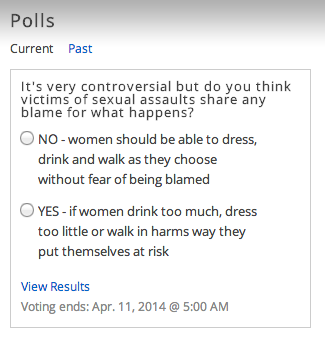
Wait, what? 630 CHED is an Edmonton talk radio station. Today's online poll asks, "It's very controversial but do you think victims of sexual assaults share any blame for what happens?"

Here are the results, as of 1:00 EDT:


I don't know what's worse, the fact that they asked this loaded question or that a third of their respondents want to blame women for being raped.

The station's previous polls run from the trivial ("Will you be celebrating world dog day?")  to impossibly oversimplified takes on big issues ("How would you resolve the problem in Syria?"). However, I failed to see anything else to suggest that victims of violent crime are partially responsible for being attacked.

Here are some suggestions for upcoming polls:

"Do the victims of a home invasion share any of the blame for living in a nice house?" 
"Does the mugging victim share some of the blame for talking on an iPhone in public?" 
"Did the victim of bullying bring it on himself by not fitting in?" 
"Should that fatal hit-and-run victim known better than to walk on the sidewalk after last call?"
Thanks to @TrinaMLee (via @LadySnarksalot) for the "twip":


Tuesday, April 8, 2014

What ISN'T wrong with this violence against women awareness campaign?

Via Ads of The World

This is a real shame, in every sense of the word. I quite liked last year's "You Are Not a Sketch" campaign for this client, Star Models of Brazil, by an agency called Revolution.

But this one? Not. At. All.

Via Ads of The World

Let's ignore the fact that it wasn't translated well into English. (Interestingly, the same campaign on Coloribus gives a different version: "It was the cleavage" and "It was the behaviour") I can't seem to find any Portuguese versions, which leads me to suspect that the agency, Revolution Brasil, created them specifically for international Web sharing.

But these are only shareworthy for how misguided they are. The assumption, that the woman in the middle of each ad is the type of person the viewer would assume was "asking for" sexual violence, and the two on the sides are not, is trying to push a point that no victim is to blame. But in doing so, it uncovers the agency team's prejudice against certain women and in doing so simply reinforces the idea that religious people, mothers, and soldiers are "better" than women who dress "slutty" or dare to have tattoos and pink hair. (WTF is that anyway? An indication that she's rebellious?)

This is not the way to address serious problems, which are commonly known in the present dialogue as "slut shaming" and "victim blaming".  You may be sick of those words, but they represent concepts that clearly are not getting through to everyone. Especially in the ad industry.


Monday, January 6, 2014

Another campaign tells young women "don't get raped"

Image via Ads of The World

You just have to shake your head. No matter how often people speak out against well-meaning social marketing campaigns that unintentionally (or not) normalize rape culture, people keep making them.

This one comes from Calderdale Council in West Yorkshire, produced in-house by the creative team of Stuart Kerray and Dave Follon. The Council told The Mail they hoped their campaign "will reduce crime and shock revellers into thinking twice about how much they drink."

Writing in her Wordpress blog, Karen Ingala Smith saw it differently. I'll let her take it from here:
Though the poster doesn’t explicitly mention rape,  the lines “when you drink too much you lose control and put yourself at risk” together with an image of a dishevelled young woman in a short dress, make clear that the risk is that of sexual violence. The article was picked up widely re-reported including in The Independent and Daily Mail and eventually discussed in a piece by Sarah Vine under the title “Sorry sisters, but girls who get blind drunk ARE risking rape” in which she stated her  refusal to join “the chorus of feminist disapproval” and argued that women need to take responsibility for their own safety, going on to mention “one or two nasty brushes” that made her realise how important it was to not willingly put herself in the path of danger and “stupidly” becoming a victim. 
The concept of a victim of violence ‘willingly and stupidly putting themselves in the path of danger’ is judgemental victim blaming.  Whether though an act of choosing  or not choosing to do something, a victim of sexual violence is never responsible for what is done to them. Rapists and abusers are the only ones responsible for rape and abuse. 
Rapists and abusers use excuses to justify their actions,  to discredit their victims and to shift responsibility for their choices away from themselves and on to their victims.  They use exactly the kind of excuses encapsulated in the Calderdale poster and Vine’s piece, in short: “She didn’t take care. “ or “She was asking for it.”
Is she reading too much into it? Let's look at how the same campaign advertises to male bingers:

Via Ads of The World

Via Ads of The World
Same playful concept, but no hint of sexual consequences. Instead, the ads talk about the danger of hurting yourself and others. Women as victims, men as aggressors. You've seen it all before.

The council’s Cabinet member for economy and environment, Coun Barry Collins, told the Yorkshire Post (in a classic non-apology) that the images "were not intended to cause offence."
We have used images of both men and women to raise awareness of the impacts on anyone of taking drugs and drinking too much. The aim of the campaign is to expose as many people as possible to timely advice to enjoy a safe night out.
He said the same images were used 
last year, with no complaints until now.

So perhaps some progress has been made?

Thursday, October 24, 2013

Can this 1974 "Raped by Mick Jagger" ad be real?


It has to be a hoax. I truly hope so, anyway.

I just saw this posted in the Facebook group "1960's and 1970's Advertisements". From there I tracked it back to a post from last June in Anorak. The oldest post I found was on Flickr from 2008.

Does anyone have provenance on this? Claimed to be from a 1974 "rock magazine," it parodies a long-running campaign for Maidenform begun by the William Weintrob Advertising Agency in New York:

Via Blogspot
So, if you combine 1970s political incorrectness, the bad-boy image of the rock press, a cheap shot at consumerism, and a wink at the contemporary rumours about a Bowie-Jagger affair, would you end up with such an ad?

If you have any information about this, please comment below.

Thursday, September 19, 2013

How many more kinds of wrong can these anti-Obamacare ads be?


Making light of rape. Misleading the public. Abusing a poor old national symbol.

This campaign by Koch Bros. stooges at Generation Opportunity has it all:


All this to try to scare college students out of getting affordable health insurance.

Fortunately, young people tend to see through this kind of advertising. They'll remember it, but only to make fun of it (and of those behind it).

But still... WTF?!?

Tip via Think Progress

Postscript: I like Jezebel's take better — "Ironic as Hell GOP Ad Says The Government Should Stay Out Of Your Vag"

Wednesday, September 18, 2013

This could be the worst Facebook ad of all time

DIY Facebook ads have long been problematic. Cheap to buy (you only pay for the clicks) and easy to create, they lend themselves to the worst sorts of hucksters.

But even worse is the practice of stealing photos for Facebook ads. It not only hurts the credibility and privacy of people who find themselves appearing to endorse random and often inappropriate things. In some cases it can be downright cruel:


According to the CBC, this Facebook ad is for a German internet dating site. (I blocked out the URL. Please don't give them traffic or PR!)

If you don't recognize the face in the ad, that's Rehtaeh Parsons, a Canadian teen who committed suicide last April after being raped at a party while too intoxicated to consent, and experiencing extreme online sexual harassment and abuse when photos of the crime were circulated among her peers.

Whether the company used the photo accidentally or on purpose is unknown. The web site the ad directs to is no longer online.

After outrage over the ad, first spotted by a Facebook user in Toronto, caused outrage, Facebook pulled the ad:
"This is an extremely unfortunate example of an advertiser scraping an image and using it in their ad campaign," a spokesperson from Facebook wrote in a statement, calling this a gross violation of their advertising policies. "We apologize for any harm this has caused."
For once, an organization famous for being so afraid of women's bodies that it even censors the word "breast" in an a non-sexual context is doing the right kind of censorship.

Tuesday, September 3, 2013

Nova Scotia consent ads take heat for blunt sexual language

Via CBC
A campaign about consent by the government of Nova Scotia has provoked mixed reactions from the very groups it hopes to champion, in the post-Rehtaeh conversation about consent and rape culture.

According to the CBC, Sherri Bain, an advocate for survivors of assault, questioned the approach:
"Their design team, I think, missed the mark,” she said. She worries the message could be misinterpreted. 
"For someone driving by, if they're seeing 'take me' and 'do me,' I'm concerned that it may do exactly the opposite of what they're intending," she said. "Our city needs to find another way to advertise besides being so overtly sexual."
A later article adds:
...since the ads have gone up, some young women and groups that work with victims of sexual violence have complained in media reports that they don't explain clearly enough that consent from someone who has been drinking or taking drugs does not qualify as true consent for sex.

Via Global

Global News also posted this shot of the call-to-action from the posters:


The campaign site, novascotia.ca/ask, positions information about drugs and alcohol very prominently.

The ads were created by Communications Nova Scotia (the Chronicle-Herald says Stir Creative) following focus group research with male and female youth. While one woman participant has come forward to say she was assured the ads would never run, the findings from the male groups convinced Marilyn More, Nova Scotia's minister of labour and advanced education, to stand by the campaign:
"They told us this is the kind of campaign they would respond to, [that] it made a difference in how they thought about consent for sexual activity," she said. 
"Quite frankly, I don't think there is a perfect ad campaign that means the same to everyone in this province but we had to start somewhere."
Personally, I'm not in love with the art direction of these ads. But the fact that they have people in national mainstream media talking about the complexities of sexual consent is a "win" as far as social marketing goes. I only wish the province had released the posters in full, so those media wouldn't have to run smartphone shots of the creative.

Wednesday, July 10, 2013

"Don't Be That Guy" campaign gets parodied by some asshole(s)


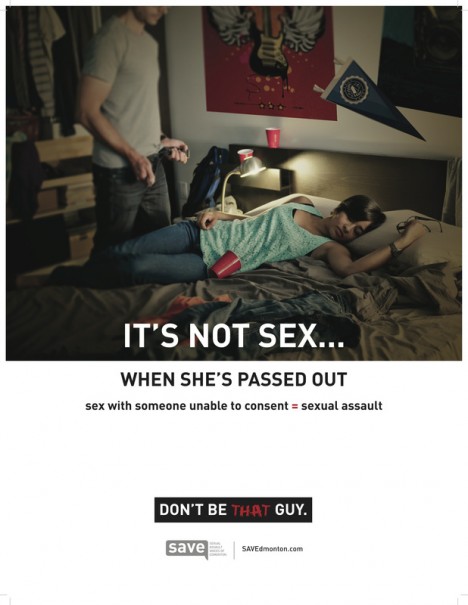
"Don't Be That Guy", a male-focussed anti-rape campaign by Sexual Assault Voices Edmonton, gained international attention and started a lot of discussions about rape culture. So of course it offended some guys who feel that they are under constant danger of having drunk women throw themselves at them just for the fun of accusing them of rape:


According to The National Post, these parody posters started showing up on an Edmonton university campus this week.

Kristopher Wells, from the University of Alberta’s Institute for Sexual Minority Studies and Services, nailed it when he said “That poster just shows why there’s a need for the (Don’t Be That Guy) campaign and the education work that still needs to happen if people still think that’s a joke or a funny parody.”


Parody, even when unfunny, is proof of the real campaign's success in changing the conversation from "don't get raped" to "don't rape". But there's obviously a long way still to go.

On their Facebook page, Sexual Assault Voices of Edmonton commented, "Let's hope this is a teachable moment that takes the conversation even further and helps folks understand that people don't lie about sexual assault."

UPDATE: CBC reports that "Men's Rights Edmonton" is responsible. It's a web site belonging to a smarmy young guy named Eric Duckman, who has a history of piggybacking his message on other people's campaigns.

Tuesday, May 14, 2013

2013: The Year of The Bystander

Via North Dakota Council on Abused Women's Services
We're hearing the term more and more, and especially in context of rape and sexual harassment.

Via Osocio
"Bystander" is the target audience for an increasing number of social marketing campaigns that attempt to change people's sense of responsibility for friends, neighbours, and even strangers.

I've been working on bystander-focussed campaigns for years, on topics such as elder abuse,  drunk driving and rider harassment on public transit. But I think this year is going to be all about what bystanders can do to stop sexual assault.

It shouldn't be any surprise. In several recent (and very disturbing) high-profile sexual abuse cases, bystanders acceptance and participation made otherwise ordinary people complicit in horrible crimes.

In Steubenville, Ohio, a young woman was sexually abused by members of a celebrated local high school football team. Classmates documented, shared, and joked about the incident. They even threatened the victim for daring to seek justice.

In Coal Harbour, Nova Scotia, another young woman was photographed having public sex while too drunk to consent (otherwise known as rape). The picture and the story were spread around the small town, and she was targeted on social media. Rehtaeh Parsons killed herself.

In Port Coquitlam, B.C., yet another young woman moved to a new school to try to escape the infamy of a topless picture she had shared with a stranger when she was in Grade 7. Schoolmates harassed her constantly about that, her depression, and a failed suicide attempt. After making a video cry for help that went viral, Amanda Todd also killed herself.

In Pitt Meadows, B.C., a young woman was gang-raped in the middle of a rave. Partygoers not only failed to intervene, they took photos and videos with their smartphones to share online.

Heard enough? One more.

In Saratoga, California, a young woman passed out at a party. She woke up to find she had been raped by up to three classmates, who had bragged of their assault by writing on her body with a Sharpie and taking and sharing pictures of the rape. Audrie Pott killed herself.

There are more. What they have in common is that these are not the actions of some individual predator acting in secret. They are a product of a culture in which rape is acceptable, under certain circumstances, and one person's humiliation is everyone else's entertainment.

It occurs to me that what's missing is empathy. Bystander empathy. But how do we increase that?

There is a role for social marketing here. And it's not just telling people not to "cyberbully" peers at risk. Instead, the greater social network needs to be connected more meaningfully to the lives and feelings of others. While the Internet is really great at turning people into harassers and trolls, it can also broaden their circle of empathy if they let it.

Via Osocio

A good example of this is the Draw The Line campaign, which I recently profiled on Osocio. It treats rape culture as a spectrum, starting with the apathetic acceptance of "distant" cases of assault and sexism in the media, and working closer to the audience's innermost circle:


The message is simple: It is all part of the same problem, and you are responsible for stopping it.

This year, will you be a bystander who makes a difference? Or will you be an accomplice?

You can start by evaluating your online behaviour.

Author Geoff Livingston, in his marketing blog, puts it like this:
So what can bystanders do? Well, they have several different options to choose from: 
1. Observe but refrain from getting involved
2. Publicly support the attacker
3. Privately support the attacker
4. Publicly support the target or victim
5. Privately support the target or victim
6. Become participants that attempt to deescalate the situation 
The vast majority of bystanders decide not to participate, and the reasons for doing so can range from feeling they don’t care enough about the problem to speak up, thinking their individual voice won’t steer the situation in a different direction, or wanting to avoid the risk of becoming a target themselves if they lend their support to either side. 
Bystanders who decide to publicly support one side or the other carry the risk, as noted, that they’ll become possible targets of furious opponents. However, by taking a stand they also have the opportunity to publicly speak out against unfair or untruthful statements and behavior. The challenge is to do so in a fact-based, rational and persuasive way, without getting sucked into the blind emotional intensity frequently seen in online exchanges and without taking cheap shots at the other side or trying to incite others into an online frenzy.

Be nice out there.


Monday, May 6, 2013

LEGO suffers another PR setback over street harassment sticker


Oh, LEGO... You used to be so cool. You sometimes still are. But too often now,  you're just so far behind the times it's sad.

This puffy sticker set was, according to AdFreak's David Gianatasio, released in 2010 by defunct licensee Creative Imagination. So they had a convenient player to throw under the bus.

But they still screwed it up. At first.

The whole PR nightmare began a little over a week ago when journalist and press freedom organizer Josh Stearns posted a photo of it on his Tumblr bog, Talking To Strangers:
I was stunned. Maybe it’s the fact that I just saw the team at Hollaback speak this month, or maybe it is that this is Sexual Assault Awareness Month, or maybe it is just that street harassment sucks. But chances are it was all three of these things that made me so mad to see a brand I love pushing this sort of thing. 
The Hollaback website notes that street harassment is the most prevalent form of sexual violence for both men and women in the United States. Internationally, they point out, “studies show that between 70-99% of women experience street harassment at some point during their lives.”
The issue was picked up by Slate and championed by the group Stop Street Harassment. That got LEGO's attention.

First, Charlotte Simonsen, Senior Director at LEGO’s corporate communications office, told Josh “To communicate the LEGO experience to children we typically use humor and we are sorry that you were unhappy with the way a minifigure was portrayed here.”

That's what we in the communication industry refer to as a "non-apology". So Josh wrote back and got the following reply from Andrea Ryder, the head of the LEGO Group’s Outbound Licensing Department, who said she was "truly sorry" that Josh "had a negative experience" with a LEGO product. She refered him to LEGO's brand values, including the line "Caring is about the desire to make a positive difference in the lives of children, for our partners, colleagues and the world we find ourselves in, and considering their perspective in everything we do." And she concluded, "we would not approve such a product again."

This is progress in brand responsibility, but it does not happen unless people are willing to speak up about the little things that reveal big problems in our society.


Laura Northrup from Consumerist wrote, "Street harassment isn’t the most pressing issue facing women today, but it can be a problem, and certainly isn’t appropriate for a children’s product."

I beg to differ on how serious this "one little picture" really is.

Just recently, I was having a conversation with someone from Hollaback about street harassment and rape culture. When you look at the big picture, the normalization of sexual harassment through bystander apathy is just one end of a continuum that ends with the dehumanization of women as targets of sexual violence.


Saturday, April 27, 2013

Rape culture attacks famed anti-rape campaign


Sexual Assault Voices Edmonton (SAVE) has earned lots of attention and praise for creating a hard-hitting campaign against sexual assault that puts the blame on rapists, not their victims.

So of course some internet dickwads decided to "parody" it with the victim-blaming message that continues to be the status quo:


I saw this screencapped on the STFU, Conservatives Tumblr, screencapped from some "joke" Facebook page. The call-to-action is A Voice For Men, an anti-feminism site that claims men are being victimized by campaigns like SAVE's.

The discussion about consent still has a long way to go.

Tuesday, April 16, 2013

Facebook ads face a serious content problem


For Facebook users, social ads are just the slightly annoying cost of using the free social network. For advertisers, they are a cheap and highly targeted way to reach potential customers.

But as with all web advertising, Facebook ads for big brands occasionally show up in context with questionable or objectionable content.

Here are some examples, from wallblog.co.uk (click to enlarge):


Facebook's problem with pages that promote rape culture is well known. The social network that has the sensibilities of a stereotyped grannie when it comes to showing certain kinds of nudity in even the most innocent context can't seem to stop pages that encourage criminal assault and rape.

The issue of brand ads showing up on awful Facebook pages made mainstream news yesterday when it was revealed that Dove — that paragon of pro-women marketing — had one of its ads show up on a page called "Drop kicking sluts in the teeth".

From the Daily Mail:
Dove Cosmetics, the RSPB [Royal Society for the Protection of Birds] and audiobook site Audible are among those who have complained to the social networking giant that group pages with titles such as 'Raping!', 'Drop kicking sluts in the teeth' and 'This is why Indian girls are raped' have all featured their adverts.
Today the site was facing a major PR crisis amid claims it was slow to respond to the complaints.
Dove said it was 'shocked to see our advert' on 'Drop kicking sluts in the teeth'.  
It complained to Facebook, who removed the group. 
However, the ‘closed group’ page is still active, listed with a 'controversial humor' warning. 
Vodafone also confirmed that it had contacted Facebook after one if its adverts appeared on a page called 'This is why Indian girls are raped', which contained pictures of scantily clad Indian women. 
The page was seen as particularly offensive given recent widespread reports of rape in India. 
The RSPB also confirmed that it had contacted Facebook about an advert that appeared on the same page. 
'Unless they can assure us that they are working out a way to guarantee this kind of thing doesn’t continue, we will be forced to consider our advertising options,' a spokesman said.
Ouch. I'm wondering what Facebook can actually do about this. Two years ago, they pulled a few controversial rape joke pages after public outcry. But the network is still home to the same kind of blatant racism and sexism that infests the internet at large.

There is, of course, a question of freedom of speech. But truth be told, Facebook is free to censor what it wants.

In its Terms Of Use, Facebook makes its position on freedom of speech pretty plain:
You will not post content that: is hate speech, threatening, or pornographic; incites violence; or contains nudity or graphic or gratuitous violence.
It also gives itself an out for what it doesn't censor:
We are not responsible for any offensive, inappropriate, obscene, unlawful or otherwise objectionable content or information you may encounter on Facebook. We are not responsible for the conduct, whether online or offline, or any user of Facebook.
Free speech is one thing; advertiser pressure is another. Just as Google Adsense tends to shut down its relationship with any site it sees violating its strict content rules, Facebook may decide that its brand advertiser money is more important than hosting the sexist rants of frustrated teenage boys.

Wednesday, March 20, 2013

Advertising rape culture in anti-rape campaigns


Victim-blaming. It's ugly, it's hurtful, and it's doing nothing to stop people from raping other people.

In the aftermath of the Steubenville rape trial, in which two teenage men were convicted of raping and humiliating an unconscious teenage woman, it's time we had another look at what these supposedly-helpful ads are saying. 

Using some of the post-verdict, victim-blaming Tweets compiled on Sociological Images, I've twinned the infamous ads with their real-life counterpart messages.

The ad above is from the Pennsylvania Liquor Control Board. I wrote about it on Osocio, and it was all over the mainstream media. The ad was pulled from the campaign.


This one is from West Mercia police. When called on it by British feminists, they refused to apologize.


This one isn't even about drinking. It's a "safe taxi" campaign by Transport for London, and note that it has the Mayor and the police endorsing it.

Christ. Did anyone pause for even a milli-second, and think, ‘Gee, maybe it’s NOT such a good idea to equate not booking a taxi with certain rape?’. Or did the advertising agency just convince Cabwise that it would provoke attention, and controversy?

Which brings us to my longtime prohibition-era nemesis, MADD:

MADD - Unbuttoned from Esparza Advertising on Vimeo.


Interestingly, when the message is being preached to men, the danger isn't being raped but rather having unwanted sex with somebody unattractive:


It's really bad, folks. People actually think that the only thing standing between a woman and her rape is how she controls herself. She must at all times be sober, fully covered, aloof and safely cloistered away from "bad people". Failure to observe any of these rules makes her responsible for anything violent that happens to her, because men — especially drunk men — have no control and will automatically seek to sexually violate her.

There is hope, however:

Sexual Assault Voices Edmonton, via Osocio.
Association of Chief Police Officers in Scotland, via Osocio

Via Men Can Stop Rape

Teach your children well.