Last week on Osocio, I reviewed an anti-FASD campaign that ran at LCBO stores, and took some heat for my claim that its potentially shaming approach to any drinking in pregnancy wasn't helpful. But that campaign was pretty mild when compared to the new ads by the government of Nunavut:
Via CBC
According to the CBC, these posters are "provoking a strong reaction from residents" — both positive and negative. They were designed by Atiigo Media Inc., a communications company in Iqaluit that specializes in northern issues.
The ads certainly are intended to provide shock value, showing the fetus literally drowning in alcohol. That's not exactly biologically accurate, but some locals apparently feel the strong messaging is justified by the high rates of alcohol abuse in the north, which has prompted some communities to ban alcohol entirely.
I still object to the unnecessary shaming or scaring pregnant women, even as I have to admit that I am culturally isolated from the communities for which this campaign was created.
It happens all the time. And the creatives may have meant well. But just because you have a clever idea for a celebrity endorsement, and access to Photoshop, doesn't mean you can use their images without permission! No matter what the cause.
Last week, I wrote about this campaign on Osocio. With the tagline, "Torture a man and he'll say anything," witth Iggy Pop confessing, “Justin Bieber is the future of Rock and Roll,” The Dalai Lama declaring that “A man who doesn’t own a Rolex by age 50 has wasted his life” and Karl Lagerfeld stating “A Hawaiian shirt and flip-flops are the height of elegance.”
Clever, yes. But suspicious. While Iggy happily shills for PETA, The Dalai Lama seemed like a stretch. Conclusion: "What I’d really like to know is if the celebrities had any say in the use of their images."
Well, guess what? Pitchfork reports that Iggy and His Holiness, at least, had no say in the use of their images.
To generate awareness about our campaign against torture, Amnesty International Belgium French speaking section used an image of Iggy Pop without his authorization. Even though we acted in good faith, we would like to apologise to Iggy Pop for having done so.
The overall goal of this campaign is to try to influence people’s ideas on the use of torture. According to surveys, a shocking number of people believe that “torture may sometimes be useful” ; more than 36% of people even think that torture is justified in some cases. This is unacceptable, and we illustrate this reality with the message that a man who is tortured will say anything in order to escape this awfulness, using provocative images and statements to attract public attention. We would therefore also like to make it clear that the statement attributed to Iggy Pop that he believes Justin Bieber is the future of rock and roll does not represent Iggy Pop’s personal opinion but was part of the creative process for this campaign and was intended to be ironic. For the launch of our latest campaign against torture, the image of His Holiness the Dalai Lama was used by our section (Belgium french speaking) and was widely shared on the internet. Although the Dalai Lama was not the target of the campaign, we understand that this image has caused particular concern in some quarters. We have therefore chosen to remove this picture from our digital material in order not to cause any further upset and ensure people’s attention remains focused on the real aim of this campaign : to stop torture.
We apologise for any upset caused by this image.
Using celebrities without permission is common practice worldwide, especially in countries that don't have strong legal ties with the celebrities' countries of residence. But to hijack an image — one that, for better or worse, is the celebrity's brand — for an organization of such high prominence, for an important cause, and in an EU country, is idiocy.
Don't worry, Amnesty. I blame your agency. Who was that, anyway?
Recently, I was interviewed (twice) by Adweek's David Gianatasio about the highly-problematic sports brand, The Washington Redskins. I received quite a bit of blowback from diehard fans on Twitter about my contention that the name is a racist anachronism that simply has to go away.
Interestingly, here in Ottawa, a local youth league football club who had named themselves after Washington's NFL franchise have just recently changed their name to the Eagles following a formal human rights complaint by Ojibway musician Ian Campeau from A Tribe Called Red.
Mr. Campeau spent two years campaigning against the Nepean Redskins name, and he says it taught him a lot about the continuing racism against Aboriginal peoples. "The backlash that this whole campaign has received to me tells me this is more than just football," he said. "It's about the entitlement of being able to label an oppressed people, to call somebody they have no ties to... that word."
Meanwhile, Washington Redskins owner Dan Snyder says he will never change the name of his team. But Native Americans and their allies are gaining force. The Oneida Indian Nation was first to speak out. Now National Congress of American Indians has joined in the opposition, backed by leaders from seven different groups: Cathy Abramson, Councilmember, Sault Tribe of Chippewa Indians; Al Goozmer, President, Tyonek Native Village of Alaska; Brian Cladoosby, Chairman, Swinomish Indian Tribal Community and President, NCAI; Edwina Butler Wolfe, Governor, Absentee Shawnee Tribe of Oklahoma; Leander McDonald, Tribal Chairman, Spirit Lake Tribe; Dennis Welsh, Chairman, Colorado River Indian Tribes; Candace Bossard, Councilmember, Ponca Tribe of Nebraska. Even President Obama has weighed in.
In my opinion, this is a human rights issue, not matter of "how many people" support the NFL or other regulators taking action to force a name change. But as we have seen with other human rights issues, such as equal marriage, it doesn't hurt to get public opinion on your side.
That's where this PSA comes in. My blogging colleague Marc just posted it on Osocio:
Simple, powerful and truthful, this video released by the Oneida — right before this weekend's Super Bowl — is the "hearts and minds" campaign the cause needs, exactly when it needs it.
It's not. This one, at least has a gag at the end:
Still a pretty embarrassing stripper campaign, but this one has an actual product message about why you, the straight man in the captive audience, need new gitch. The insight is pretty solid. I have some underpants that are holier than the Shroud of Turin.
I'm not sure whether to classify this one as a shock gag or just more run-of-the-mill sex in advertising. If the former, considering it was done with a great deal more "shock" and "gag" just two years ago for cancer awareness by JWT London, this one has some stiff competition.
Recently, I wrote a piece on Osocio about the may attempts people have made to bring attention to Barbie's exaggerated proportions — elongated legs, tiny waist, and huge head.
They ran from the thought-provoking:
To the absurd:
This latest entry, from 3-D printer artist Nickolay Lamm, stands up with the best of them:
Here is its backstory (via ONTD Political on Livejournal):
Artist Nickolay Lamm of MyDeals.com used CDC measurements of an average 19-year-old woman to create a 3-D model, which he photographed next to a standard Barbie doll. Lamm then photoshopped the 3-D model to make it look like a Barbie doll.
"If we criticize skinny models, we should at least be open to the possibility that Barbie may negatively influence young girls as well," Lamm said in an email to the Huffington Post. "Furthermore, a realistically proportioned Barbie actually looks pretty good."
Considering how peculiar a Barbie body would look in real life, Lamm concluded: "If there's even a small chance of Barbie in its present form negatively influencing girls, and if Barbie looks good as an average-sized woman in America, what's stopping Mattel from making one?"
But is this a realistic portrayal? As you can see above, I maintain a healthy skepticism about these things. I finally found the original source link, and here is the artist's explanation:
This white model was made using measurements that match up closely with CDC measurements of the average 19 year old woman in America. The end result is what Barbie would look like if she was a healthy, beautiful, 19 year old woman.
Some people say that we shouldn't pay attention to the body proportions of Barbie because she is just a toy. On the surface, that sounds like a valid argument. But a closer look, through research, suggests that Barbie may lead to the following… - Heightened body dissatisfaction among young girls (Dittmar)- Unhealthy eating behaviors (Dittmar)- A desire to achieve a slim body and therefore eat less (Anschutz)
"Bystander" is the target audience for an increasing number of social marketing campaigns that attempt to change people's sense of responsibility for friends, neighbours, and even strangers.
I've been working on bystander-focussed campaigns for years, on topics such as elder abuse, drunk driving and rider harassment on public transit. But I think this year is going to be all about what bystanders can do to stop sexual assault.
It shouldn't be any surprise. In several recent (and very disturbing) high-profile sexual abuse cases, bystanders acceptance and participation made otherwise ordinary people complicit in horrible crimes.
In Steubenville, Ohio, a young woman was sexually abused by members of a celebrated local high school football team. Classmates documented, shared, and joked about the incident. They even threatened the victim for daring to seek justice.
In Coal Harbour, Nova Scotia, another young woman was photographed having public sex while too drunk to consent (otherwise known as rape). The picture and the story were spread around the small town, and she was targeted on social media. Rehtaeh Parsons killed herself.
In Port Coquitlam, B.C., yet another young woman moved to a new school to try to escape the infamy of a topless picture she had shared with a stranger when she was in Grade 7. Schoolmates harassed her constantly about that, her depression, and a failed suicide attempt. After making a video cry for help that went viral, Amanda Todd also killed herself.
In Saratoga, California, a young woman passed out at a party. She woke up to find she had been raped by up to three classmates, who had bragged of their assault by writing on her body with a Sharpie and taking and sharing pictures of the rape. Audrie Pott killed herself.
There are more. What they have in common is that these are not the actions of some individual predator acting in secret. They are a product of a culture in which rape is acceptable, under certain circumstances, and one person's humiliation is everyone else's entertainment.
It occurs to me that what's missing is empathy. Bystander empathy. But how do we increase that?
There is a role for social marketing here. And it's not just telling people not to "cyberbully" peers at risk. Instead, the greater social network needs to be connected more meaningfully to the lives and feelings of others. While the Internet is really great at turning people into harassers and trolls, it can also broaden their circle of empathy if they let it.
A good example of this is the Draw The Line campaign, which I recently profiled on Osocio. It treats rape culture as a spectrum, starting with the apathetic acceptance of "distant" cases of assault and sexism in the media, and working closer to the audience's innermost circle:
The message is simple: It is all part of the same problem, and you are responsible for stopping it.
This year, will you be a bystander who makes a difference? Or will you be an accomplice?
You can start by evaluating your online behaviour.
So what can bystanders do? Well, they have several different options to choose from:
1. Observe but refrain from getting involved 2. Publicly support the attacker 3. Privately support the attacker 4. Publicly support the target or victim 5. Privately support the target or victim 6. Become participants that attempt to deescalate the situation
The vast majority of bystanders decide not to participate, and the reasons for doing so can range from feeling they don’t care enough about the problem to speak up, thinking their individual voice won’t steer the situation in a different direction, or wanting to avoid the risk of becoming a target themselves if they lend their support to either side.
Bystanders who decide to publicly support one side or the other carry the risk, as noted, that they’ll become possible targets of furious opponents. However, by taking a stand they also have the opportunity to publicly speak out against unfair or untruthful statements and behavior. The challenge is to do so in a fact-based, rational and persuasive way, without getting sucked into the blind emotional intensity frequently seen in online exchanges and without taking cheap shots at the other side or trying to incite others into an online frenzy.
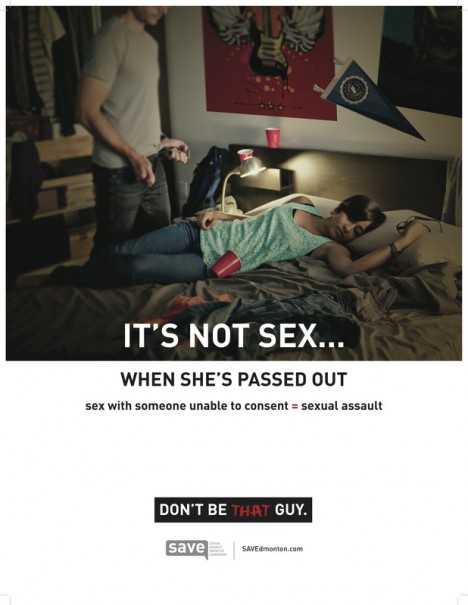
Sexual Assault Voices Edmonton (SAVE) has earned lots of attention and praise for creating a hard-hitting campaign against sexual assault that puts the blame on rapists, not their victims.
So of course some internet dickwads decided to "parody" it with the victim-blaming message that continues to be the status quo:
I saw this screencapped on the STFU, Conservatives Tumblr, screencapped from some "joke" Facebook page. The call-to-action is A Voice For Men, an anti-feminism site that claims men are being victimized by campaigns like SAVE's.
The discussion about consent still has a long way to go.
I've written before, both here and on Osocio, about the appropriation of anarcho-feminist group Pussy Riot's knitted balaclava brand. Here's the latest sighting, from former Disney star Vanessa Hudgens' '$$$ex' Teaser Video (via Huffington Post):
By all accounts, the former child actress is trying to shed her innocent image in the new Spring Breakers movie. It's a complete reversal from her concern for her younger image when she had her nude photo scandal six years ago. But careers evolve. It's just too bad she had to "borrow" so shamelessly this time, from women who are currently suffering for standing up for their independence.
I've written quite a bit about how shame is not an ideal motivator in social marketing. But there's another aspect to shame and attempts to influence behaviour that is vigilante — rather than institutional — in nature: public surveillance.
My Osocio colleague Claire shared a Tumblr called "I Hope Your Bag is Comfortable, Asshole" that attempts to shame Toronto public transit riders out of the cardinal sin of avoiding a seat mate on a full bus or train by blocking the empty seat beside them with a bag.
It's an interesting strategy, although I'm not sure it will work. Not just because of legal and privacy concerns, but also because it seems more like revenge punishment than rehabilitation.
This is just one of many name-and-shame Tumblrs. Public Shaming documents awful Twitter reactions to the Steubenville rape case. Hello There, Racists! documents another type of hate.
But is taking pictures of people in public to shame them fair, or even legal?
It brings to mind the case of Adria Richards, the "Company Evangelist" for SendGrid who tweeted a photo of two men at a PyCon conference to out them for sexist public comments. Not only were they fired, but she was too. The company said in a release, "Her decision to tweet the comments and photographs of the people who made the comments crossed the line. Publicly shaming the offenders – and bystanders – was not the appropriate way to handle the situation."
The big problem with photos, as opposed to Tweets, is that Twitter is a public medium. Information shared is deliberate, and the statement stands alone without need of context (or, if a response, is attached to the context.) A photo can tell a skewed story, because it lacks context.
The hope is that, to avoid being busted in this way by social media vigilantes, people will behave better in public. But is the answer to minor social ills really to be found in spying on each other?
The text reads "Fiat celebrates women: For one day only, the third, fourth and fifth gears are included for the normal price".
My friend and Osocio colleague Marc shared this via Facebook, via the Italian language Viralmente page. I was a little suspicious, so I did some searching. While there is no evidence of the post on Fiat's Italian page now, this screencap is still in the "posts by others" section:
You don't need to speak Italian to understand the outrage. Italian women and men are not amused by the 1950s-era joke about women's driving skills. They took it down and replaced it with this:
The car manufacturer has been accused of sexism before. Last year, they personified their sportier models as sexy (and slightly crazy) Italian women. They even managed to get ranked as the "second most sexist Super Bowl ad of the year" by Fem2.0. They even managed to draw fire from radical women's group Femen by appropriating their semi-nude protest tactics to sell cars in Brazil.
Which is odd, because recently Fiat has made a big effort in the UK to attract certain women drivers by empathizing with their demographic. Remember the Mother Hood?
Back in January, I wrote on Osocio about a campaign by American muslims to promote friendship through a better understanding of what "jihad" really means. A little lightweight, but part of a necessary discussion about the prejudice against Islam that has beed particularly nasty since September 11, 2001.
Part of the impetus for the #myjihad campaign was a reaction against anti-Islam ads run by Pamela Geller's American Freedom Defense Initiative in major American cities. The ads survived a freedom of speech claim, despite advertising space owners not wanting to run them.
Now, the AFDI has used its freedom to get even more nasty.
Nidal Malik Hasan is a 39-year-old U.S. Army major serving as a psychiatrist. He is charged with killing 13 people and wounding 29 others at Fort Hood in 2009. Hasan had been in contact with Yemen-based cleric Anwar al-Awlaki prior to the shooting, and witnesses claim his attack was accompanied by shouted religious slogans.
A reasonable person might assume that Hasan was suffering a severe mental illness. It's what we usually assume when an individual suddenly turns on familiar people as a raving mass murderer. But the AFDI would like the people of Washington DC to believe that Islam caused the murder. Worse, by association it implies that the nice people in the #myjihad campaign are just like him.
This e-card has been making the rounds for Julyna, a Toronto-based answer to Movember during which women groom their pubic hair into whimsical patterns to raise money for cervical cancer research.
Bell Canada has declared today (Feb 12) as "Bell Let's Talk Day." It's a corporate responsibility outreach that encourages Canadians to Tweet share messages to raise awareness of mental health issues. Furthermore, they're donating 5¢ " help fund mental health initiatives across Canada" for every text or long distance call made on their network, as well as for every sharer of their campaign images on Facebook, or Tweet of their hashtag #BellLetsTalk.
Great, eh? Well...
As I wrote earlier on Osocio, I have an issue with campaigns like this. Not about the issue, which is important and very close to home. It's the underlying strategy, something I call "Buyral Marketing."
I made up the term to describe the kind of social media campaign in which a major brand attaches itself to a popular cause, creates branded content, and provides an incentive — in the form of a small donation to that cause.
As an adman, I can't deny that the strategy can be extremely successful. My Facebook feed is full of Bell's facts about mental health, shared by good people who want to do something to help. Their ticker is almost at 10 million shares.
But you know what? Most of these people would share campaign material like this anyway. Bell isn't paying people (through a donation) to share facts about mental health. People on social media have shown that they can be motivated to share a feel-good campaign with very little incentive beyond a desire to belong to something good. It's paying them to overlook the fact that they are sharing branded advertising for a for-profit corporation.
Consumers aren't stupid. Many of my friends are fully aware of the ulterior corporate motives involved, and choose to participate anyway. Social media movements like Condescending Corporate Brand Page make it hard to let yourself believe that Bell is in this for anyone but themselves.
But I hope brands engaging in Buyral Marketing are aware that this tactic has its limits. The cynicism will grow, a little, each time consumers are asked to work for a brand's CSR department.
Don't get me wrong. "Let's Talk" is great branding, highlighting the natural association between a telecommunications company and the need for a public conversation about mental health. Perhaps next year Bell will take a higher road, committing those nickels to the cause without requiring shares (or use of their paid products!) to do so, simply because their message is highly sharable on its own merits.
It's been a weird year for me, but I keep coming back to this blog as a way to think out loud about my complicated relationship with the advertising industry (on which I depend to pay my half of the mortgage). Luckily for me, quite a few people have decided that these thoughts are worth reading. Thank you for that. Here were your five favourites.
This was a silly self-parody of FHM's "100 Sexiest Women in the World" list, but open to user nominations and votes featuring imaginary women of fiction, legend, pop culture and advertising. The contest site is no longer live, so I have no idea who won.
This was a joke ad, by someone named Alexander Bozhko for "Altai Fake Festival" — something akin to the Chip Shop Awards. But that didn't stop it from being taken as real, once it showed up on Ads of The World.
Thanks to my Ukrainian friend Eugene Smirnov helped me get to the bottom (heh heh) of this one. Also to Mark Duffy ("Copyranter") who posted my debunking on Buzzfeed, leading to big analytics.
This was a look at how Italian social issues artist Anna Utopia Giordano put classic Venus nudes under the harsh knife of photoshop to make a point about changing beauty standards in media. The post got a lot of viral lift after being linked on Sociological Images.
What can I say? Certain keywords always lead to high readership.
In this case, the post was a teaser for a campaign by Britain’s CoppaFeel! and Male Cancer Awareness Campaign (MCAC) about male breast cancer. I followed it up on Osocio.
My most-clicked post of 2012 was a bit of a surprise to me, as it had no naked ladies in it whatsoever. It's about how a public transit etiquette campaign by Queensland Rail became a popular parody meme. I guess I need more like that.
Well, that's all for me in 2012. This year, I have give this blog a little more focus on the issues that are of most professional interest to me, particularly ethics. (Which is why the name is changing.)
But what would you like to see more of? I'd love to hear from you in the comments below.
Today, October 15, is Blog Action Day. It's an opportunity for bloggers around the world to post simultaneously on a single topic that relates to social issues or social change. This year, the topic is "The Power of We":
We choose this theme for a couple of reasons. Firstly, the popularity of the your suggestions; Community, Equality, Transparency/Anti-Corruption and Freedom, in our theme poll.Secondly, The Power of We is a celebration of people working together to make a positive difference in the world, either for their own communities or for people they will never meet half way around [t]he world.
When I thought about how I'd represent this idea in a marketing context, I have to admit that the first thing that popped into my head was an ad almost as old as I am, from of all advertisers, Coca-Cola:
Times have sure changed. Now, "Big Soda" is the enemy of activist marketers like former CP+B creative demigod Alex Bogusky. But, consumerism aside, was this hippy-dippy "we're all in it together" dream ever even achievable? Part of me really wants it to be possible.
As the father of a third-grader, I try to encourage my son to view all fellow humans as brothers and sisters. Growing up in a multicultural community, he has not yet learned to categorize people by skin colour or cultural affiliation. When I ask him to describe a classmate or adult in his life, he describes them based on their personality and actions, rather than appearance. It's nice, but I also realize it will not last.
Perhaps he will not grow up with the same racialized context I still work hard to leave behind, but as he grows he will join tribes of interests, location or politics that will inevitably bring him into conflict with others.
"We" humans are tribal. There is no getting around it. Social experimenters continue to replicate the same results when they create artificial or arbitrary tribal differences between groups of strangers. For example, diversity trainer Jane Elliott is able to turn brown-eyed and blue eyed groups agains each other. Tribalism is so engrained in our very biology that it threatens our world and future as a species. While it can express itself in (usually) harmless ways, like fanatic team loyalty in organized sports, even that can turn into violence. "We" in this context is another way of saying "us over them".
This idea of "we" exists in nationalism, religion, politics, even what band you like. And it's killing us. In the Middle East, "we" are under threat from a corrupt western civilization that insults our religion and wants to turn our daughters into prostitutes. So "we" attack and kill foreigners in their embassies, and even in their own cities.
In North America, "we" don't believe in biological, statistical, economic or climate science, so we oppose measures that would reduce our impact on the climate, help the poor and sick, and prevent unwanted pregnancies. It goes on and on.
Membership in a group is usually defined by opposition to other groups. And to protect our tribal identity, we naturally dehumanize outsiders. The most extreme cases are in war. But it happens every day when we make generalizations about "those people" or fail to treat our own tribe's agreed-to "truths" with healthy skepticism.
Which brings us to the world of cause marketing. Tribalism can be an incredibly powerful source for change, especially as the internet allows formerly isolated individuals to gain strength from a positive group identity.
A good example is the It Gets Better project, in which Dan Savage's attempt to reach out to LGBT youth at risk turned into a massive outpouring of support from both LGBT and straight ally communities.
What was great about this effort was its inclusiveness. Anyone was welcomed to join the tribe, as long as they had a message of hope and positivity for the youth. But they were still defined by a common enemy: homophobia. The other good thing about that campaign was that it was based on hope, rather than fear. In fact, the enemy was fear.
Usually, when an enemy is defined, exaggerated fear of that enemy (rational or not) is used to rally the troops. And once rallied, those troops start to lose any sense of logic or common sense.
This can happen in any movement, whether its members consider themselves conservative or progressives.
This Blog Action Day, as a blogger, social marketer and human being, I would like to urge you all to embrace the positive side of "The Power of We". Welcome your friends. Understand and empathize with your enemies. And don't get sucked into the dark side of the We.
Although a little derivative of Allstate's sardonic "Mayhem" campaign, this haunting campaign for British Red Cross is nonetheless intriguing.
Perhaps it's the performance that makes it effective. Crisis personified by a unexpectedly wicked young woman and her wolf companion has such an eerie effect.
The take-away, that anything can happen to anyone, is similar to that of the insurance ads. But in this case, the client is asking you for money to help strangers as well.
You could say that it simply tells an inconvenient truth about inconsistent cultural attitudes towards tragedy and death. But that point would be made at the expense of causing further hurt to the families of the World Trade Centre attack, as well as to those deeply affected by it.
Now, strangely, the 2005 tsunami tragedy that is being exploited to make a point about war and the arms trade:
The ad is by TBWA, Paris, for Amnesty International.
This brings the saga of over-produced, tragedy-exploiting ads full circle: "an epic and tragic natural disaster killed more people than an infamous terrorist act, but the arms trade is even worse."
Once again, creatives go for maximum impact to make one message of human loss at the cost of trivializing another. This kind of trade-off is a devil's bargain, in my opinion. It's all bad. You don't need to get into a comparison of which is worse. From my perspective this looks like lazy strategy and the elaborate (yet derivative) execution is blatant award-bait.
And I say this as a member of Amnesty. You can do better than this. You often do.
When I was writing a post for Osocio this morning, about a campaign for Reporters Without Borders, I briefly visited the McCann, Germany, site to see if there was a version in original language. Instead, I was treated to a rather ballsy image show that portrayed the account team advising Jesus on his brand symbolism.
It's a very funny in-joke for admen, the client picking the entirely wrong approach, while the agency folk desperately try to steer him in the recommended direction. (To take it too literally, though, why would they even have shown him the square and the circles? And isn't he choosing the instrument of his death?)
Put this one down to European humour. Hopefully, offended Christians won't react as violently as some of their Muslim brethren have to recent religious ridicule.
The other image in the series features Fidel Castro and his iconic cigar:
Ironically, the Cuban leader stopped smoking them in the 1980s, due to health. And he actually enacted some pretty strong smoking bans in Cuba before his retirement. But I get what they're saying.
This is edgy stuff, and the over-the-top arrogance plays as a gag. But does it make good business sense for the global advertising brand? I guess we'll see.
Update: Adland's Åsk Wäppling informs me that this stunt is actually eight years old. I guess they still like it.