Showing posts with label ad industry. Show all posts

Wednesday, May 6, 2015

Who owns "Adland"?


If there's one thing that advertising people actually value, it's a brand. Especially if it's one of our own.

So it's no surprise that Åsk Wäppling, the Swedish owner of the advertising blog adland.tv, doesn't want other people using the term "Adland."

Adland is absolutely ancient in internet terms, having been established in 1996 when most ad people were still trying to figure out if the web was good for anything except free shock porn. A young Ms. Wäppling, under the pseudonym "Dabitch," instead saw the opportunity to create an online global ad archive and professional forum, which in this decade Brand RepublicBusiness Insider, and Fast Company have listed as one of the most influential in the industry. She even trademarked the name, several years ago. And he's been a mentor as I've fumbled my way into the ad blogosphere.

So you'd think it would be pretty clear that "Adland" = adland.tv. Especially among ad industry bloggers.

Apparently not. As you can see from the Google screencap above, venerable industry magazine Ad Age uses the term "adland," in a generic sense, to refer to the industry in several posts. I have no idea if they used it this way in print, years back, but online it definitely infringes on Dabitch's intellectual property. And she's let them know, many times.

Now other people are letting them know. When Ad Age posted "Adland seeks to hire veterans," Dabitch says she started getting resumes. After finding out they didn't mean THAT Adland, one vet let Ad Age know what he thought about the avoidable confusion:

Courtesy Dabitch
(adland.tv ended up helping the guy get some job leads anyway.)

Dabitch has written directly to Ad Age's legal heads, but after receiving what she characterizes as "nya, we won't" replies, she has taken to the court of social media.

She told me, "Now I tweet at them every time they use the word in a headline and I hope the responses take off."

Here's a recent example:


Cheeky. But will it get Ad Age's attention now? (More importantly, will it get the attention of its readers and advertisers?) We'll see. Because there are a lot of important ad pros watching that little red TV.


Tuesday, April 7, 2015

Weren't we supposed to stop using captive great apes in ads, Google?


Business Insider just published Ace Metrix's list of top-performing ads in 30 categories for the first quarter of 2015. Among them is Google's "Friends Furever" spot for Android:


Wait a minute here: Didn't the US Ad Council announce that it no longer supports the use of great apes in ads back in 2008?

PETA has been lobbying the ad industry to stop using apes as props for years. As a result,  Omnicom Group's BBDO, GSD&M and Merkley & Partners; Interpublic's McCann Erickson, DraftFCB and RPA; Havas' Arnold and Euro RSCG; WPP's Grey Group, Ogilvy & Mather, Young & Rubicam and JWT; and Publicis Groupe's Saatchi & Saatchi and Leo Burnett all agreed to stop using great apes in ads in 2011. The Google ad was created by Droga5, who apparently didn't get the memo.

I'm not PETA's greatest fan, but as a human (and having the Jane Goodall Institute as a client) the exploitation of our closest cousins by my industry troubles me.

The challenge with using any animals in advertising is their treatment, since they are not willing performers. The most intelligent social animals, such as great apes (chimpanzees, bonobos, gorillas and orangutans), elephants, and whales/dolphins, are wild animals that suffer from anxiety and depression when removed from their peers — even if captive bred. (Dogs are domestic animals, so they're a little bit of a different issue.)

The Google ad has representatives of all three of these animal groups performing for your amusement, and that of 16 million of your closest friends.

Jane Goodall is asking people like us, who create ads and entertainment, to sign a pledge not to use captive great apes in our work. I think it's time we stopped treating our cousins like props.

Wednesday, November 6, 2013

Advertising people are abnormal


They say the worst mistake a marketer can make is to think he or she is just like the target audience. That's mostly because we can't look at ads without deconstructing them, we think that social media buzz is way more important than it really is, and we value breakthrough ideas over easy results.

Here are some other weird things about my people, via Lowe Roche in Toronto:


In this case, ad people are the target audience, landing this agency video on Adfreak where we'll all see it. Some of the stats hit pretty close to home.

It's just too bad they screwed up their poutine:

Shredded cheese? Abomination.

Friday, April 26, 2013

Creative team proposes "Take Your Non-Ad Person to Work Day"


That's right — we poor, misunderstood Creatives need some empathy from loved ones. Because how many times have you described a hard day of arriving late, then spending eight hours coming up with the perfect tagline for a client while drinking at work, only to be told "must be nice"?

There are six ads in this series (via Ads of The World) but this is the best one. Oddly, after all this work to promote themselves, creative team Mark Moll and Jason Busa lazed out and repeated the same body copy on all of them.

Friday, April 12, 2013

#agencylife is way more fun than agency life


Yesterday, my friends at Adland started a fun hashtag thing on Twitter. Called #agencylife, it was inspired by one Adlander's complaint about a typical agency problem. Soon, everyone was doing it.

It became a thing. So much so that AdAge reported on it, asking "are folks just having a laugh or sharing some harsh truths about the industry?"

the answer is, "both". The hashtag brought together creatives and suits, large and small agencies, from countries all over the world. There are no secrets being shared here, just the kind of in-jokes that any industry breeds due to the day-to-day demands of trying to please everybody and manage a stable full of clashing egos.

I was really happy to see one of my contributions make the AdAge post:


Even better was the response I got from Noise Digital:


To which I responded:


And then this happened:


There's nothing like a Twitter support group to make another week in advertising worthwhile.


Monday, December 31, 2012

A New Year's Resolution for the Ad Industry


Repeat after me: "I will not appropriate women's sexuality to sell unsexy stuff..."


This will be a hard one to keep, as long as Kate Upton keeps offering her services to the big brands. But let's put aside the feminist angle for a moment and look at this as professionals: Oversexed advertising is creatively lazy. It's borrowed interest.

On one hand, it definitely increases brand awareness, because anything that primal will cause controversy and arouse plenty of views. But does sex really sell product?

Source: streetcouch.com via Tom on Pinterest


The intuitive answer is "yes". And science tends to back it up. A recent study at Yale showed that male capuchin monkeys shown explicit images of sex and power really did prefer “brands” associated with them. Social scientists Dan Ariely and George Loewenstein experimented on human males, and found that the more sexually aroused they were, the poorer their judgement became on matters of morals and self-preservation. The topics at hand had to do with their propensity to engage in risky and even criminal sex acts. But it's a fairly easy leap to assume that aroused men also make poor consumer decisions.

Or as Men's Health put it, "You act like a goof with the Hooters waitress, leaving a tip that doubles the bar bill. But why? Beautiful women cause a man's limbic system (the amygdala and other brain-stem structures, which are in charge of emotion) to fire up at the same time that his PFC checks out, leaving the judgment area vacant."


You'll note that much of this research has been focussed on men. What about women? The Next Web reports that "Women make or influence 85% of all purchasing decisions, and purchase over 50% of traditional male products, including automobiles, home improvement products and consumer electronics," and yet "91% of women say that advertisers don’t understand them."

That's not at all surprising. Only 3% of advertising Creative Directors are women. I can't find a reliable ratio for women Marketing Directors on client side, but I will note that the Chief Marketing Officers of CKE (Hardee's) and DirecTV (responsible for two of those Kate Upton ads) are men.

The conventional wisdom in advertising is that you can never go wrong using women's sexuality in ads, because men want them and women want to be them. But things could change fast.

In 2012, women started to show their democratic muscle. In the US Presidential election, unmarried women were a huge force in support of Barack Obama. They were mobilized by Republican statements and stances against reproductive choice. A teenager named Julia Bluhm got 86,439 people to help her demand the 17 Magazine to "commit to printing one unaltered—real—photo spread per month" as a statement about healthy body image. As a result, the magazine has made an even bigger commitment to "not alter the body size or face shape of the girls and models in the magazine and to feature a diverse range of beauty in its pages."

Does this mean that sex in advertising is on its way out? Unlikely. Women like sex too, after all. Most people are attracted to beauty in both sexes, and the promise of sexual fantasies fulfilled. But we, as an industry, can do it much better. Not just because we respect the awesome power of women's sexuality, but because we actually want our clients to succeed.


Here are some conversation-starters from Ira Kalb of the Marshall School of Business at USC:
For the many products that are not related to sex, using sex to sell them does not work. It can even backfire. A recent University of Wisconsin study shows that audiences view ads 10% less favorably if they use sex to sell un-sexy products. This study agrees with the data David Ogilvy accumulated over his long and storied career in advertising. In his book Ogilvy on Advertising, he says that sex sells only if it is relevant to the subject being sold. Advertising Professor Jef I. Richards from the University of Texas says, “Sex sells, but only if you're selling sex.”

Have a look at Adrants' list of "The 30 Sexiest Ads of 2012" and ask yourself, how many of them are selling sex? It would be a daunting but incredibly worthwhile task for someone more academic than me to chart the success of those various campaigns in actual sales.

But I'm not calling for censorship of any kind. In a free market, at the end of the day, it will be up to women to organize themselves as a consumer force and decide what they are willing to put up with.

Newest Miss Representation Trailer (2011 Sundance Film Festival Official Selection) from Miss Representation on Vimeo.

Call me a prude if you like. The fact is, I consider myself a very "sex positive" person.  (Some of my readers seem to think I'm a little too "positive") I have an instinctive and an aesthetic appreciation of the diverse expressions of the female form and I respect and appreciate the women around me as equal human beings who are not only defined by their sexuality.

I just don't like the way women's bodies and sexuality are commoditized to get cheap attention for brands and products. It's not helping us have a respectful and equal society.

One of the unfortunate lessons I have learned from the internet is how easy it is for people to treat others as objects for their racism, sexism, and general scorn. I can't help but imagine the worst of them jerking off to the ad with one hand while simultaneously typing "what a dumb bitch" in the comments thread with the other. Advertising may not be the worst contributor to rape culture, but why would any brand want to contribute at all?


Tuesday, December 11, 2012

"Warm Wishes from Adland" shows the true Xmas spirit in the industry


Currently trending, "Warm Wishes from Adland" is an anonymous compilation of 21 bitter and cynical comments about other people's work, compiled from comments on Ads of The World, Agency Spy, or elsewhere. (But oddly, not Adland.)


Lovely.

Now who is going to take credit?

Via Twitter

UPDATE: Adfreak's David Gianatasio identified the culprits as "a bunch of staffers at BBH in New York":

Tim Nolan, the interactive group cd who heads up BBH Labs, tells AdFreak: "As we approach that time of year where we all wish each other the warmest, we thought we would look at how we, as an industry, extend our 'warm wishes' throughout the year and under the veil of anonymity. After carefully curating some of the worst 'semi-safe-for-work' comments from around Ad Land, we picked our favorites and gave them all a dip in holiday cheer." 

He adds: "Traffic has been pretty steady since launching [Tuesday] afternoon. Most of the original visits came in from Twitter and Facebook, since each 'Warm Wish' is individually sharable. I'd say we are more pleased with the 'trending-ness' of it all, rather than being surprised. I mean, everyone likes to share a bit of 'naughtiness' around the holidays."


Saturday, September 15, 2012

WWJD? He'd get branding advice from McCann!


When I was writing a post for Osocio this morning, about a campaign for Reporters Without Borders, I briefly visited the McCann, Germany, site to see if there was a version in original language. Instead, I was treated to a rather ballsy image show that portrayed the account team advising Jesus on his brand symbolism.

It's a very funny in-joke for admen, the client picking the entirely wrong approach, while the agency folk desperately try to steer him in the recommended direction. (To take it too literally, though, why would they even have shown him the square and the circles? And isn't he choosing the instrument of his death?)

Put this one down to European humour. Hopefully, offended Christians won't react as violently as some of their Muslim brethren have to recent religious ridicule.

The other image in the series features Fidel Castro and his iconic cigar:


Ironically, the Cuban leader stopped smoking them in the 1980s, due to health. And he actually enacted some pretty strong smoking bans in Cuba before his retirement. But I get what they're saying.

This is edgy stuff, and the over-the-top arrogance plays as a gag. But does it make good business sense for the global advertising brand? I guess we'll see.

Update: Adland's Åsk Wäppling informs me that this stunt is actually eight years old. I guess they still like it.

Friday, July 6, 2012

Agency recruitment video has unfortunate context #FdAdFriday


Boone Oakley of Charlotte, NC, produced clever-clever little recruitment video that offers to help interviewed candidates explain their absence from their current agency by fabricating tragedies and injuries with the hep of a makeup artist. (Via AdFreak)


They mean well, but when I first looked at the still (above) on the AdFreak link, I immediately assumed it was a domestic violence awareness campaign. Especially with the "excuses" onscreen.

It also just so happens that this week, a real domestic violence awareness campaign launched, in which a makeup artist shows women how to hide the signs of physical abuse on their faces:


Not that Boone Oakley intended anything negative by it. But it just goes to show that portrayals of battered women — even in jest — are loaded with unintended cultural context.

Tuesday, May 22, 2012

Sibling rivalry: Identical twin ADs square off on beer label design contest

Duelling Wantucks at the National Art Gallery
Okay, so this is fun.

My good friends Tim Wantuck and Daryn Wantuck are identical twins. And they don't just have looks in common — they're both accomplished designers, illustrators and art directors at Ottawa agency The Bytown Group. And if you know them, you're already aware that they never saw a logo or packaging design contest they could walk away from.

So, predictably, when Kichesippi Beer Co. decided to crowdsource a label for its newest brew, Heller High Water, both Daryn and Tim got in on the action. And what do you know? They both made the Top 4:

Daryn's is on the right.

Tim's is on the right.
Sibling rivalry? Oh, yeah! If you'd like to weigh in on either twin's design, or even vote for one of the other, non monozygotic-clone-designed, ones, go to the Kichesippi Beer page and "Like" your favourite(s) to vote them up.

Friday, March 2, 2012

PR people define their profession, jargon ensues

Image via this blog
A PR person I follow on Twitter shared this NY Times article about how the Public Relations Society of America decided its profession had a PR problem.

The initiative, known as Public Relations Defined, began in November and drew widespread interest, along with not a small amount of sniping, snide commentary and second-guessing. 
The complaints grew loud enough to produce a response from an executive of the organization that was leading the effort, David C. Rickey, who described the criticism thusly: “Nothing more clearly illustrates the reason why the profession hasn’t arrived at a ‘de facto’ definition in more than a century of existence.”
Indeed, the attempt to croudsource a definition of what PR people do, among PR people themselves, generated no fewer than 927 definitions in about two weeks!

The PRSA somehow pared it down to three finalists:

¶ “Public relations is the management function of researching, communicating and collaborating with publics to build mutually beneficial relationships.” 
¶ “Public relations is a strategic communication process that builds mutually beneficial relationships between organizations and their publics.” 
¶ “Public relations is the strategic process of engagement between organizations and publics to achieve mutual understanding and realize goals.”
Yes, they're jargony. As someone who preaches the religion of plain language to clients every goddamn day of my working life, I am both amused and horrified that this is the clearest my PR friends could be about what they do.

They voted on it, and chose the middle one. But I'll bet my readers could do better. Are you up for it?

Wednesday, January 4, 2012

The latest stock photo meme

Stock photo cliché memes are a thing now, from women laughing alone with salad to things real people don't say about advertising.

This one, from Sad and Useless (via 22 Words) started last October and is pretty uneven, but some of them are worth sharing:


Yeah, ad people are cynical.

Tuesday, November 29, 2011

Scientists develop tool to measure Photoshop Disasters

Via Wired
Scientists in the United States have developed tools to quantify the amount that an image has been digitally manipulated — but only of they have access to the original image.

While Wired talks about the breakthrough as a way to regulate image manipulation in advertising, at a time when some jurisdictions are cracking down on altered images, Nature says the system was developed as a way of combatting image fraud in scientific journals.

Nature also quotes developer Hany Farid, a computer scientist who studies digital forensics, wo points out that this system is no magic bullet:

"The requirement for both original and retouched images is an obvious flaw in his system, admits Farid, as researchers can’t always find their originals. But, in his opinion, it is impossible to get an accurate score for the extent of manipulation without the original image. Moreover, for both scientific journals and popular magazines, the very act of requiring original images to be provided could act as a deterrent against manipulation, he says."
In advertising and the fashion industry, therefore, the system will only work if media or regulators institute a scale of manipulation and insist on access to unaltered images. Which won't do much to deter dishonest marketers, who are not bound by the same honour and reputation system as scientists.

So, while this is pretty cool, we'll probably have to keep discovering image fraud the old fashioned way.

Monday, November 28, 2011

Marketing Big Meat

Mother Jones recently ran an interesting exclusive: branding and packaging pages from a draft marketing plan fror Sara Lee about how they could reposition Hillshire Farm deli meats as a more sustainable and healthy option.

The scanned document looks like it was nicked from a recycling bin, but it's worth reading just for gems like this:

Give it up for pepper!

And this:

Good job, bees!
This off-the-cuff, conversational style is supposed to represent a new era of transparency and sustainability  in megameat.


Well, aspiring to transparency and sustainability anyway. And buying up small farms so that their newly-pluralized brand name actually means something.

It's good, though, that consumer pressure is forcing big processors into at least wanting to be seen as wholesome and small.

They also want to break into the food snob market by developing two new premium brands, "Smith & Smith" and "Flat Iron Ranch".


"Size of the prize"? I'm amazed that agency people can present that to a client with a straight face. But they also committed the following atrocities:


I am so ashamed of my industry right now.
Does this look into the marketing minds behind Big Meat surprise you? Disappoint you? Or just confirm what you already suspected.

This kind of rebranding, dressing factory-processed meat in a neighbourhood butcher's apron, is happening throughout the packaged meat sector.


But the big question is, how much marketing spin are you prepared to swallow?

And note to self: shred all draft marketing plans.

Monday, October 24, 2011

Obama creating jobs by putting creatives out of work?

Adland brought to my attention a truly ironic move by US President Obama's 2012 re-election team: unpaid crowdsourcing for a new campaign promoting job growth.


From the Art Works site:

"Obama for America is seeking poster submissions from artists across the country illustrating why we support President Obama's plan to create jobs now, and why we'll re-elect him to continue fighting for jobs for the next four years.


Your poster can address the broader themes of the President's plan or pinpoint a specific aspect, from supporting small businesses to rebuilding roads and bridges for the 21st century. For more on the desired specs, read the creative brief.


We'll pick the 12 best submissions received by November 4th, 2011, then put the finalists to a vote. Three winners will receive a framed print of their poster signed by President Obama and a limited edition of their poster will be sold in the campaign store."

Here are a couple of gems from the "Creative Brief":

"You hereby represent and warrant that all equipment, materials, and facilities used to produce your poster are owned by you and were not provided by a corporation, labor union, foreign national, or federal contractor. Any disposable materials purchased specifically to produce the poster will be treated as in-kind contributions to Obama for America."

I'm sure this one is being violated repeatedly by people who cannot afford to have their own equipment outside of the office.

"All submissions will become property of Obama for America."

And for all that, here's what you win:

"Three (3) winners will receive the following prize: A framed copy of the Poster (defined below) signed by Barack Obama and all or part of the winner's Poster will be used and displayed on Sponsor's website and/or in other Sponsor advertising or promotional material (to be determined in Sponsor's sole discretion) associated with Sponsor's political advertising efforts (approximate retail value: $195)."

When a country's economy goes bad, the marketing industry — including ad and design creatives — is the canary in the coal mine. Companies in trouble tend to cut marketing budgets early on as they struggle to reduce the bleeding. Agencies lose revenue, then lay people off (or even shut their doors).

There is nothing creative professionals hate more than a paid work opportunity being given over to free crowdsourcing. The Obama campaign is well-funded, too — Adland says they have "$60 million cash on hand in campaign funding".

Creating jobs means supporting professionals who depend on a certain trade for a living. But this contest asks ll entrants to give away their work for free even if they don't get any credit for it. By undermining the value of concept and design, the Obama campaign has thumbed its nose at one of the USA's most celebrated industries.

And when you piss off creatives, you can get some very creative responses.

Monday, September 26, 2011

Creative team threatens to "get gay married" if they can't land a job

What a clever, but terrible, idea.

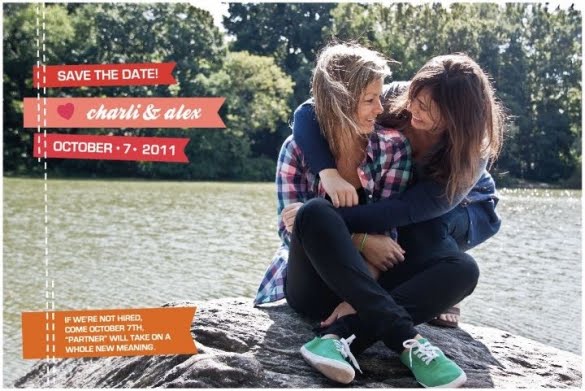
Creative self-promo pieces are usually pretty kooky. In this one, according to Adland, Charli Hoffmann and Alex Otis threaten NYC agencies that they will have to get married to keep Charli in the country unless the Hoffmann can renew her work visa before October 7 by landing a job.


It's funny, if two straight girls making light of the struggle to get same sex marriage recognized in NY doesn't irk you. Your call.

The joke works in the ad world because creative teams do become like married people after a time, no matter what their sex or orientation. But putting intent to defraud U.S. Immigration on a Facebook Page?

Not a smart move for a foreign worker these days. Even in jest.

Good luck with that.

Thursday, September 1, 2011

My fellow admen, this is why they hate us (again)

According to Agency Spy, this was the goodbye gift to two summer interns at digital agency R/GA:


Good Bye Interns from Leif on Vimeo.

And here I thought Mad Men was historical fiction, and that we now worked in an enlightened industry in which women are respected colleagues and clients rather than sexual playthings and passive eye candy.

But apparently I was wrong. So in that case, sweetheart, stop your yapping and go fix me a stiff drink.

(Previously in My fellow admen, this is why they hate us )

Monday, August 29, 2011

Australian reality show invites admen to solve impossible briefs

Why don't we have a show this cool in North America?

Australia's The Gruen Transfer has a segment called "The Pitch" in which it asks viewers to suggest objectives for "impossible" creative briefs via social media, which real admen and adwomen then have to pitch spec creative on.


This episode, in which Australians were asked to support a ban on vulgar language, was pretty fucking hilarious. (Wear headphones if you don't work in an unashamedly vulgar ad agency office.)


You can just leave the playlist going to see other briefs. I just love how this show not only entertains, but educates viewers on how ads are conceived, and how different two good solutions to one problem can be.

CBC, I hope you are reading this.

Thursday, May 5, 2011

Is media the new creative?

Acart's Media and Consumer Marketing Director, Sue, shared these funny self-promo spots from Astral Media. (She e-mailed them, but I'm pretty sure she was smiling a vengeful smile when she hit "send":)


The presentation from Astral on Vimeo.


The portfolio from Astral on Vimeo.


The media donna from Astral on Vimeo.


The visit from Astral on Vimeo.


As a Creative Director, can I say I love them. Nobody in the industry deserves to have their asses kicked like stereotyped primadonna creatives, and agency perceptions of media people really do need a healthy shot in the arm.

It's not that "media is the new creative", however. In the current communication age, media IS creative IS digital IS public relations IS strategy. We're all being called upon to be a little more collaborative and a lot more open-minded than ever before.

Ironic, though, that none of these spots is timed to fit into neatly a :30 or :60 spot. Isn't it? It's almost as if the whole campaign is meant to be... unpaid viral? ;)

Via Astral Media

Tuesday, March 8, 2011

On behalf of the admen of the world, I am sorry

This post contains relevant images of nudity and other mature content.

Today — March 8, 2011 — is the 100th anniversary of International Women's Day.

But as many bloggers, journalists and commenters will point out, women's equality still has a long way to go.

When I think about what has changed since 1911, the progress towards legal, financial and social gender equality in my own country has been unprecedented. Women vote, women own businesses, women make their own reproductive choices, and women have equal protection under the law.

That's on the surface, anyway. Look a little deeper, and you will see that there are still issues with pay equity, discrimination against mothers, and the pervasive threat of sexual violence. Look a little farther, and you will see that most women in the world are little better — and usually worse — off than Canadian women in 1911.

But let's look on the bright side. I live and work in a society where women can — and do — choose their own paths. I count many women among my esteemed colleagues. Powerful adwomen like Arlene Dickinson are shaking up the old boys network both in the industry and in popular culture. So everything should be cool, right?

Wrong. Oh... so... very wrong.

A quick browse through my RSS feed this morning shows what advertising is doing to women today:

Copyranter: American Apparel Ad Watch: (nsfw) Neat Pleats & Teats

Mark rips on American Apparel for its latest print ad, showing two female models in pleasted pants leaning back so their bare breasts point upwards, and their faces are obscured. "The pants-optional CEO probably paid out even lower model day rates than usual," he snarks.

(UPDATE: Dov Charney, AA's "Pants-Optional CEO", is being sued for sexually assaulting a female teen employee.)

Illegal Advertising: Naked Chicks Skating

That really is the headline, of both the video ad the post. And that is exactly what it is — a minute of four nearly-identically generic women skateboarding in the nude. (At least when Queen did this for their 1978 Bicycle Race video, they were considerate enough to give the nude women protective gear!) The advertiser? Playboy.
Ads of The World Blog - First look at Lexus Sports Illustrated Swimsuit issue ad

'Nuff said.

Adland: Jennifer Aniston Sex tape - possible the worst "viral" ever made.

Yes, I covered that one yesterday. And it quite possibly is.

(Somewhat surprisingly, Adrants, whose author Steve Hall also writes for Playboy's The Smoking Jacket, had a pretty harmless recent feed.)

To be fair, most of these industry bloggers use the examples of "sexy ads" to criticize the casual sexism of the advertising industry. But the big question is: If so many people are against it, why doesn't it change?

I have my own theory, and it is something for which we are all — men and women alike — culpable.

It goes to the nature of today's media, and our increased tolerance to sexuality.

I'm not talking about the "good" kind of tolerance here, either. I mean "tolerance" in the drug and alcohol context — decreasing sensitivity that requires higher doses for the same effect.

Here's a sexy/ist ad from the 1960s:

You're looking at somebody's Grandma.
Blatantly sexual, yet pretty tame by today's standards, no?

This is nowhere near their most graphic. Sasha Grey did a full frontal one.

To be honest, these American Apparel ads don't even titillate me anymore. Why would they? Women's sexuality has been so devalued — from overexposure in the media — that it takes something truly shocking to get through.

There's a much more explicit version here, but I suspect it make be 'shopped.

That's right. Advertising and porn have come together (pun intended) into an orgy of over-the-top sensuality. And yet, the more sexually graphic the ads become, and the more extreme porn gets, the less effective it becomes. So the producers have to turn up the volume once again.

But this is all harmless fun, right? We're human after all, and some of us are heterosexual men who respond instinctively to these images. Sex sells.

But then how do we address the use of increasingly bizarre sexuality in fashion ads aimed at women? Two great new photoblogs I just discovered — I Hurt I Am In Fashion and (more explicitly) The Fashion Tit — call their industry to task on the commoditization of women's nudity in ads and photo spreads.

I Hurt I Am In Fashion
And that's the bottom line: Commoditization. And it's not just advertising. It's all the trashy media we consume like starving wolves.

Anna Holmes, who writes for Jezebel, published an interesting essay in the New York Times titled "The Disposable Woman" in which she blames reality TV for people's flip acceptance of women being treated as sexual commodities by people like Charlie Sheen:

"These assumptions — about women, about powerful men, about bad behavior — have roots that go way back but find endorsement in today’s unscripted TV culture. Indeed, it’s difficult for many to discern any difference between Mr. Sheen’s real-life, round-the-clock, recorded outbursts and the sexist narratives devised by reality television producers, in which women are routinely portrayed as backstabbing floozies, and dreadful behavior by males is explained away as a side effect of unbridled passion or too much pilsner.

...

On reality television, gratuitous violence and explicit sexuality are not only entertainment but a means to an end. These enthusiastically documented humiliations are positioned as necessities in the service of some final prize or larger benefit — a marriage proposal, a modeling contract, $1 million. But they also make assault and abasement seem commonplace, acceptable behavior, tolerated by women and encouraged in men"

And there it is again, "tolerated". Desensitized. We are on a dangerous trajectory that will not reach its apogee until we are are so numb that we end up watching explicit live sex shows as online branded entertainment for some Goddamned running shoes — without raising even an eyebrow.

And for this, I am sorry. Although I don't usually do "that kind" of advertising, I have to take responsibility as both a part of the industry and as a male consumer who can't seem to help but have his head turned by hypersexualized ads.

We do, however, have a choice. All consumers do. While I am against unnecessary censorship, I am all for rational consumers who take matters into their own hands. Don't like an ad? Don't buy the product! [He wrote while shifting uncomfortably in his American Apparel organic cotton undershirt.] And let them know what you think on their public social media channels.

But don't forget that positive reinforcement is the best force for change. Figure out which brands are respecting you, and support them. Give them a shout-out. Tell your friends.

And don't be afraid to like ads that actually get sexy right. That make you feel good about yourself, your body, and your place in society. There's a huge difference between being sex-positive and sex-crazed.

As Dr. Gwen Sharp, of Sociological Images, told me in an interview yesterday:

"I think the sad thing is that we see so few examples of ads that are sexy without being sexist. It’s actually somewhat odd, given that advertisers claim to want—and need—to come up with something original or striking that will draw viewers’ attention, and yet we have this major failure of imagination when it comes to representing sexuality, with advertisers drawing on the same sexist messages over and over. The originality seems to be only in exactly how you tell that sexist story of female objectification, but not in actually finding new ways to represent or use sexuality itself."